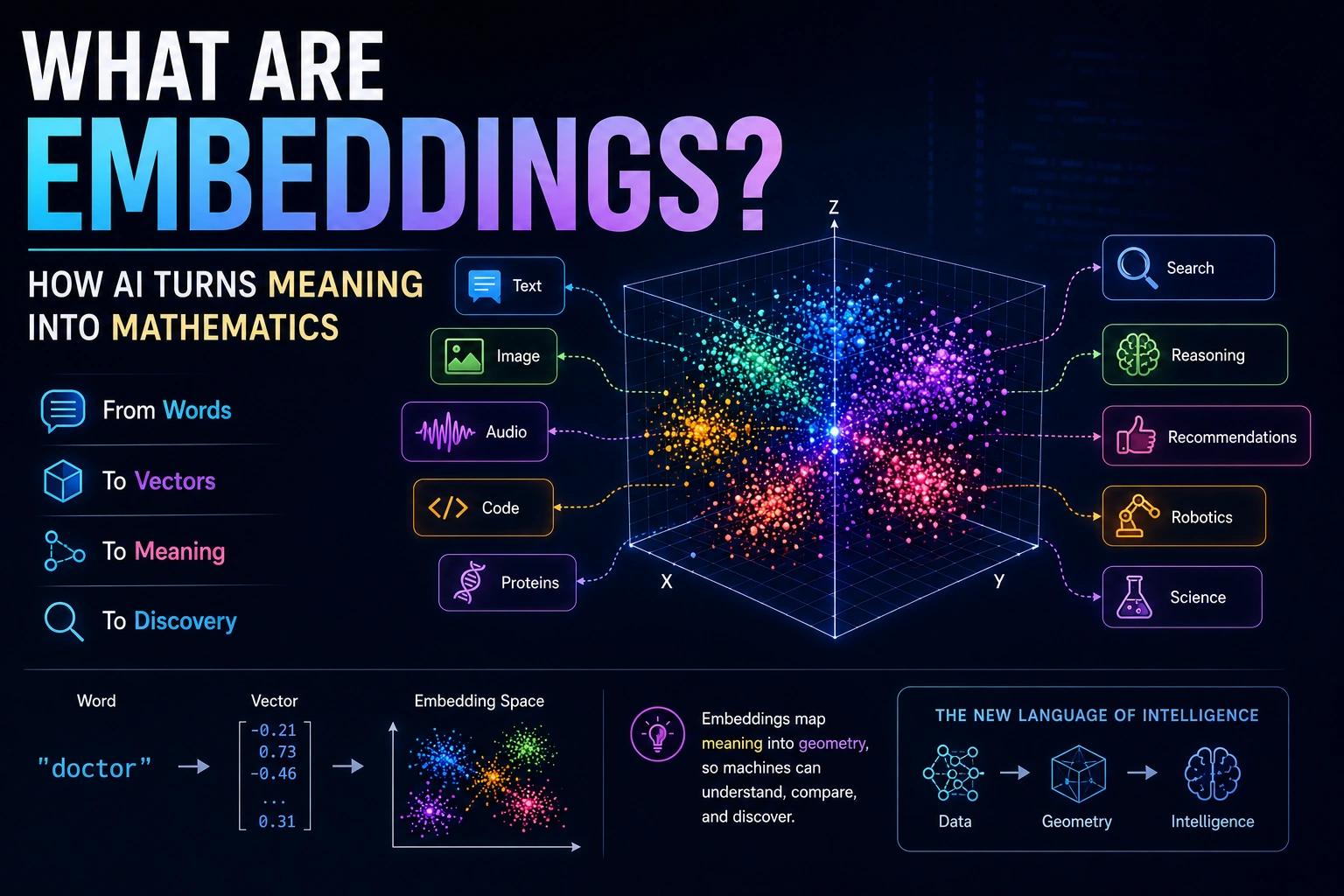
What Are Embeddings? How AI Represents Meaning as Mathematics
Almost every modern AI system can perform a strange trick.
:: Table of Contents
Search Google for "fast automobile", and it confidently returns pages that only mention "quick car." Ask ChatGPT about a physician, and it immediately understands that you're talking about a doctor. Recommendation systems know that someone interested in quantum mechanics may also enjoy linear algebra, even if those words never appear together. None of these systems rely on dictionaries or handcrafted rules for every possible synonym. Somehow, they have learned that different words, phrases, images, and even pieces of code can represent similar ideas.
Yet computers have no inherent understanding of language.
At their lowest level, computers manipulate electrical signals that become binary digits, binary digits become numbers, and numbers become instructions. Nowhere inside a processor is there a concept of a doctor, a car, or even the English language itself. If a machine only understands mathematics, then an obvious question emerges: where does meaning actually come from?
That question has quietly become one of the most important in modern artificial intelligence. Every large language model, semantic search engine, recommendation system, retrieval pipeline, and vector database depends on solving exactly this problem. Before a machine can reason about information, it must first transform meaning into something mathematics can operate on.
That transformation is made possible by embeddings.
Embeddings are far more than lists of numbers. They are one of the fundamental ideas that allow machines to organize knowledge, measure similarity, retrieve information, and build internal representations of the world. Understanding embeddings is not simply learning another AI term—it is understanding how modern intelligent systems bridge the gap between human language and mathematical computation.
By the end of this essay, you'll understand not only what embeddings are, but why they work, how they're created, where they're used, and why they have become one of the foundational building blocks of contemporary artificial intelligence.
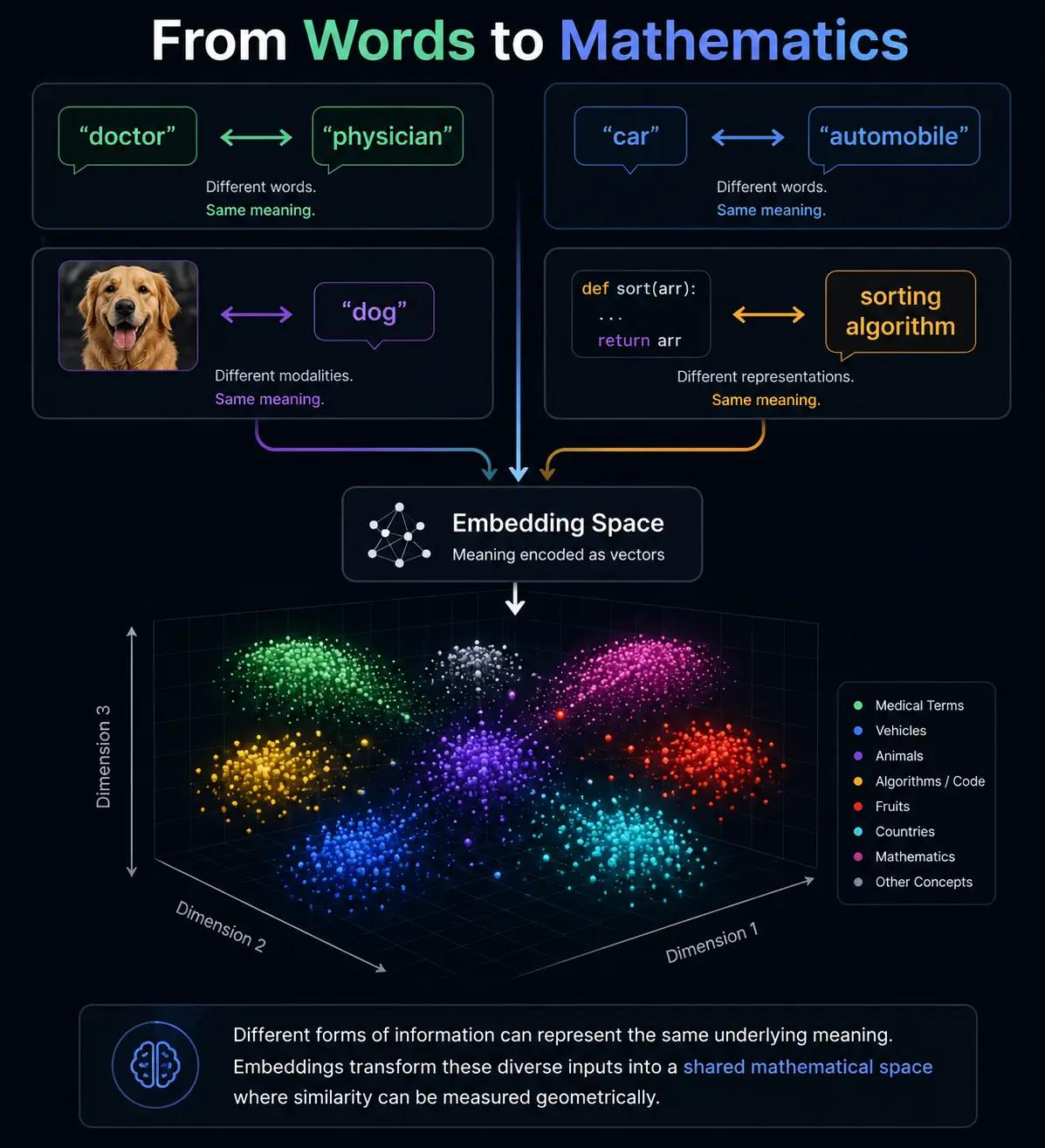
A side-by-side comparison of semantically equivalent phrases.
humans immediately recognize these pairs as expressing nearly identical ideas, even though very few words overlap.
Mental Model
"There are no words inside a computer. Only mathematics. Embeddings are the bridge between the two." Style: Large highlighted quotation.
1. The Problem Nobody Talks About3 min read
When we read a sentence, we rarely notice how much understanding happens automatically.
You can read the phrase "the cat sat on the mat" without consciously analyzing each word. You understand that cat refers to an animal, sat describes an action, and mat is an object. More importantly, you understand the relationships between them. If someone replaced cat with dog, the sentence would still make sense. If they replaced it with algorithm, something would immediately feel wrong.
Language is not just a collection of words. It is a network of meanings, relationships, context, and experience that our brains navigate almost effortlessly.
Computers, however, experience none of this.
A processor does not know what a cat is. It has never seen a dog, driven a car, visited a hospital, or read a novel. It has no intuition about language and no built-in understanding of concepts. Every piece of information that enters a computer must eventually become electrical signals, binary digits, and numerical values that the hardware can process.
From the computer's perspective, these two sentences are not obviously related:
The doctor examined the patient.
The physician treated the sick person.
A human immediately recognizes that they describe nearly the same situation. A computer does not. Unless someone explicitly teaches it that doctor and physician are connected, they are simply different sequences of characters.
The challenge becomes even clearer when we look beyond synonyms. Consider the following words:
- Cat
- Dog
- Tiger
- Lion
- Car
- Airplane
Without any prior knowledge, a computer has no reason to believe that cat should be more closely related to dog than to airplane. To us, the relationships feel obvious because they are built upon years of experience and accumulated knowledge. To a machine, every word initially arrives as an isolated symbol with no inherent meaning.
This is one of the central problems of artificial intelligence.
Before a machine can search documents by meaning, recommend similar products, answer questions, generate text, or reason about knowledge, it must first answer a surprisingly fundamental question:
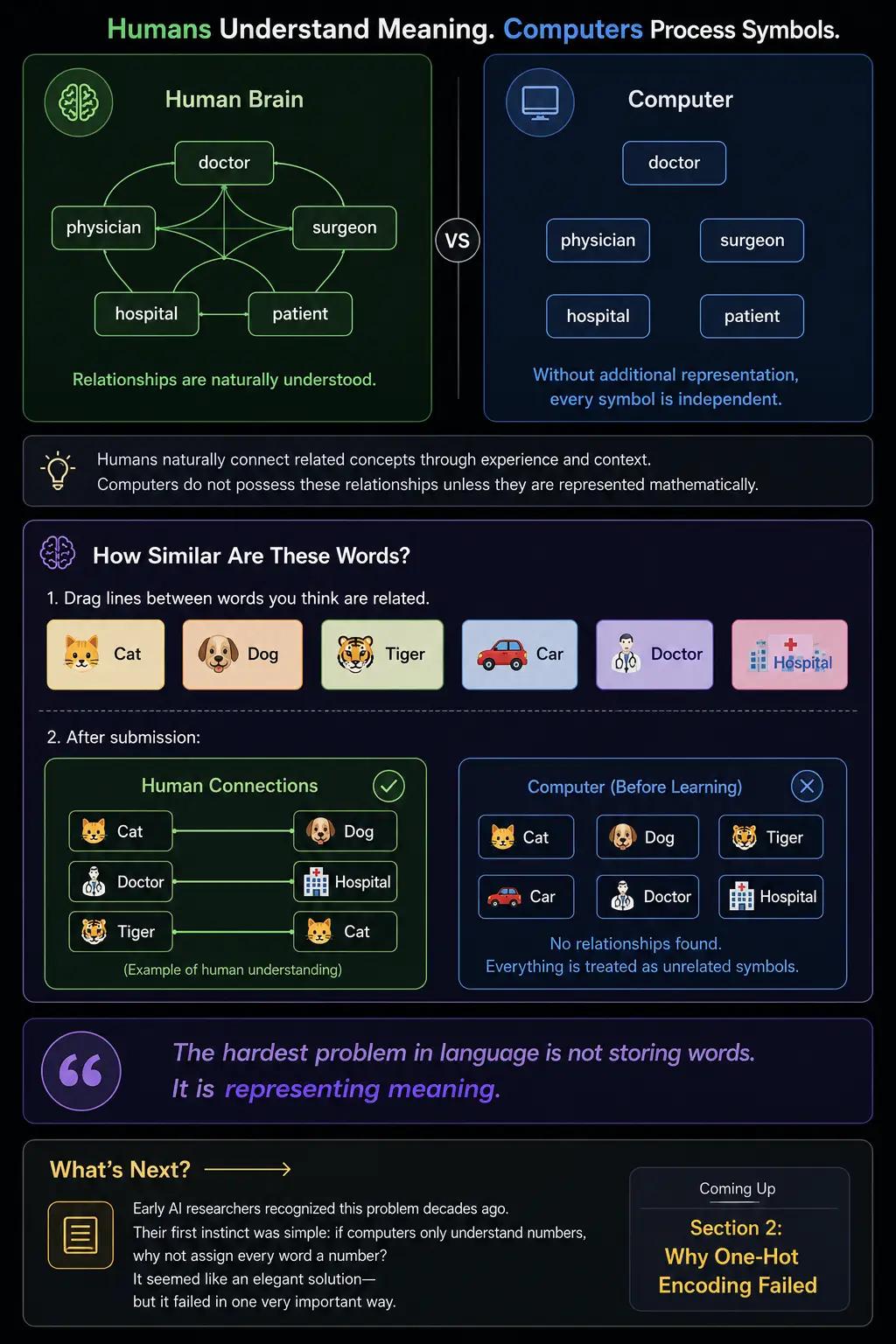
Mental Model
"The hardest problem in language is not storing words. It is representing meaning."
Early AI researchers recognized this problem decades ago. Their first instinct was simple: if computers only understand numbers, why not assign every word a number? It seemed like an elegant solution—but it failed in one very important way.
📚 WANT TO DIVE DEEPER?
Vector Databases Explained: How Embeddings, Similarity Search, and AI Retrieval Really Work
2. Why One-Hot Encoding Failed5 min read
If computers only understand numbers, then the most obvious solution seems almost embarrassingly simple.
Assign every word a unique number.
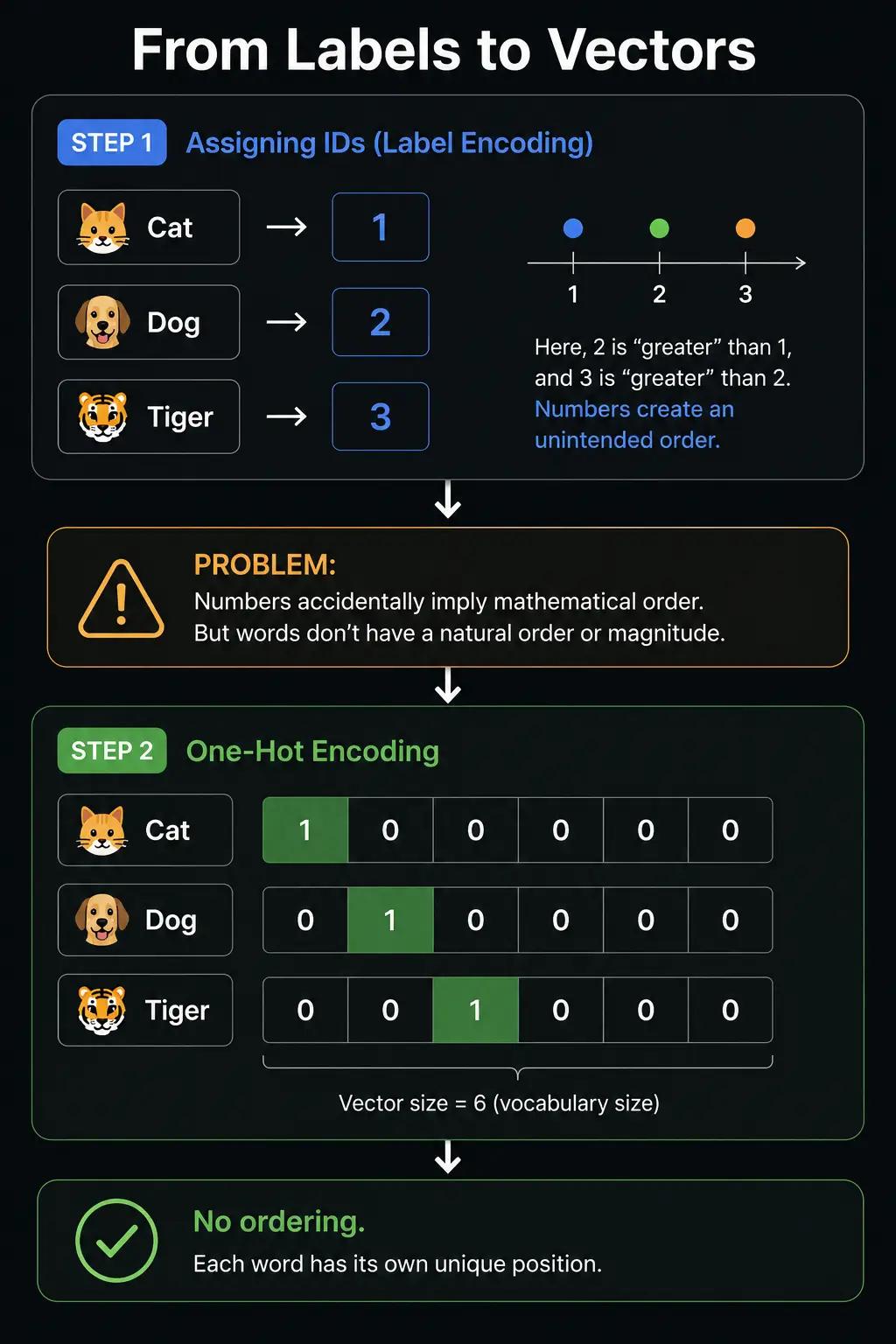
For example, imagine we are building a tiny vocabulary containing just six words:
Now every word has a numerical identity. The computer no longer sees the string "doctor"—it simply sees the number 5.
At first glance, this appears to solve the problem. Human language has been converted into numbers, exactly what computers need.
Unfortunately, this representation introduces a new and even bigger problem.
Suppose the computer receives the words Cat and Dog.
To us, these concepts are obviously related. Both are animals, both are common household pets, and they share many biological characteristics. If someone asked whether Cat is more similar to Dog or Hospital, the answer would be immediate.
The computer, however, has no way to reach that conclusion.
From its perspective:
- Cat = 1
- Dog = 2
- Hospital = 6
Does that mean Dog is "twice as much" as Cat?
Is Hospital six times larger than Cat?
Does the difference between 1 and 2 imply similarity?
Of course not.
The assigned numbers carry identity, but they carry no meaning. They are simply labels chosen by us. If tomorrow we renamed Cat as 87 and Dog as 13, nothing about their meaning would change. The numbers themselves contain no information about the relationships between concepts.
Researchers quickly realized that ordinary integer IDs were unsuitable for machine learning models. Neural networks interpret numbers mathematically, so assigning arbitrary values accidentally suggests relationships that do not exist.
To avoid this, researchers developed a representation known as one-hot encoding.
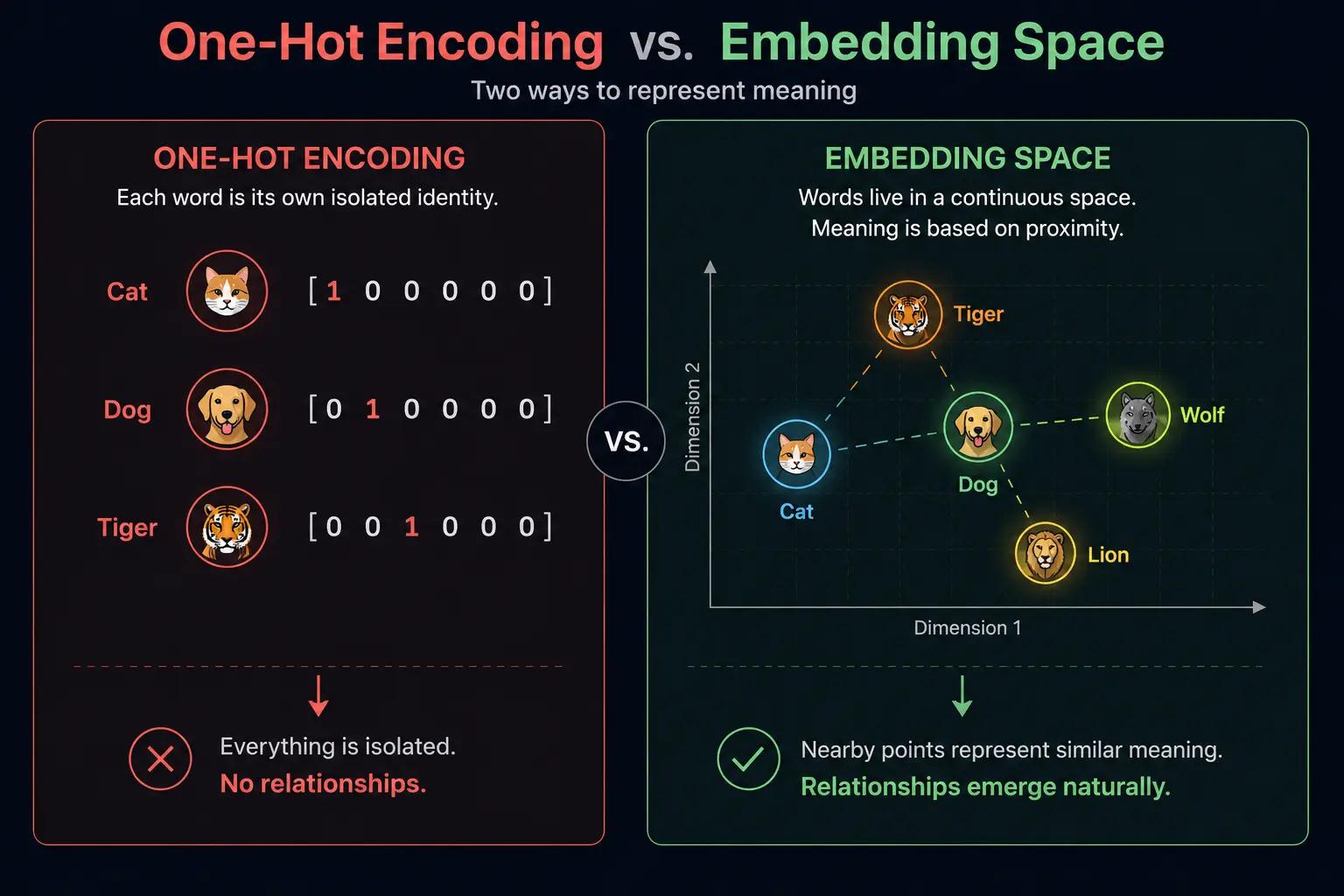
Instead of assigning each word a single integer, every word receives its own position inside a vector. Only one position is active (represented by 1), while every other position remains 0.
For our small vocabulary, the representation looks like this:
This was an important improvement.
Unlike simple integer IDs, one-hot vectors no longer imply that one concept is "larger" than another. Every word is represented independently, avoiding misleading numerical relationships.
However, they introduced a different limitation.
Now let's compare two vectors.
Cat
[1 0 0 0 0 0]
Dog
[0 1 0 0 0 0]
Intuitively, we know these concepts are closely related.
Yet mathematically, something surprising happens.
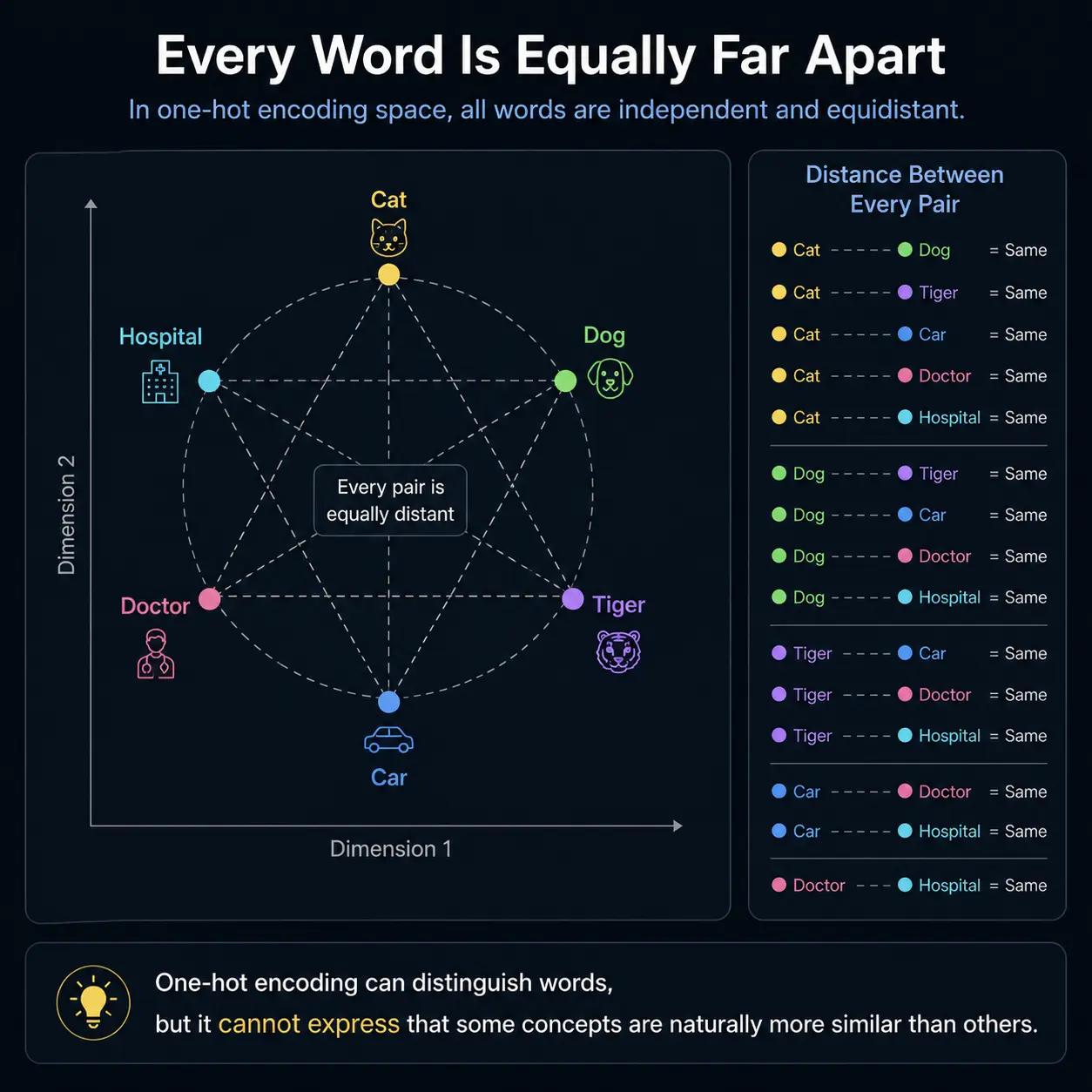
They share no common dimensions.
Their dot product is 0.
Their cosine similarity is 0.
Their Euclidean distance is exactly the same as the distance between Cat and Hospital.
To the computer, every pair of different words is equally unrelated.
Whether we compare:
- Cat ↔ Dog
- Cat ↔ Tiger
- Cat ↔ Car
- Cat ↔ Hospital
- Doctor ↔ Airplane
the answer is always the same.
There is no notion of semantic closeness.
Every concept occupies its own isolated corner of the mathematical space.
One-hot encoding solved the problem of arbitrary numerical IDs, but it failed to solve the much harder problem we actually cared about:
How do we represent meaning?
That realization changed the direction of artificial intelligence research.
Instead of asking,
"How can we assign every word a unique identifier?"
researchers began asking a far more ambitious question:
"Can a machine learn where words should live relative to one another?"
That single shift—from assigning identities to learning relationships—gave birth to one of the most influential ideas in modern AI:
Embeddings.
Key Insight
One-hot encoding gave every word an identity. It never gave them a meaning.
Researchers realized that the missing ingredient wasn't another encoding scheme—it was geometry. If related concepts could be placed close together and unrelated concepts farther apart, meaning itself could become something we measure. The challenge was no longer assigning coordinates by hand, but teaching machines to discover them automatically.
Join the frequency
Subscribe to our newsletter for the latest updates.
3. The Birth of Embeddings6 min read
One-hot encoding taught computers how to distinguish words.
It never taught them how words relate to one another.
Researchers eventually realized they had been asking the wrong question.
Instead of asking,
"How can every word have its own identity?"
they began asking,
"What if every word had its own location?"
That small change transformed the field of artificial intelligence.
Imagine opening Google Maps.
A city is not identified by a single number. Instead, it is described by coordinates. Two nearby cities have similar coordinates because they occupy nearby locations. Cities on opposite sides of the world have very different coordinates because they are far apart.
The coordinates themselves are not the city.
They simply describe where the city exists relative to every other city.
Researchers realized that language might work the same way.
What if words could live inside a mathematical space, where similar ideas naturally appeared close together and unrelated ideas drifted farther apart?
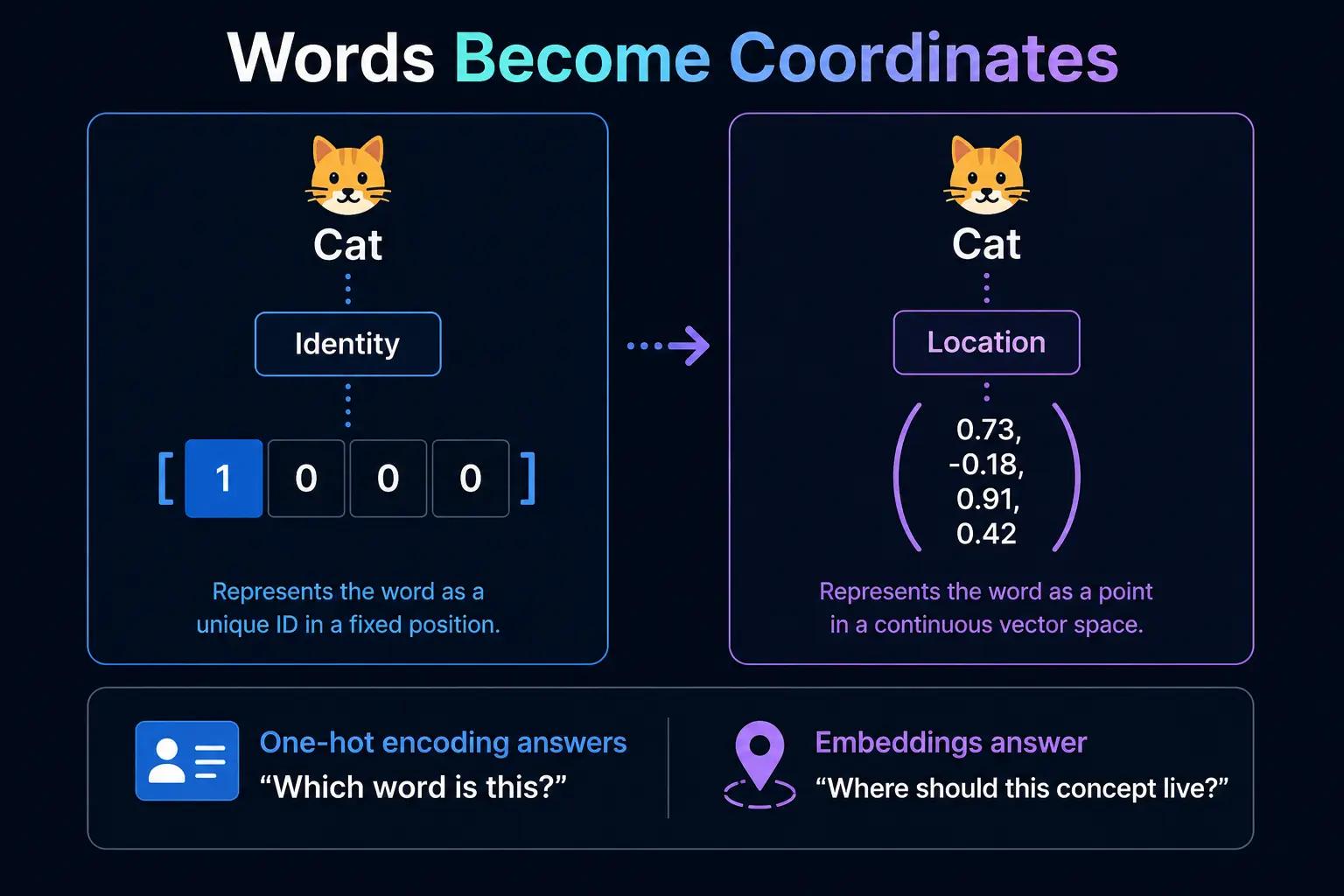
Instead of representing Cat as
[1 0 0 0 0 0]
the model could learn something like
[0.73, -0.18, 0.91, 0.42, ...]
Likewise,
[0.71, -0.21, 0.88, 0.45, ...]
Notice something interesting.
The numbers themselves are completely meaningless to us.
Looking at either vector tells us nothing about cats or dogs.
The magic lies somewhere else.
Because the two vectors are very similar, the computer can immediately recognize that the concepts themselves are related.
The numbers are not intended for humans to interpret individually.
Their purpose is to preserve relationships.
Meaning has quietly transformed into geometry.
A New Way to Think About Meaning
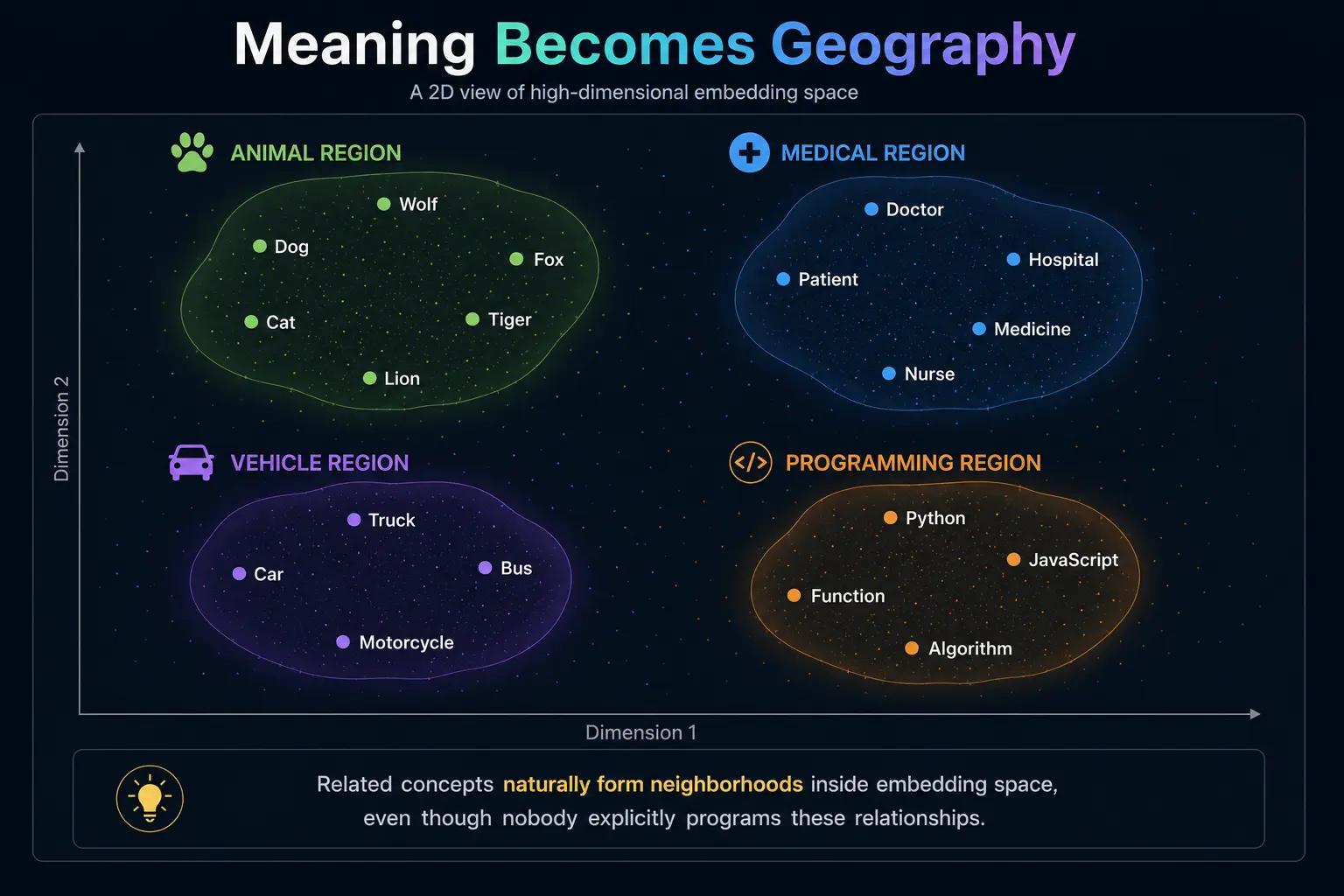
Suppose we could somehow shrink this enormous mathematical space into two dimensions.
It might look something like this.
Dogs appear close to wolves.
Cats appear close to tigers.
Hospitals appear near doctors.
Cars appear near trucks.
Meanwhile, hospitals and tigers end up on opposite sides of the map.
No one manually places these concepts there.
The model gradually discovers these relationships by observing millions—or even billions—of examples during training.
Instead of memorizing definitions, it learns structure.
Instead of learning words, it learns relationships.
This idea is remarkably powerful.
If two concepts frequently appear in similar contexts, they begin moving closer together inside the embedding space.
If they rarely appear together, they drift apart.
Without anyone explicitly defining what a doctor is, the model slowly discovers that doctor, nurse, hospital, patient, and medicine belong to the same semantic neighborhood.
The geometry itself becomes the knowledge.
But Who Chooses These Coordinates?
This raises an obvious question.
If embeddings are simply coordinates, who decides where every word should be placed?
Surely someone isn't manually assigning billions of vectors.
They aren't.
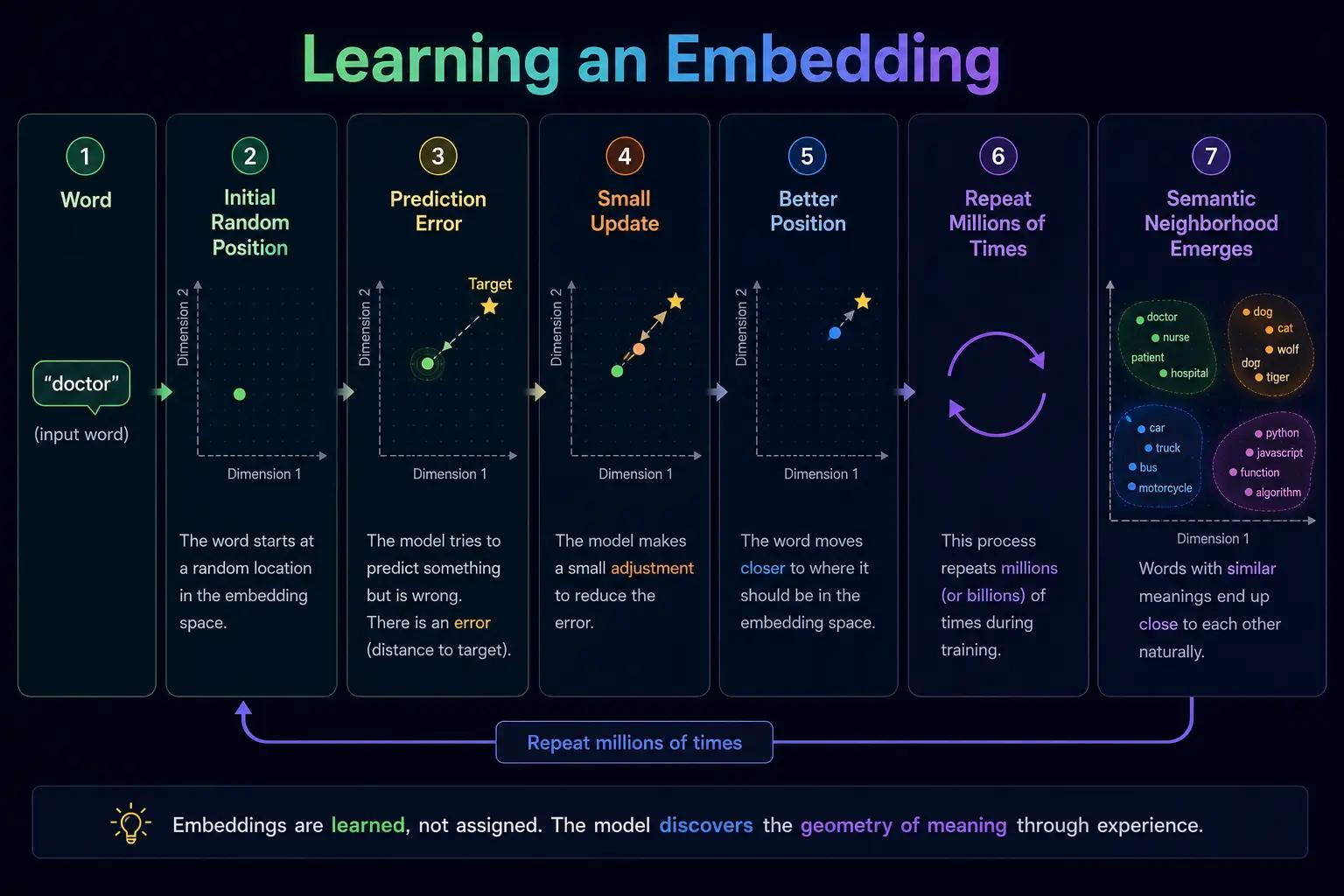
The coordinates are learned automatically.
Every time a model predicts the next word, answers a question, classifies an image, or retrieves a document, it receives feedback about whether its prediction was correct.
Tiny adjustments are then made to millions—or even billions—of parameters.
Among those adjustments are the embedding vectors themselves.
Words that frequently appear in similar contexts gradually move closer together.
Words used in completely different situations slowly drift apart.
This process happens millions of times during training.
Over time, the embedding space organizes itself.
Not because someone designed it by hand.
But because the model continuously discovers a geometry that makes prediction easier.
This idea became one of the biggest breakthroughs in machine learning.
Instead of programmers writing relationships explicitly,
machines began learning meaning from data.
This Changed Everything
Once researchers realized that meaning could be represented as learned coordinates, an entirely new generation of AI became possible.
Search engines no longer had to rely solely on matching keywords.
Recommendation systems could discover hidden similarities.
Language models could reason about concepts instead of isolated words.
Vector databases could retrieve documents by meaning rather than exact phrasing.
Even images, audio, proteins, source code, and molecules could be represented inside similar mathematical spaces.
Embeddings did not merely improve artificial intelligence.
They fundamentally changed what machines could represent.
Mental Model
Embeddings don't store definitions. They preserve relationships.
If embeddings are locations inside a mathematical space, another question naturally follows.
Why does simply placing related concepts near one another make intelligent behavior possible?
The answer lies in one of the most beautiful ideas in machine learning:
Meaning lives in geometry.
That is exactly what we'll explore next.
4. Meaning Lives in Geometry6 min read
At this point, we've arrived at a remarkable idea. Words are no longer represented as isolated identities. Instead, they become locations inside a mathematical space. But that immediately raises another question.
Why should simply placing similar concepts near one another allow a machine to understand language?
The answer lies in one of the oldest ideas in mathematics:
Geometry is a language of relationships.
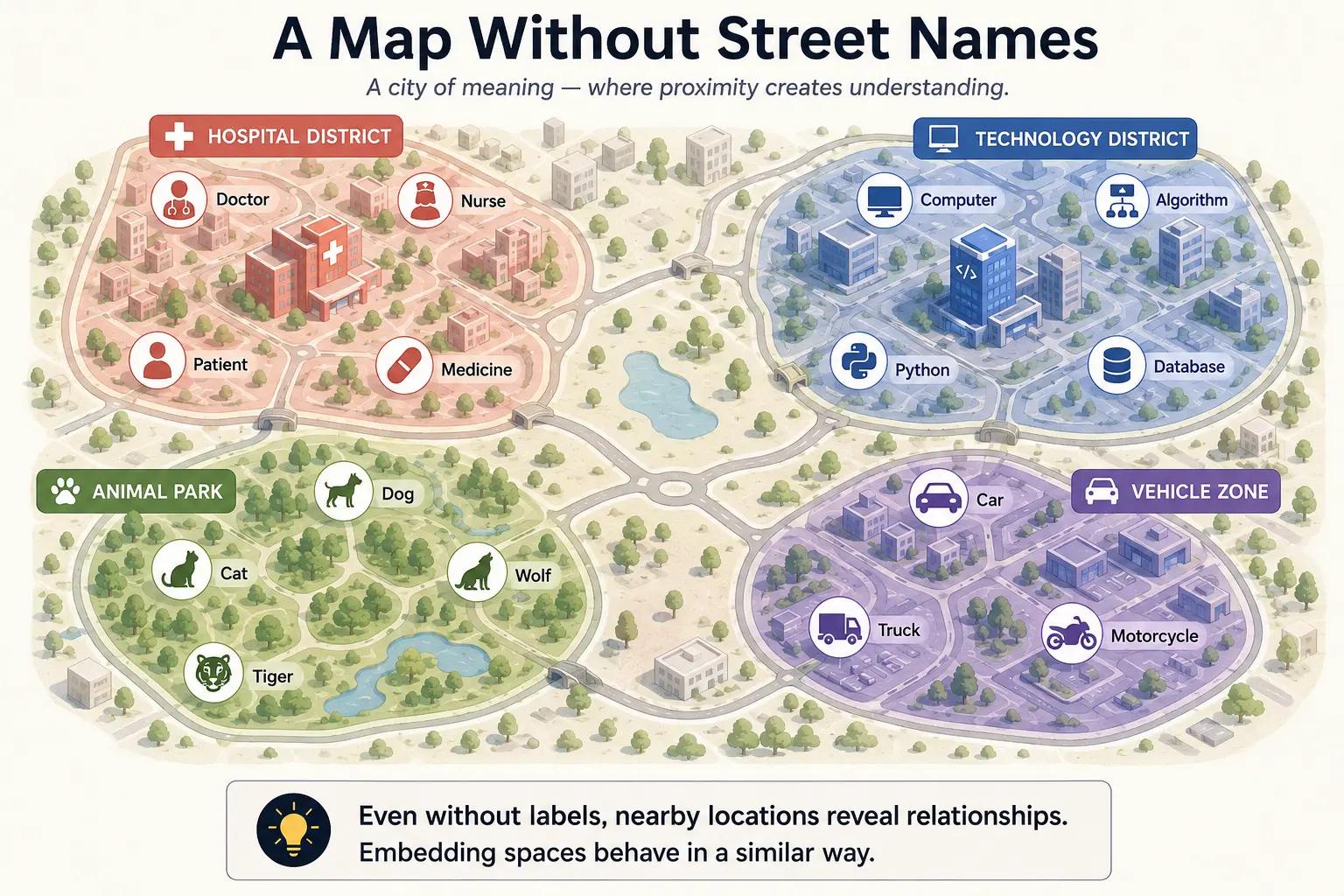
Imagine unfolding a paper map of a city.
Without reading a single street name, you can already infer a surprising amount of information. Restaurants tend to be surrounded by other restaurants. Residential neighborhoods look different from industrial districts. Airports usually sit far from city centers. Hospitals are often close to pharmacies.
The map does not explicitly explain any of these relationships. They emerge naturally from where things are located.
Embedding spaces work in much the same way.
A machine does not memorize a dictionary that says doctor is related to hospital.
Instead, it discovers that these concepts consistently appear near one another inside a geometric space.
The relationship is not stored as a rule. It is stored as distance.
Distance Becomes Meaning
This idea changes everything.
Instead of asking,
"Are these two words identical?"
we can ask,
"How far apart are they?"
That single shift transforms language into a measurable problem.
Suppose we compare these pairs of concepts.
Notice what has happened.
We are no longer comparing characters. We are comparing positions. Meaning has become geometry.
Geometry Preserves More Than Similarity
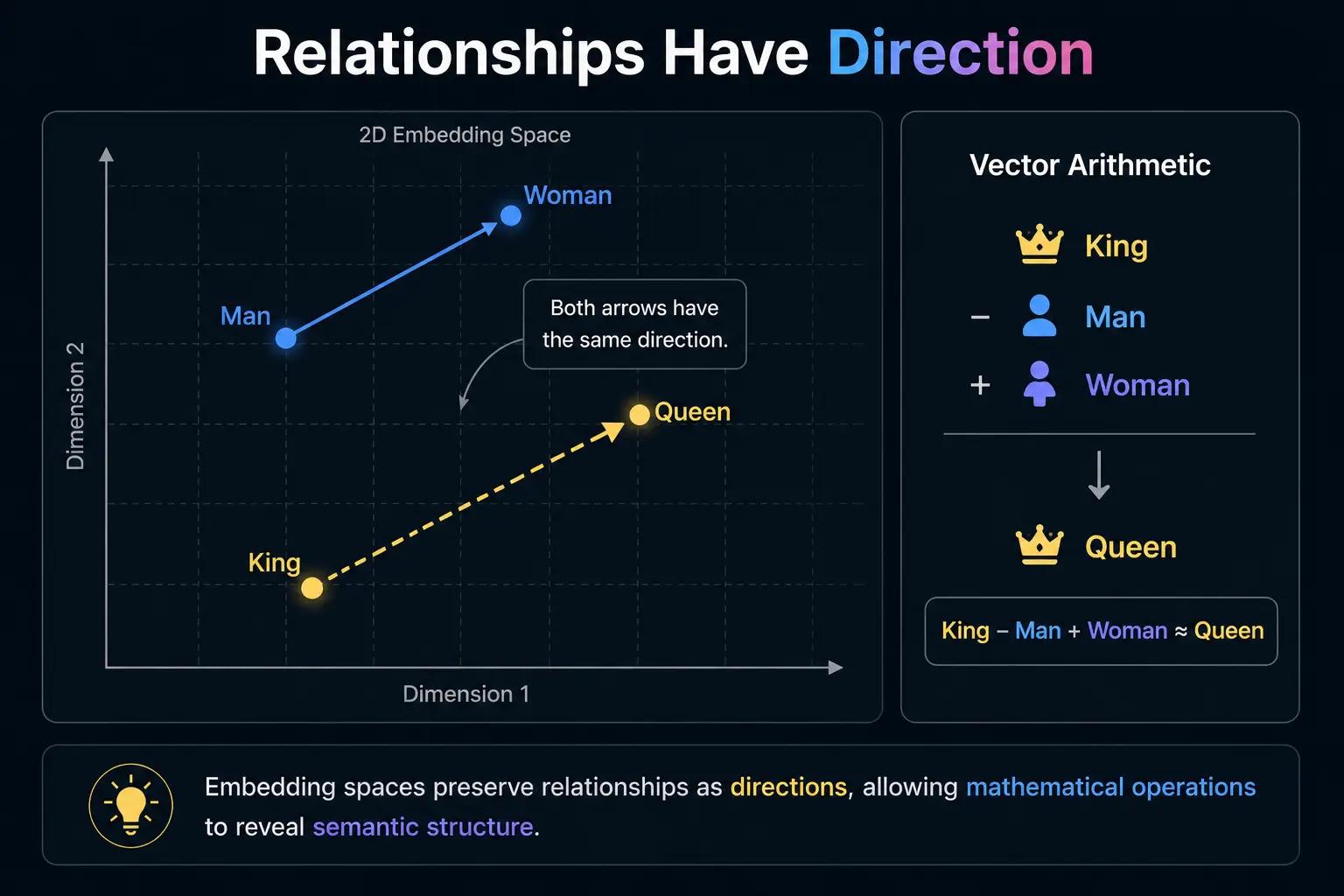
One of the most beautiful discoveries in machine learning is that embedding spaces preserve not only similarity, but also relationships.
Consider these words.
King
Queen
Man
Woman
If we plot them inside an embedding space, something extraordinary appears.
The direction from Man to Woman is almost identical to the direction from King to Queen.
Mathematically, this means we can perform operations like
King− Man+ Woman≈ Queen
This equation became famous because it demonstrated that embedding spaces learn patterns far richer than simple synonym matching.
They capture structure.
The vectors are not memorizing facts.
They are organizing concepts according to consistent geometric relationships.
Neighborhoods Create Intelligence
Think about how people navigate unfamiliar cities.
If someone tells you that a restaurant is near the train station, you immediately know approximately where to search.
You don't need exact coordinates. The neighborhood itself provides useful information. Embedding spaces work the same way.
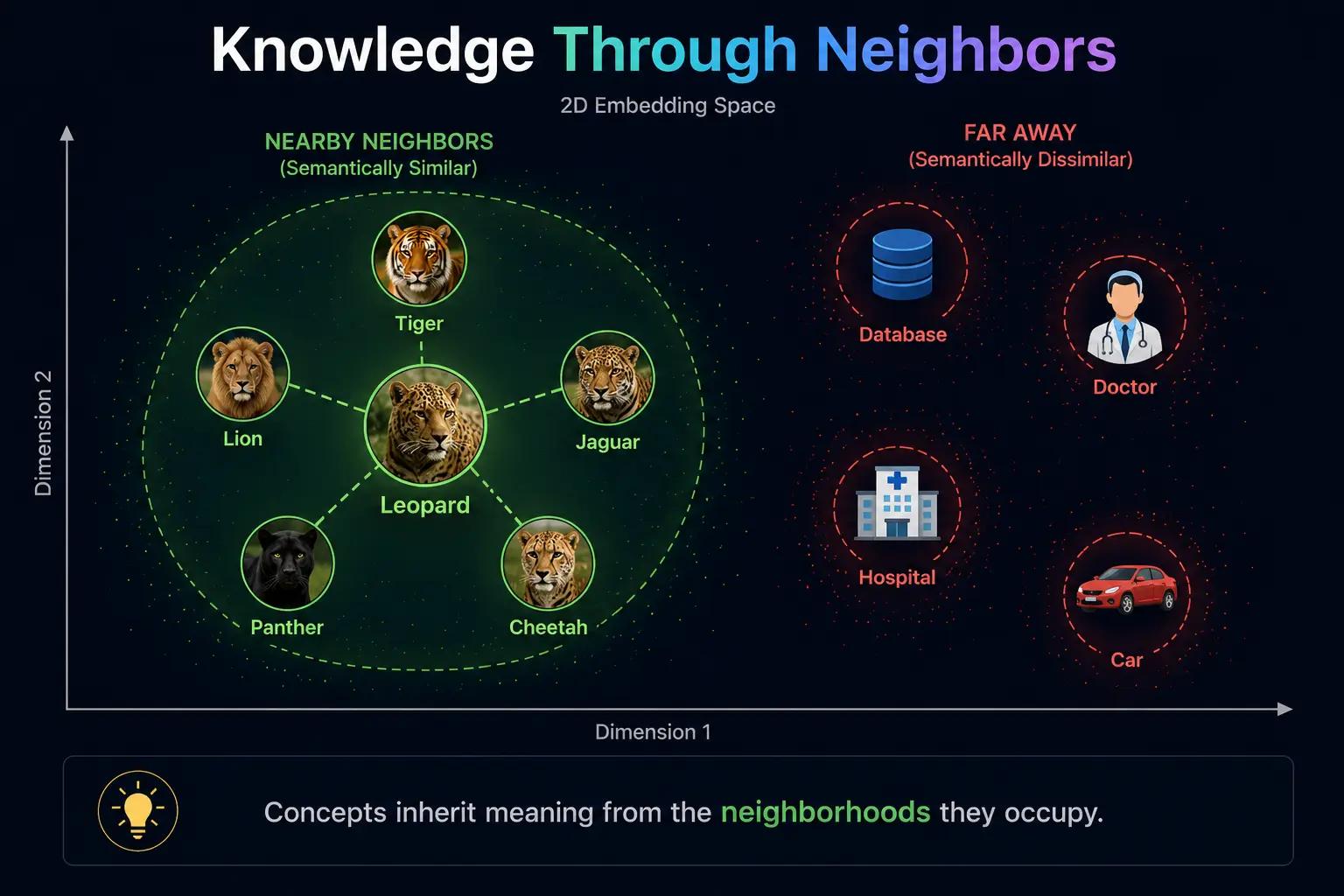
Suppose an AI encounters the word
Leopard
for the first time. It has never memorized a dictionary definition. Yet the embedding places Leopard close to
Tiger
Lion
Jaguar
Cheetah
Panther
From geometry alone, the model can infer that Leopard is probably another large feline.
It doesn't reason from definitions. It reasons from neighbors. Local structure becomes knowledge.
Geometry Enables Generalization
This is one of the reasons modern AI systems can respond sensibly to situations they have never encountered before.
Instead of memorizing every possible sentence, they learn a landscape.
When a completely new concept appears, it simply finds its place within that landscape. Nearby regions already contain useful information. Knowledge becomes continuous rather than discrete.
That is why embeddings are so much more powerful than one-hot encoding.
One-hot encoding creates isolated islands. Embeddings create connected worlds
Key Insight
Embeddings don't teach machines facts. They teach machines where facts belong.
By now, one mystery remains.
We've seen that embeddings become meaningful because similar concepts gradually organize themselves into geometric neighborhoods.
But those neighborhoods were not drawn by hand.
No engineer manually decided where doctor, hospital, or patient should live.
So who creates this map?
The answer takes us inside the training process of modern neural networks, where millions of tiny adjustments slowly reshape the embedding space until meaningful structure emerges.
That's exactly what we'll explore next:
How Models Learn Embeddings.
5. How Models Learn Embeddings6 min read
By now, we understand that embeddings are not assigned by humans.
No engineer sits in front of a giant map deciding that doctor should be placed next to hospital, or that cat belongs near tiger. If that were possible, every new language, every scientific discipline, and every emerging concept would require someone to redraw the entire map by hand.
Instead, the map is discovered automatically.
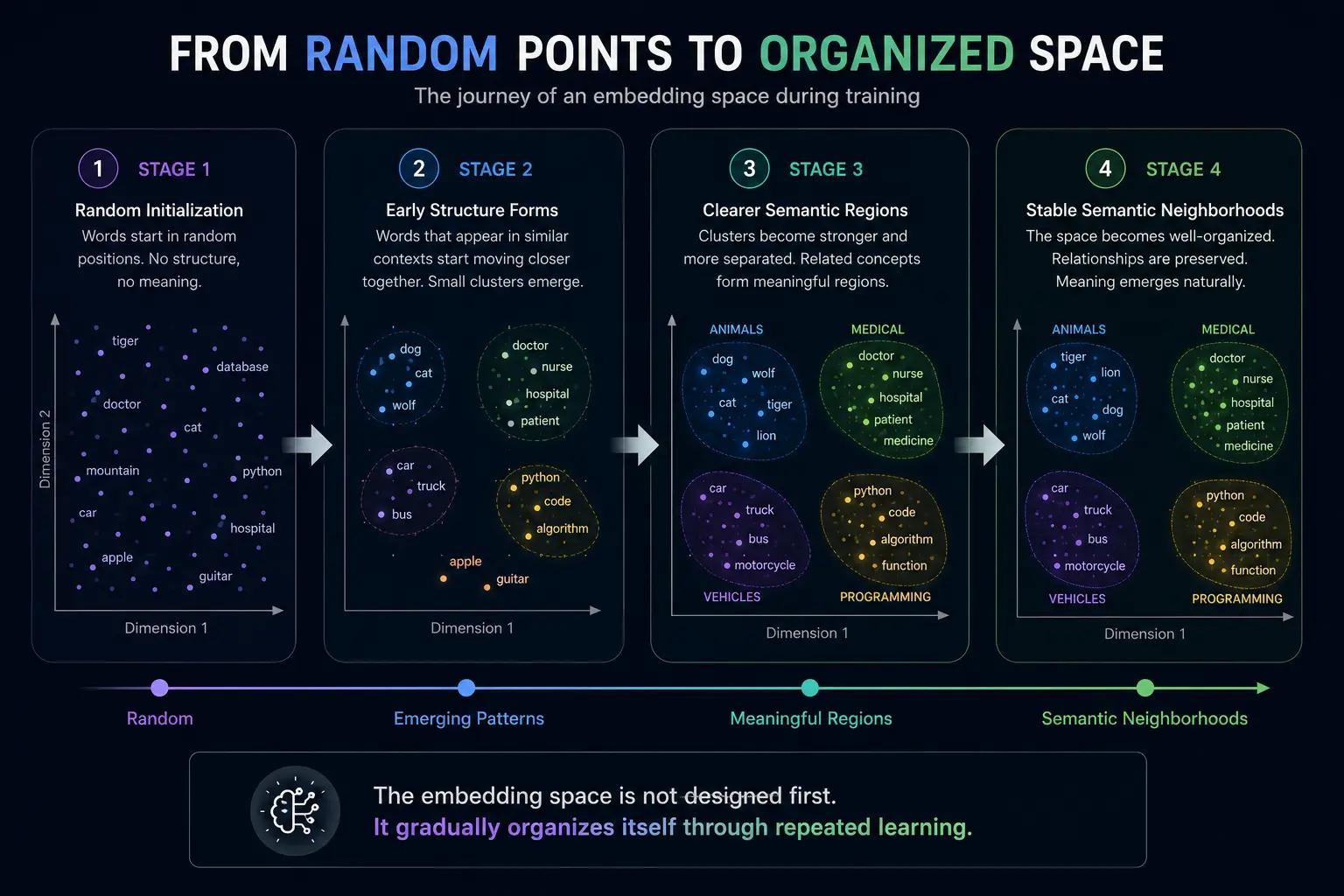
The remarkable idea behind modern machine learning is that the embedding space begins with no structure at all. At the start of training, every word occupies an essentially random position. The model has no concept of animals, medicine, programming, or geography. As far as it is concerned, cat, database, doctor, and mountain are simply unrelated points floating inside an empty mathematical space.
The organization that eventually emerges is a consequence of learning—not design.
Learning Through Prediction
Imagine teaching a child a language by repeatedly asking them to finish sentences.
You begin with a simple phrase:
The cat drank the...
A young child might guess incorrectly at first. After enough exposure, however, they begin predicting milk far more often than engine or keyboard. They improve because every mistake teaches them something about the structure of language.
Modern language models learn in a surprisingly similar way.
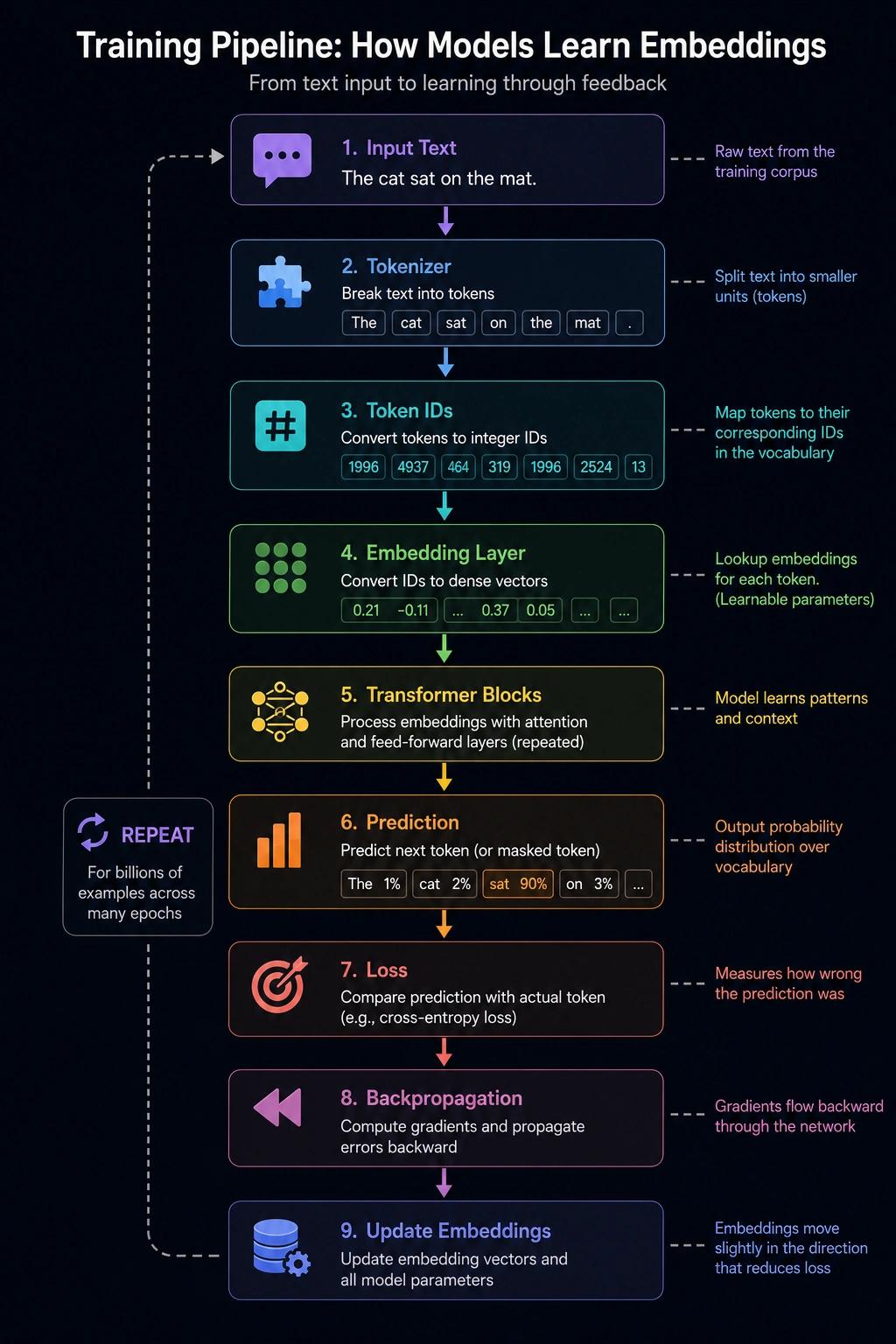
During training, the model is shown enormous amounts of text and asked to predict missing or upcoming words. Each prediction is compared with the correct answer. Whenever the prediction is wrong—and it usually is during the early stages—the model measures how wrong it was.
That difference is called the prediction error or loss.
Rather than rewriting everything it has learned, the model makes tiny adjustments to its internal parameters. Among the parameters being adjusted are the embedding vectors themselves.
Each update is almost imperceptible. A word might move only a microscopic distance inside the embedding space. Yet these adjustments happen billions of times across billions of training examples.
Eventually, meaningful structure begins to emerge.
Why Similar Words Move Together
The movement of words is not random.
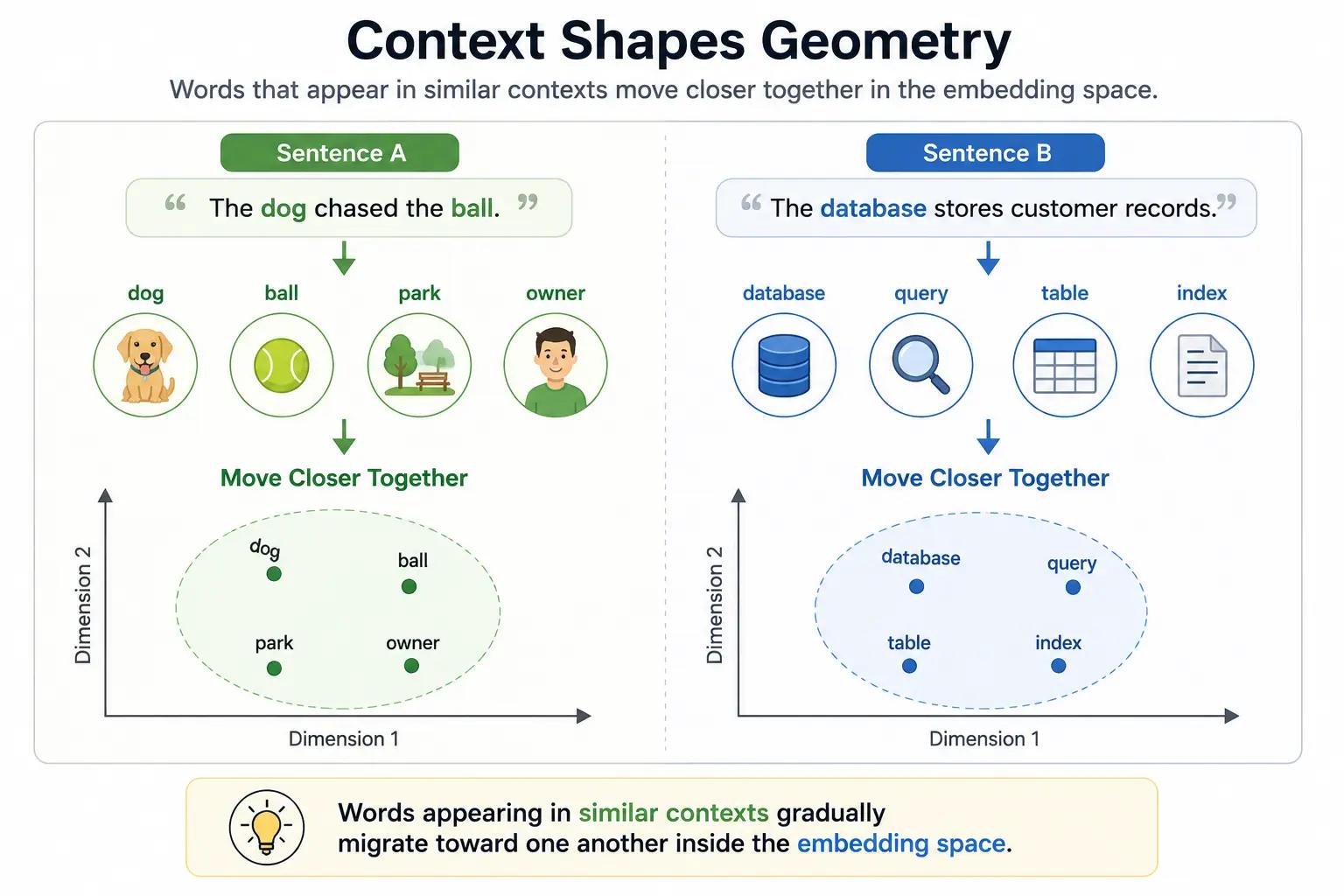
Suppose the model repeatedly encounters sentences like these:
The dog chased the ball.
The puppy ran across the yard.
The wolf hunted in the forest.
Although these sentences describe different situations, the surrounding context overlaps. Words such as dog, puppy, and wolf frequently appear near concepts involving animals, movement, and behavior.
Because the model repeatedly observes these shared contexts, it gradually adjusts their embeddings so that they occupy nearby regions.
Now consider a completely different sentence:
The database stores customer records.
The surrounding context is entirely different. Words such as database, table, query, and index consistently appear together instead.
Over millions of examples, the model begins separating these concepts into distinct neighborhoods.
Nobody tells the model that dogs are animals or that databases are software systems.
It discovers these relationships because similar concepts consistently appear in similar contexts.
This principle is so fundamental to natural language processing that it is often summarized by a famous idea known as the distributional hypothesis:
You shall know a word by the company it keeps.
That single observation underpins decades of research, from Word2Vec to today's largest language models.
Embeddings Are Learned Together With Everything Else
One common misconception is that embeddings are trained separately from the language model.
In most modern transformer models, that isn't the case.
The embedding layer is simply the first stage of the network. During training, every prediction generates feedback that flows backward through the model. That feedback updates attention weights, feed-forward layers, normalization parameters, and the embeddings themselves.
In other words, the model learns its vocabulary and its reasoning process simultaneously.
As the transformer becomes better at predicting language, the embedding space also becomes more organized.
The two improve together.
From Random Numbers to Knowledge
If you were to inspect an embedding vector before training, it would appear indistinguishable from random noise.
After training on trillions of words, however, those same numbers encode an astonishing amount of structure.
Nearby concepts become neighbors.
Analogies emerge naturally.
Relationships become measurable.
Entire scientific disciplines occupy coherent regions of the space.
Nothing about the individual numbers is meaningful in isolation.
Their significance comes entirely from how they relate to every other vector.
Knowledge is not stored inside one coordinate.
It emerges from the geometry of the entire space.
Mental Model
Embeddings are not programmed. They are discovered through prediction, correction, and repetition.
By this point, we understand how embeddings are created. But not every embedding space is equally useful. Some models produce neighborhoods that are remarkably accurate, while others fail to capture important relationships.
That leads to the next question:
What makes an embedding "good"?
In the next section, we'll explore the characteristics of high-quality embeddings, including semantic similarity, contextual awareness, dimensionality, normalization, and why different embedding models behave differently.
6. What Makes a Good Embedding?7 min read
By now, we understand that embeddings transform meaning into geometry.
We also know that they are learned automatically from data rather than being manually designed.
But this raises another important question.
If two different models both produce embedding vectors, how do we decide which one is better?
The answer is not the vectors themselves.
A good embedding is not defined by its individual numbers. It is defined by the structure those numbers create.
Imagine drawing a map of the world.
The exact coordinates assigned to London, Tokyo, or New York are not important by themselves. What matters is that the distances and relationships between cities remain accurate. If Paris suddenly appeared closer to Sydney than to Berlin, the map would become useless, even if every city still had valid coordinates.
Embedding spaces work in exactly the same way.
Their purpose is not to assign numbers.
Their purpose is to preserve relationships.
Semantic Similarity
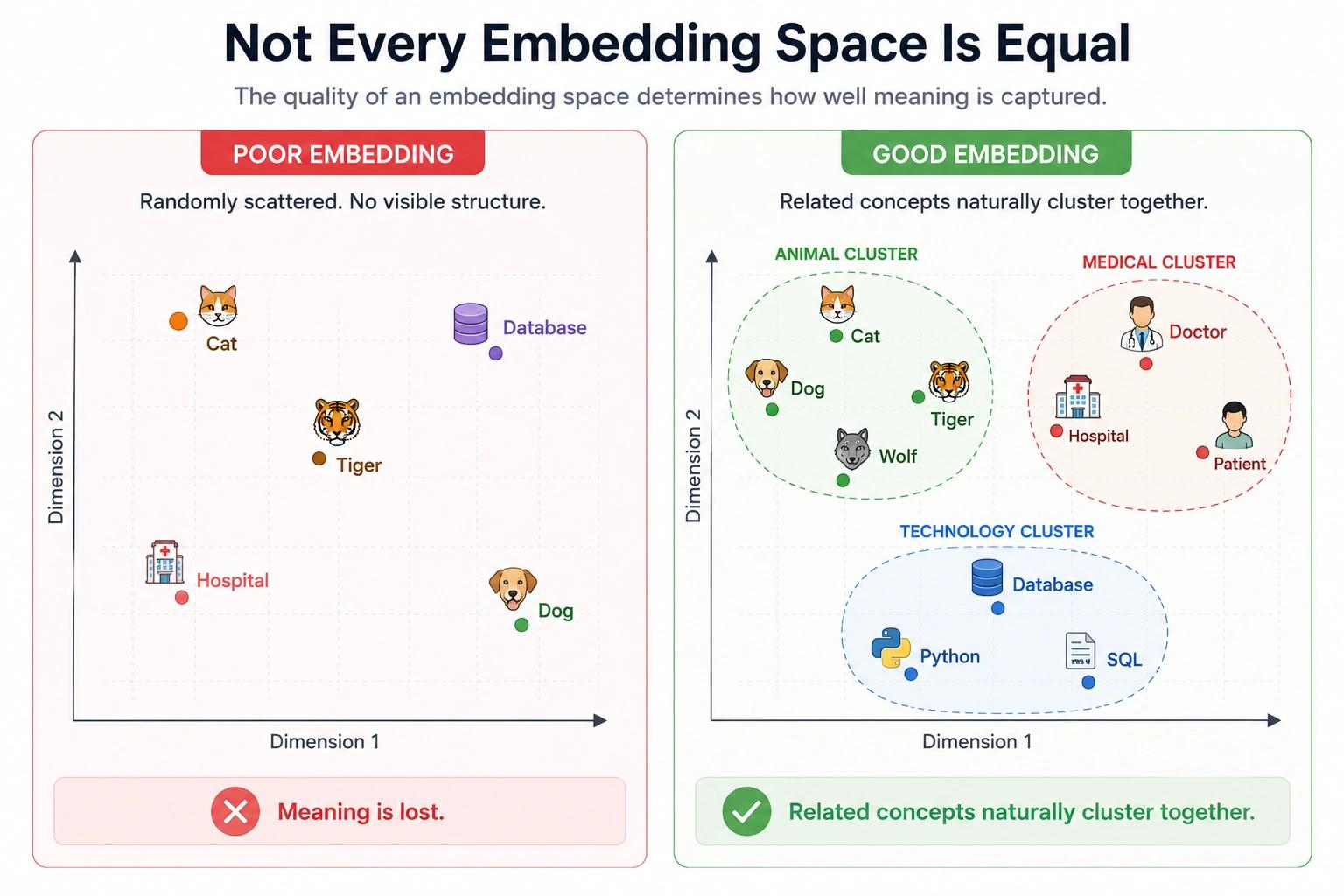
The first property of a good embedding is that similar concepts naturally appear close together.
If we embed the following words,
CatDogWolfTigerLion
they should occupy the same general region of the space.
Likewise,
DatabaseSQLTableQueryIndex
should form an entirely different neighborhood.
The exact coordinates are irrelevant.
Only the relative positions matter.
When this happens consistently, the embedding captures semantic similarity rather than merely matching identical words.
Context Matters
Meaning is rarely fixed.
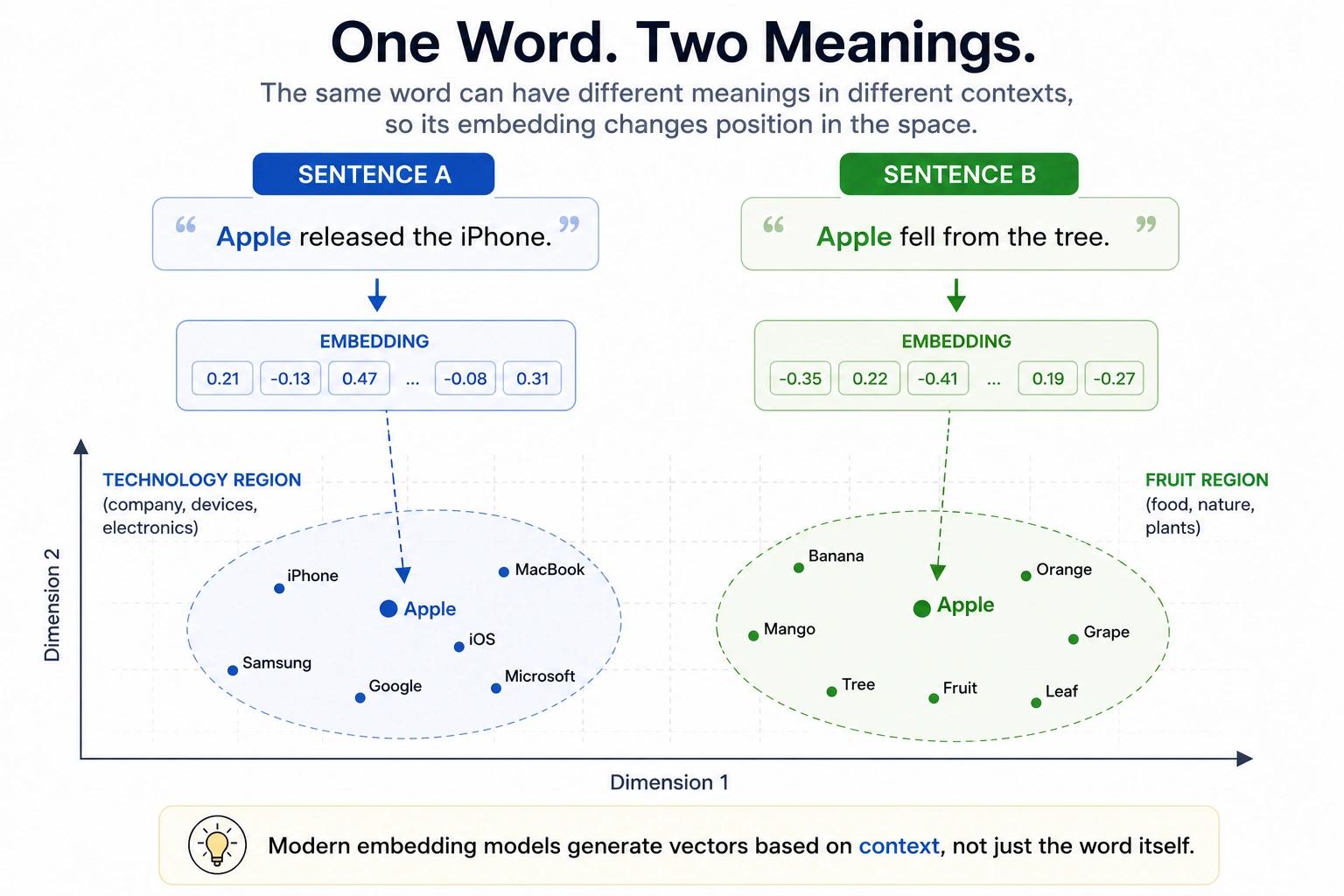
Consider the word Apple.
In one sentence,
Apple released a new MacBook.
the word refers to a technology company.
In another,
I ate an apple after lunch.
it refers to a fruit.
Humans effortlessly distinguish these meanings because we understand context.
Modern embedding models attempt to do the same.
Early systems such as Word2Vec generated a single embedding for every word, regardless of how it was used. As a result, every occurrence of Apple shared the same position in the embedding space.
Today's transformer-based models generate contextual embeddings, meaning the representation changes depending on the surrounding words.
The same word can therefore occupy slightly different regions of the space depending on what it means in that particular sentence.
This ability dramatically improves search, translation, summarization, and question answering because the model no longer assumes that every word has only one meaning.
Dimensionality
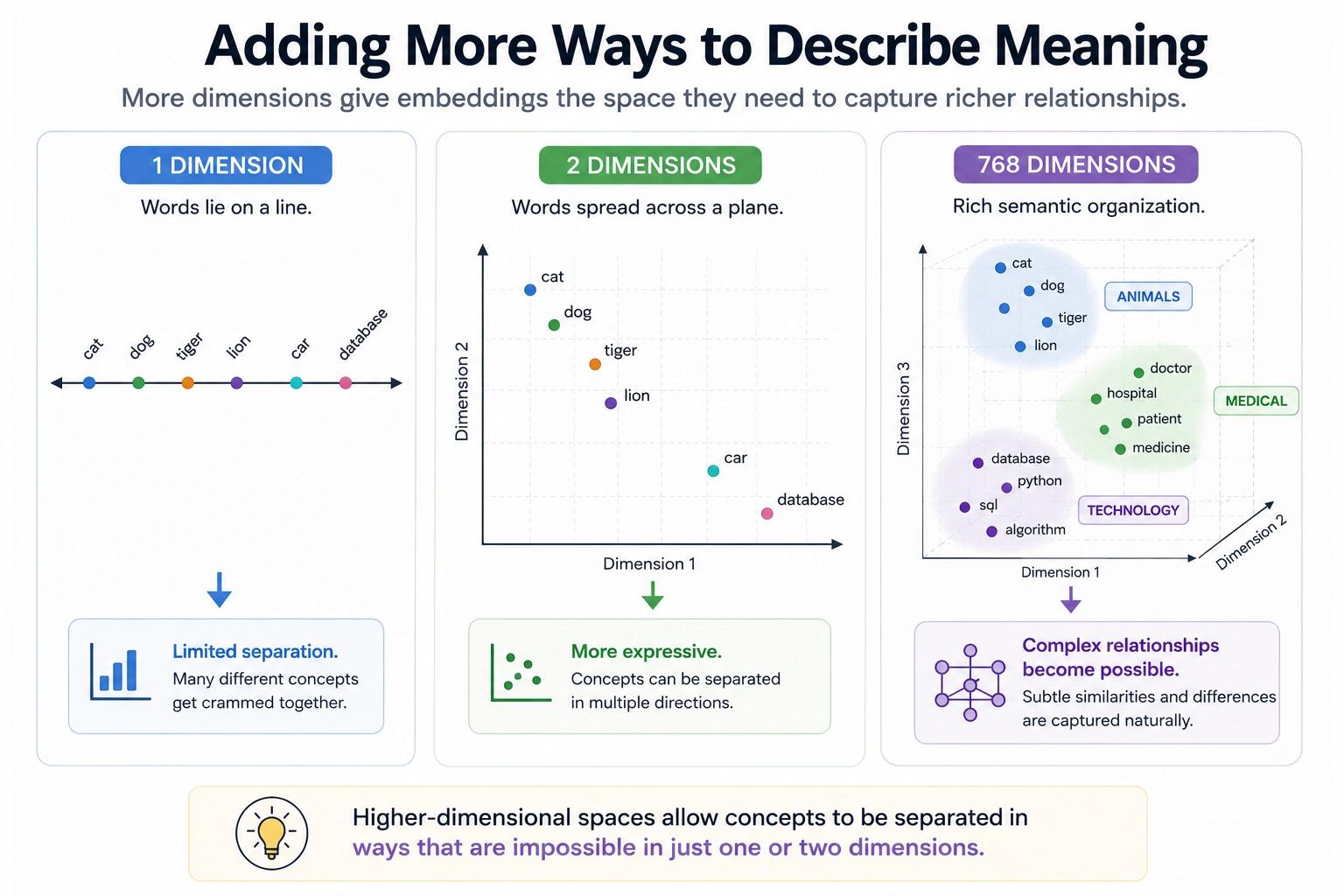
Embedding vectors are often described as living in a space with hundreds or even thousands of dimensions.
At first, this sounds intimidating.
Fortunately, you don't need to imagine a thousand physical directions.
A dimension is simply another numerical feature that helps distinguish one concept from another.
Think of it like describing a person.
One feature might represent height.
Another might represent age.
Another might represent eye color.
Another might represent profession.
A single feature tells you very little.
Thousands of features together create a rich description.
Embeddings work in a similar way.
Each dimension contributes a tiny piece of information. Individually, those values are difficult—or even impossible—for humans to interpret. Collectively, however, they create a mathematical representation capable of distinguishing subtle differences between concepts.
The goal is not to maximize the number of dimensions.
It is to provide enough capacity for meaningful relationships to emerge.
Consistency
Imagine searching for research papers today and then searching for the exact same query tomorrow.
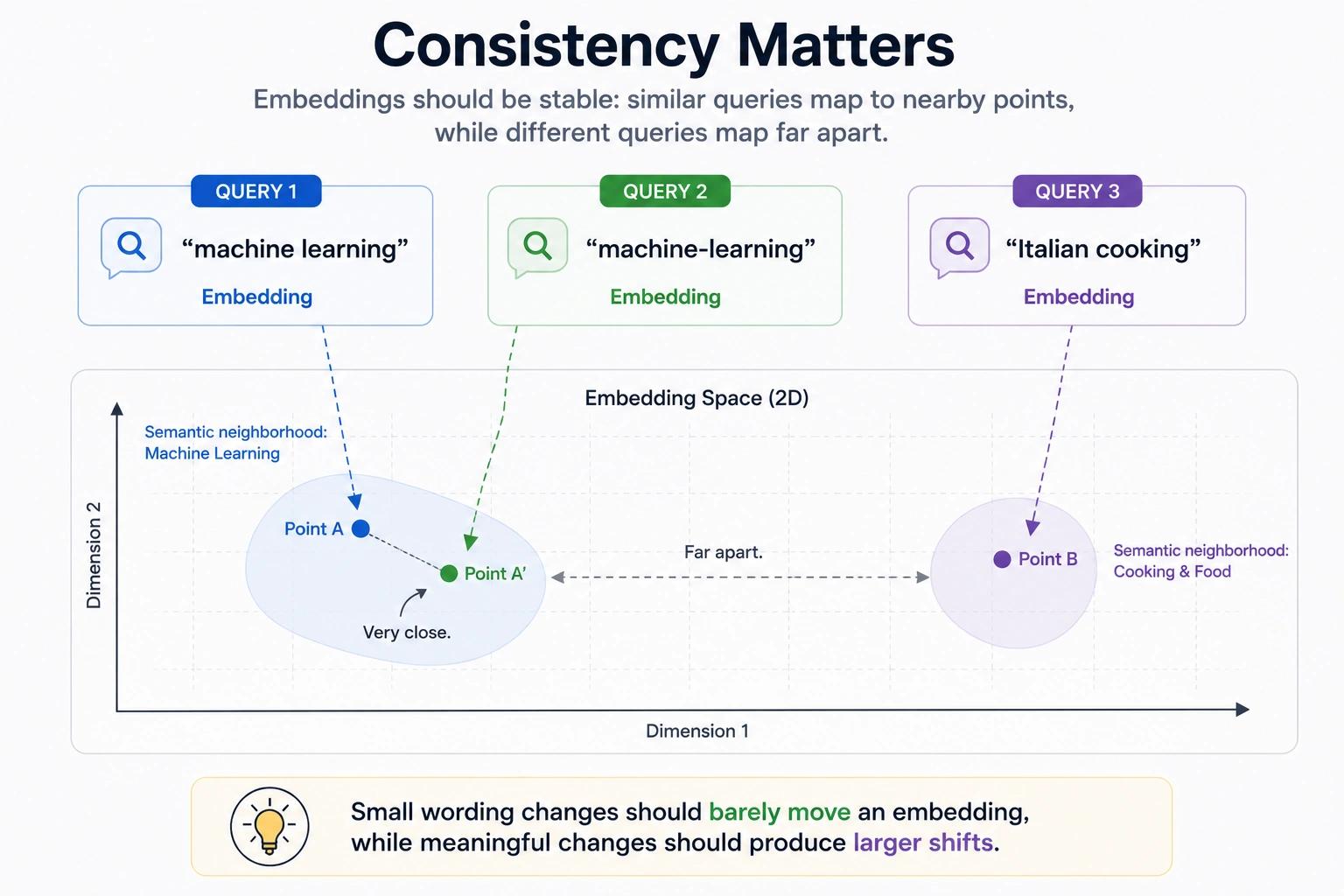
If the embedding model placed every concept in a completely different location each time, semantic search would be impossible.
A useful embedding space must therefore be stable.
Similar inputs should consistently produce similar vectors.
Small changes in wording should produce small changes in position.
Large changes in meaning should produce large movements through the space.
This consistency allows vector databases to retrieve reliable results and enables recommendation systems to behave predictably.
Generalization
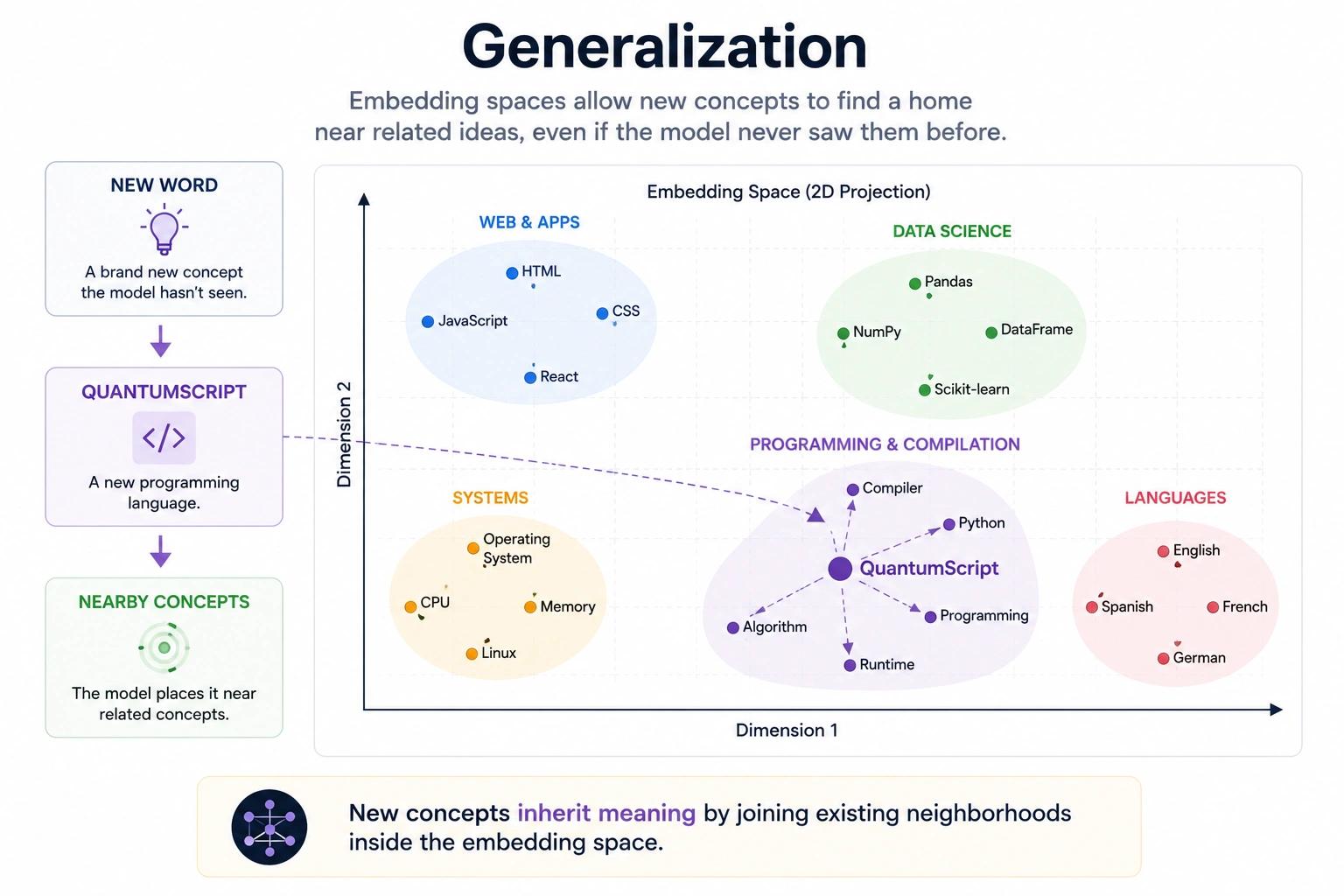
Perhaps the most valuable property of a good embedding is its ability to represent concepts it has never seen before.
Suppose a new programming language becomes popular tomorrow.
Even if the embedding model has never encountered it during training, surrounding context may still place it near concepts such as compiler, syntax, runtime, and software engineering.
Rather than memorizing isolated facts, embedding spaces learn general structure.
This is why they remain useful even as language evolves.
A Good Embedding Is Invisible
One of the most interesting characteristics of a high-quality embedding is that you rarely notice it.
When semantic search returns exactly the document you wanted, when recommendations feel surprisingly relevant, or when a chatbot understands what you meant instead of what you literally typed, the embedding has done its job.
It quietly organizes information so that every other system built on top of it becomes more intelligent.
Mental Model
A good embedding doesn't memorize words. It preserves the structure of knowledge.
Once we have a high-quality embedding space, an entirely new capability becomes possible.
Instead of searching for exact words, we can search for nearby meaning.
That simple idea powers modern recommendation systems, retrieval-augmented generation (RAG), image search, code search, and vector databases.
To understand why, we need one final mathematical ingredient:
How do we measure the distance between two embeddings?
That's the question we'll answer in the next section: Similarity Search.
7. Measuring Meaning: Similarity Search8 min read
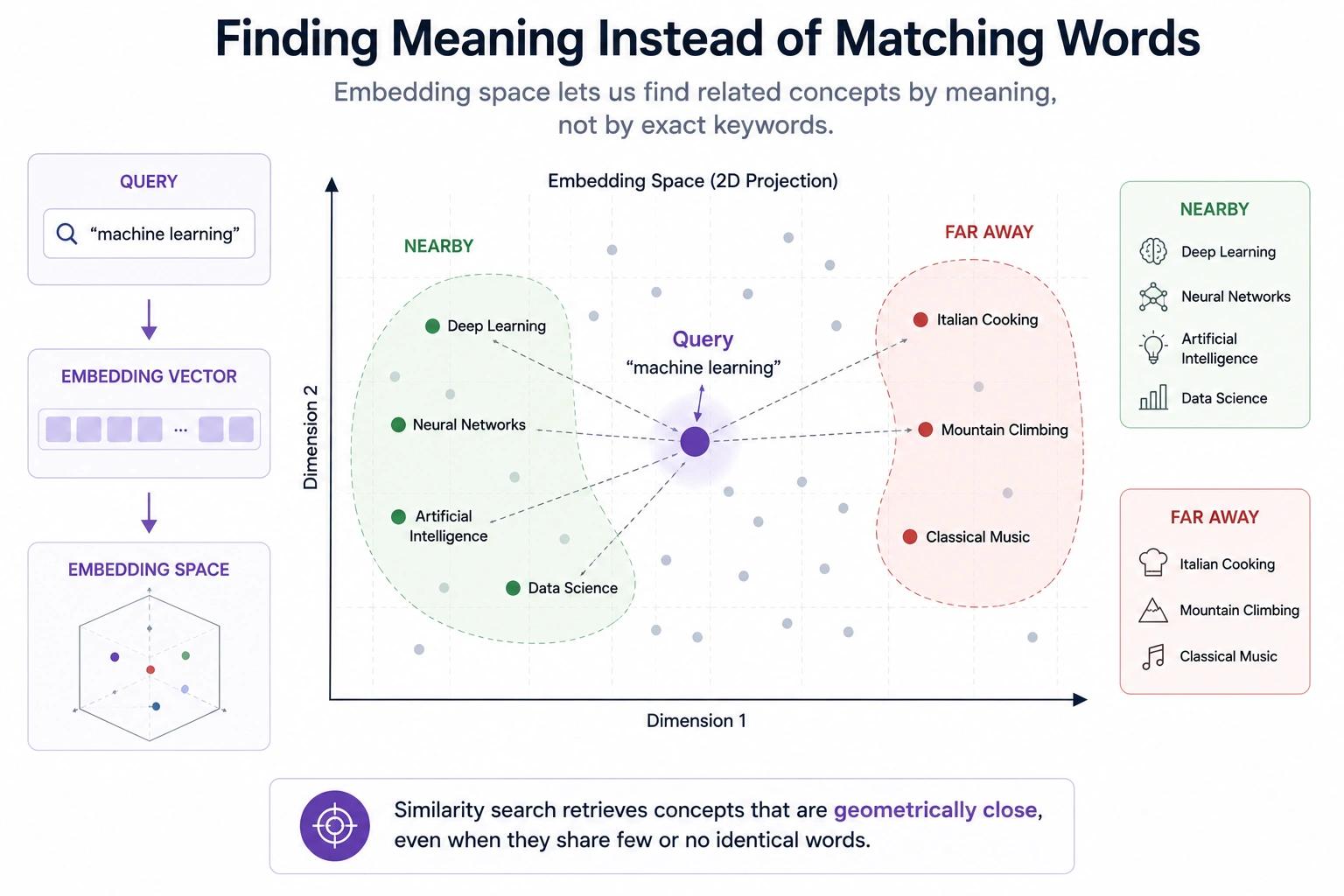
Once information has been transformed into embeddings, a remarkably simple question remains.
How do we compare two meanings?
Suppose we have converted these phrases into vectors.
machine learning
and
artificial intelligence
Intuitively, we expect them to be closely related.
Now compare
machine learning
and
Italian cooking
Most people would immediately agree that these ideas are much farther apart.
The challenge is that computers cannot rely on intuition.
They need a mathematical way to answer a seemingly human question:
How similar are these two ideas?
Fortunately, once meaning has been transformed into geometry, the problem becomes one of measuring distance.
Distance Is No Longer Physical
When we hear the word distance, we usually imagine measuring the gap between two cities on a map.
Embedding spaces work differently.
The points do not represent physical locations.
Instead, they represent concepts.
If two vectors are close together, their meanings are likely to be similar.
If they are far apart, the concepts are probably unrelated.
Similarity search therefore becomes a geometric problem.
Rather than asking,
"Do these documents contain the same keywords?"
we ask,
"Which vectors are closest to this one?"
That simple change powers semantic search, recommendation systems, retrieval-augmented generation (RAG), image search, code search, and countless other AI applications.
Measuring Closeness
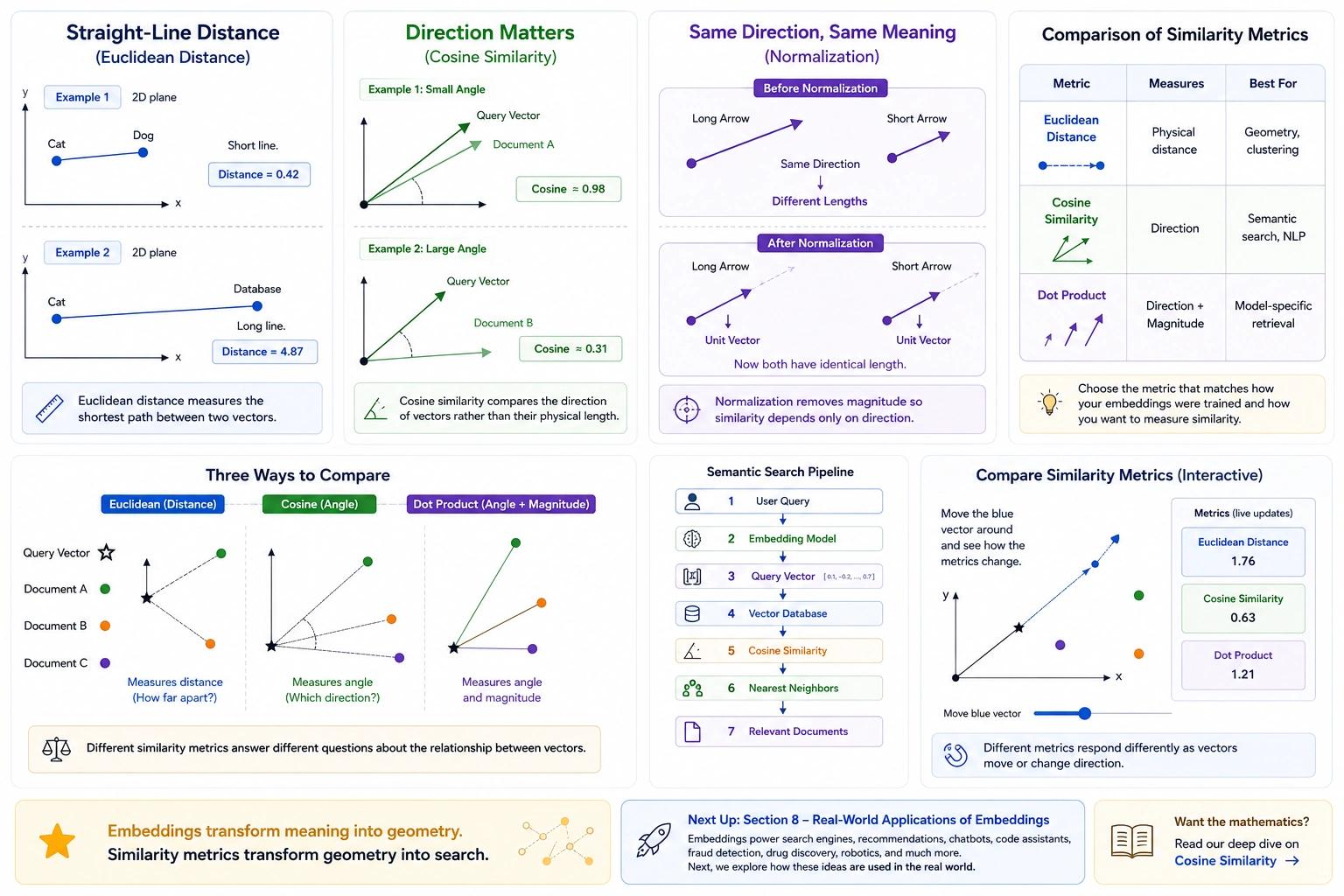
To determine whether two vectors are similar, we need a way to measure the distance between them.
Several mathematical approaches exist, each useful for different types of problems.
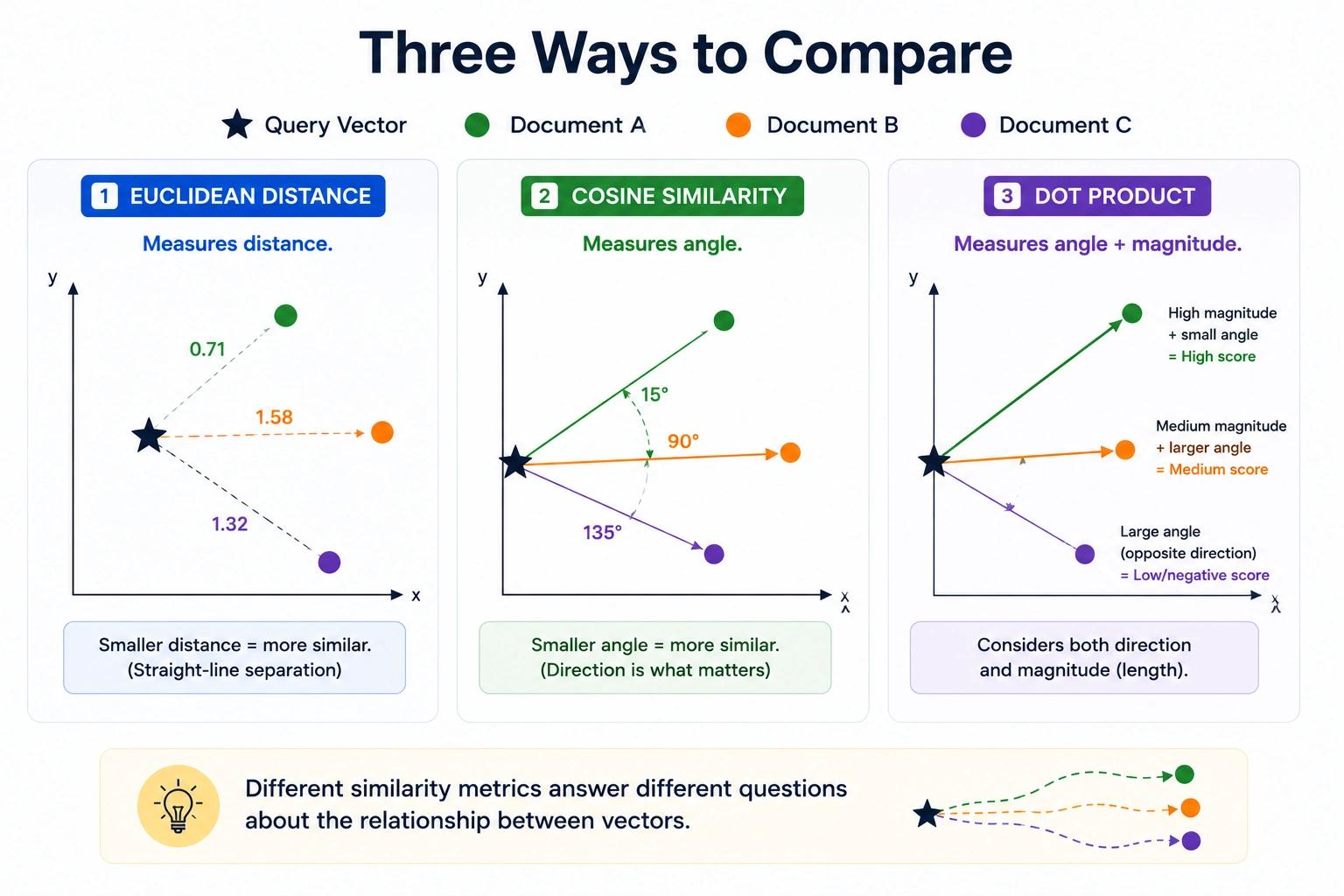
The three most common are:
- Euclidean Distance
- Cosine Similarity
- Dot Product
Although they often produce similar results, they measure different properties of the vectors.
Understanding when to use each one is an important part of building modern AI systems.
Euclidean Distance
The simplest approach comes directly from high-school geometry.
Imagine plotting two points on a graph.
The shortest path between them is a straight line.
That length is called the Euclidean distance.
Embedding spaces extend the same idea into hundreds or even thousands of dimensions.
If two vectors lie close together, the distance is small.
If they are far apart, the distance grows larger.
For example,
Distance = Small
Distance = Large
Euclidean distance is intuitive because it measures absolute separation.
However, it is not always the best choice for language models.
Two vectors may point in almost exactly the same semantic direction while differing greatly in magnitude.
In those cases, another metric performs much better.
Cosine Similarity
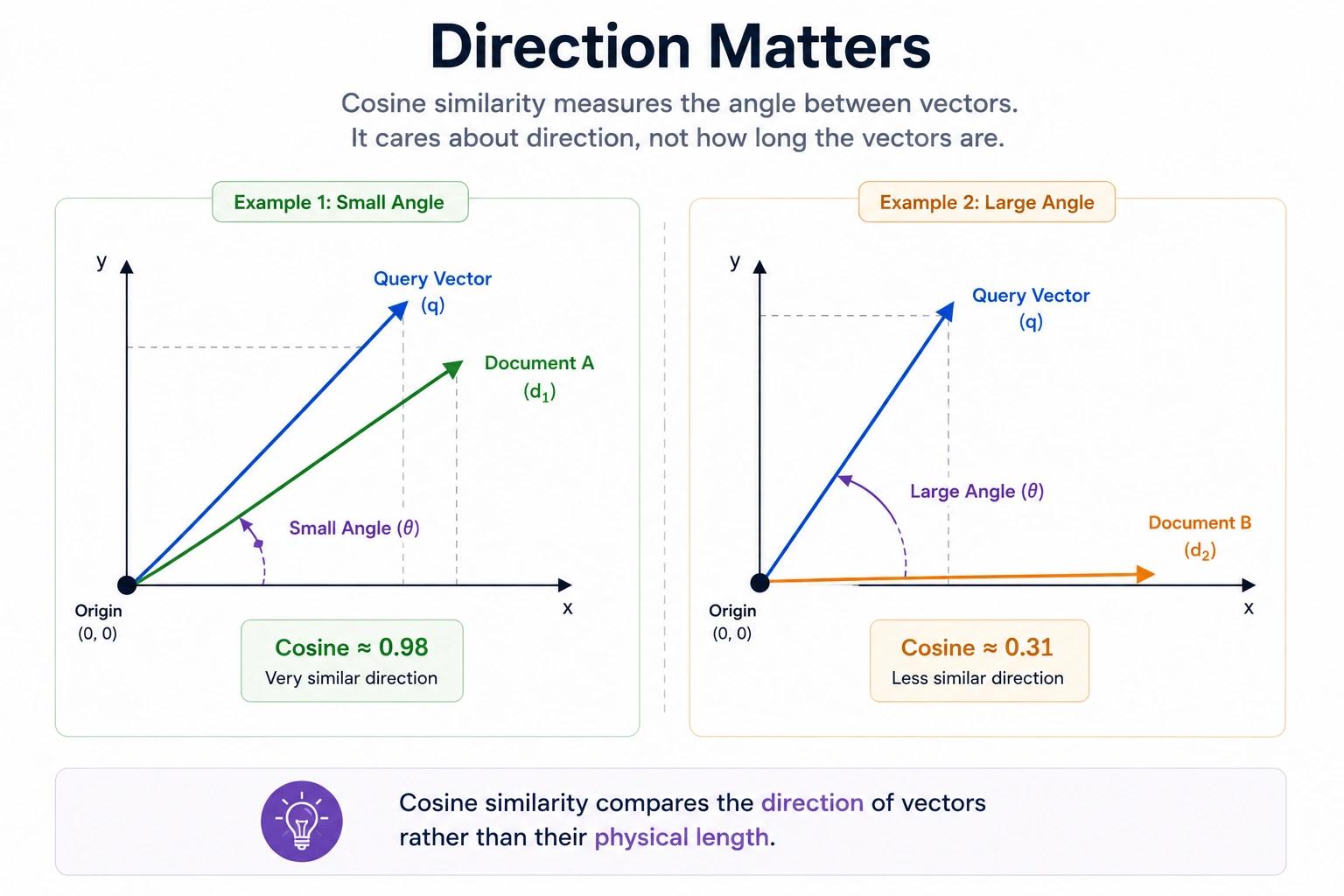
Cosine similarity approaches the problem differently.
Instead of asking,
How far apart are these vectors?
it asks,
Are they pointing in the same direction?
Imagine standing at the center of a circle and shining two laser pointers.
If both lasers point almost the same way, the angle between them is very small.
If they point in completely different directions, the angle becomes much larger.
Cosine similarity measures exactly that angle.
When two vectors point in nearly the same direction, their cosine similarity approaches 1.
When they are perpendicular, the similarity approaches 0.
When they point in opposite directions, the similarity becomes -1.
Because embeddings primarily encode relationships rather than physical length, cosine similarity often captures semantic similarity better than Euclidean distance.
This is why it has become one of the most widely used metrics in natural language processing.
Why Normalize Embeddings?
You may have noticed something interesting.
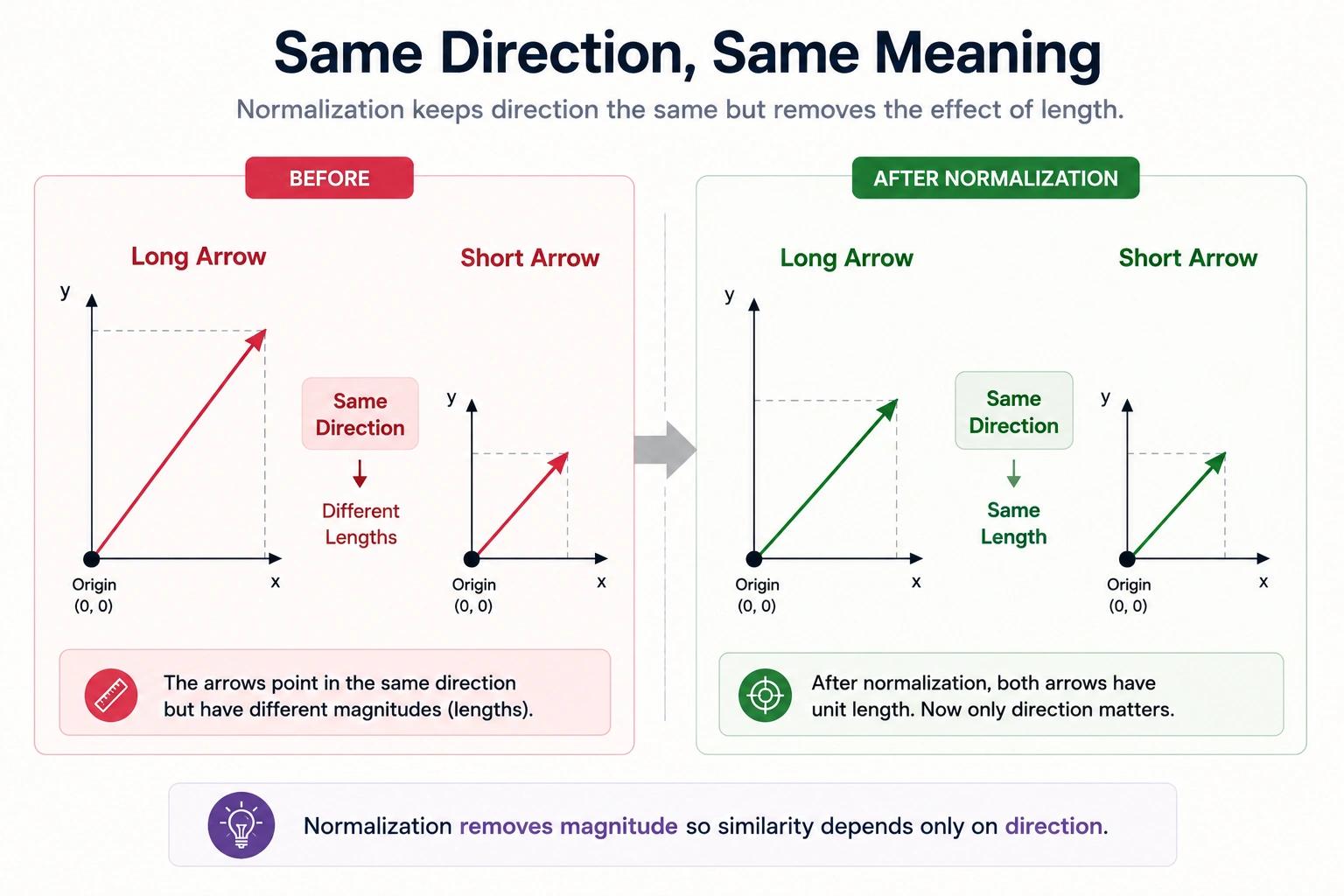
Cosine similarity cares only about direction.
It ignores magnitude.
That observation explains why many embedding models normalize their vectors before storing them.
Normalization scales every vector to the same length while preserving its direction.
Imagine replacing arrows of different sizes with arrows of identical length.
Their directions remain unchanged, making comparisons much more consistent.
This is particularly useful in semantic search because the goal is to compare meaning, not the arbitrary size of the vectors.
Dot Product
The third common measure is the dot product.
Unlike cosine similarity, the dot product considers both the direction and the magnitude of the vectors.
If two vectors point in similar directions and have large magnitudes, the dot product becomes larger.
This makes it useful in situations where vector magnitude itself carries meaningful information.
Some embedding models are trained specifically so that dot product performs well, while others are optimized for cosine similarity.
The correct choice depends on how the embeddings were trained.
Comparison table
From Mathematics to Search
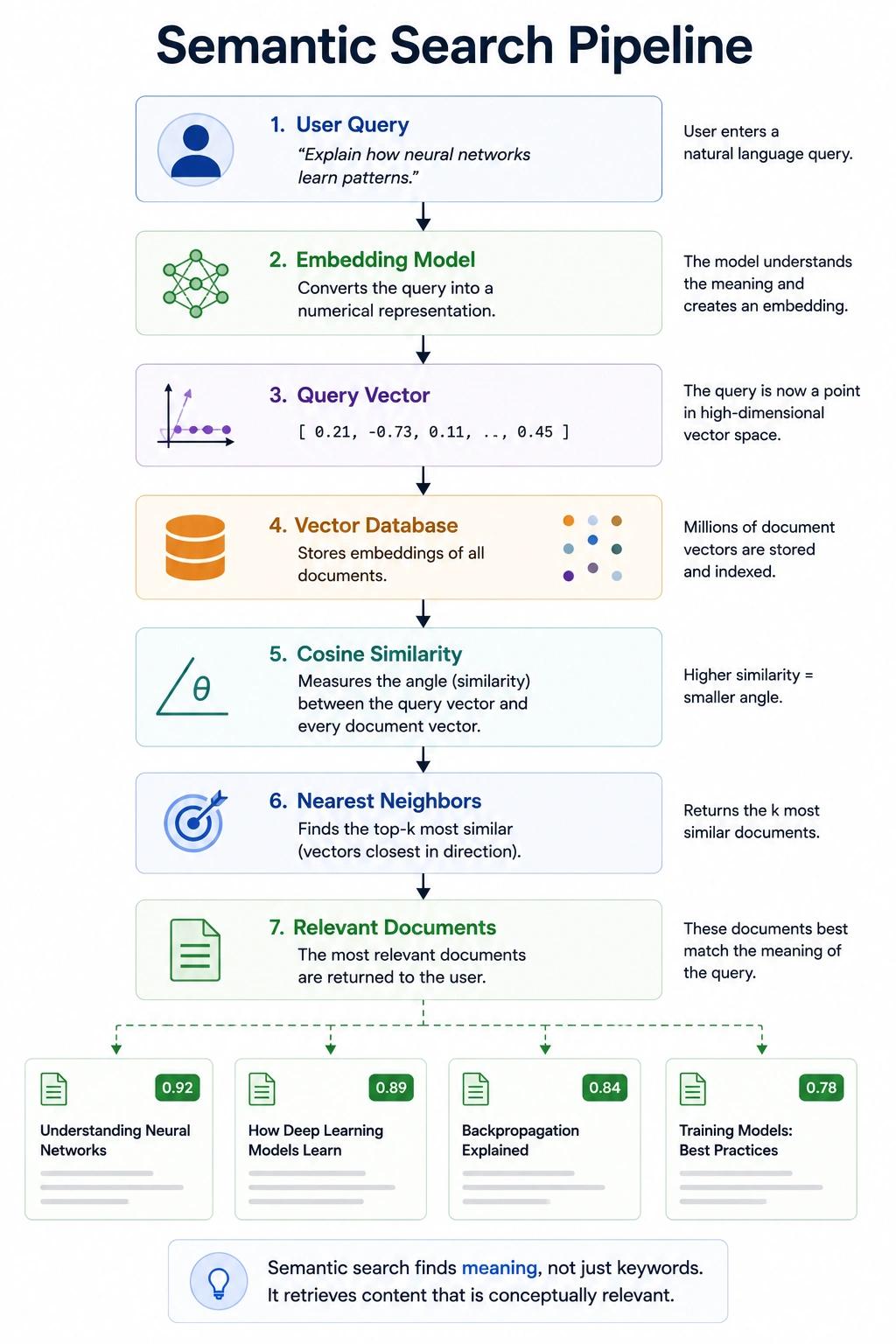
Once we can measure similarity between vectors, searching becomes surprisingly straightforward.
A user's query is converted into an embedding.
Every document in the database has already been converted into an embedding.
The system simply finds the vectors that are closest according to the chosen similarity metric.
Those nearest neighbors become the search results.
This process often retrieves documents that never contain the exact query words but still discuss the same underlying idea.
That is why modern search systems feel dramatically more intelligent than traditional keyword matching.
Mental Model
Embeddings transform meaning into geometry. Similarity metrics transform geometry into search.
At this point, we understand almost everything needed to build semantic search.
We know how embeddings are learned.
We know how meaning is organized.
We know how similarity is measured.
But one question remains.
Where are these ideas actually used?
The answer is: almost everywhere.
From Google Search and Netflix recommendations to ChatGPT, GitHub Copilot, fraud detection, protein discovery, robotics, and multimodal AI, embeddings have quietly become one of the foundational technologies behind modern intelligent systems.
That's where we'll go next in Section 8: Real-World Applications of Embeddings.
8. Real-World Applications of Embeddings8 min read
At first glance, embeddings might seem like a technique built exclusively for language models.
After all, we've spent most of this article talking about words, sentences, and documents.
In reality, embeddings have become one of the most widely used representations in modern computing.
The underlying idea is remarkably simple: convert complex information into vectors that preserve meaning. Once everything can be represented as points in the same mathematical space, similarity becomes something a computer can measure.
That principle extends far beyond text.
Search engines, recommendation systems, fraud detection platforms, scientific research, autonomous vehicles, and multimodal AI all rely on embeddings in one form or another.
The representation changes.
The geometry remains the same.
Semantic Search
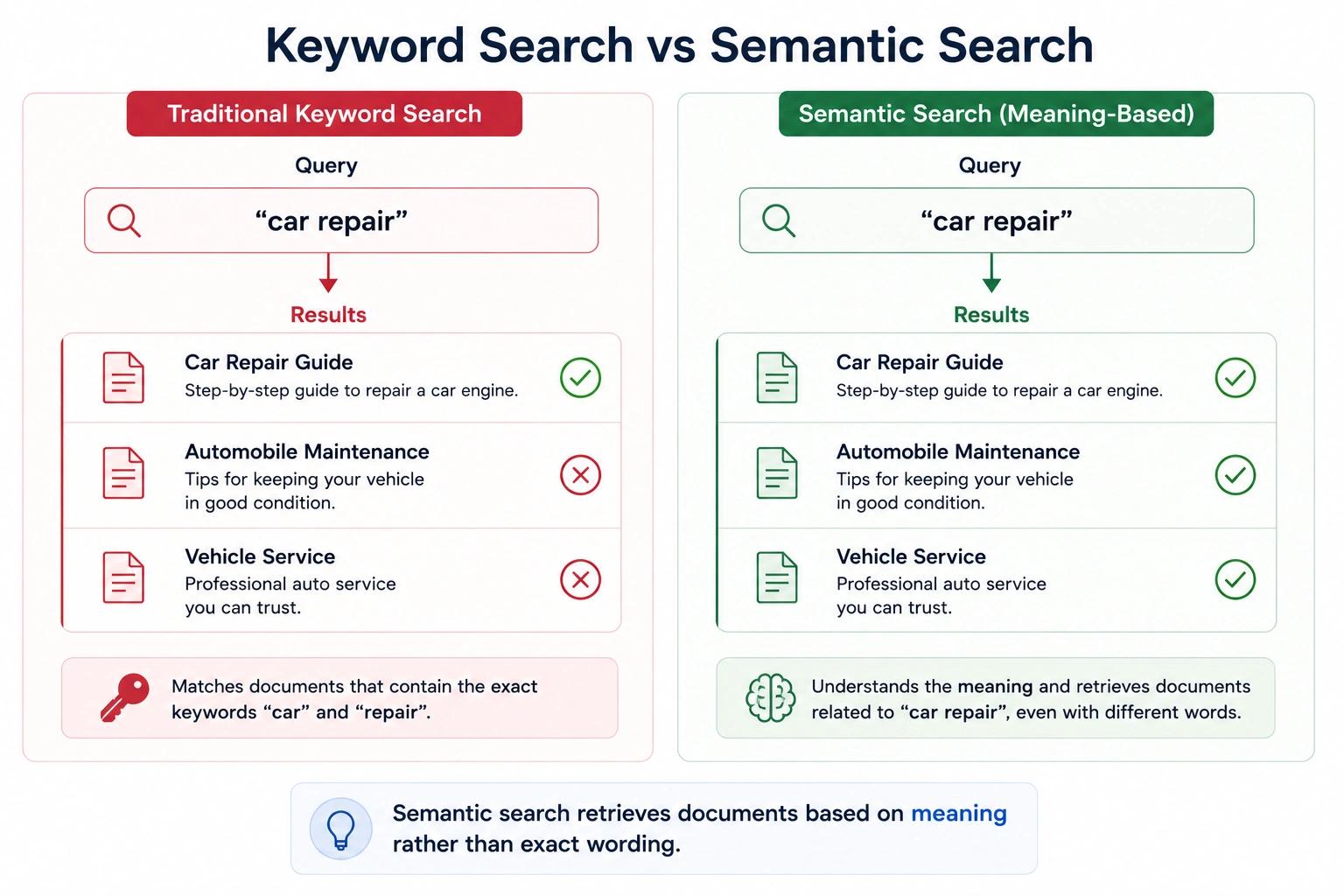
Traditional search engines relied heavily on matching exact keywords.
If a document contained the words you searched for, it ranked highly. If it used different wording, it might never appear, even if it discussed the exact topic you wanted.
Embeddings changed that completely.
Instead of searching for matching words, modern systems search for nearby meaning.
A query such as
How do neural networks learn?
may retrieve documents titled
Backpropagation Explained
or
Gradient Descent from First Principles
even though neither document contains the original question verbatim.
The search engine recognizes that these ideas occupy nearby regions of the embedding space.
It retrieves concepts rather than keywords.
Recommendation Systems
Every recommendation platform faces the same challenge.
How do you decide what someone is likely to enjoy next?
Embeddings provide an elegant answer.
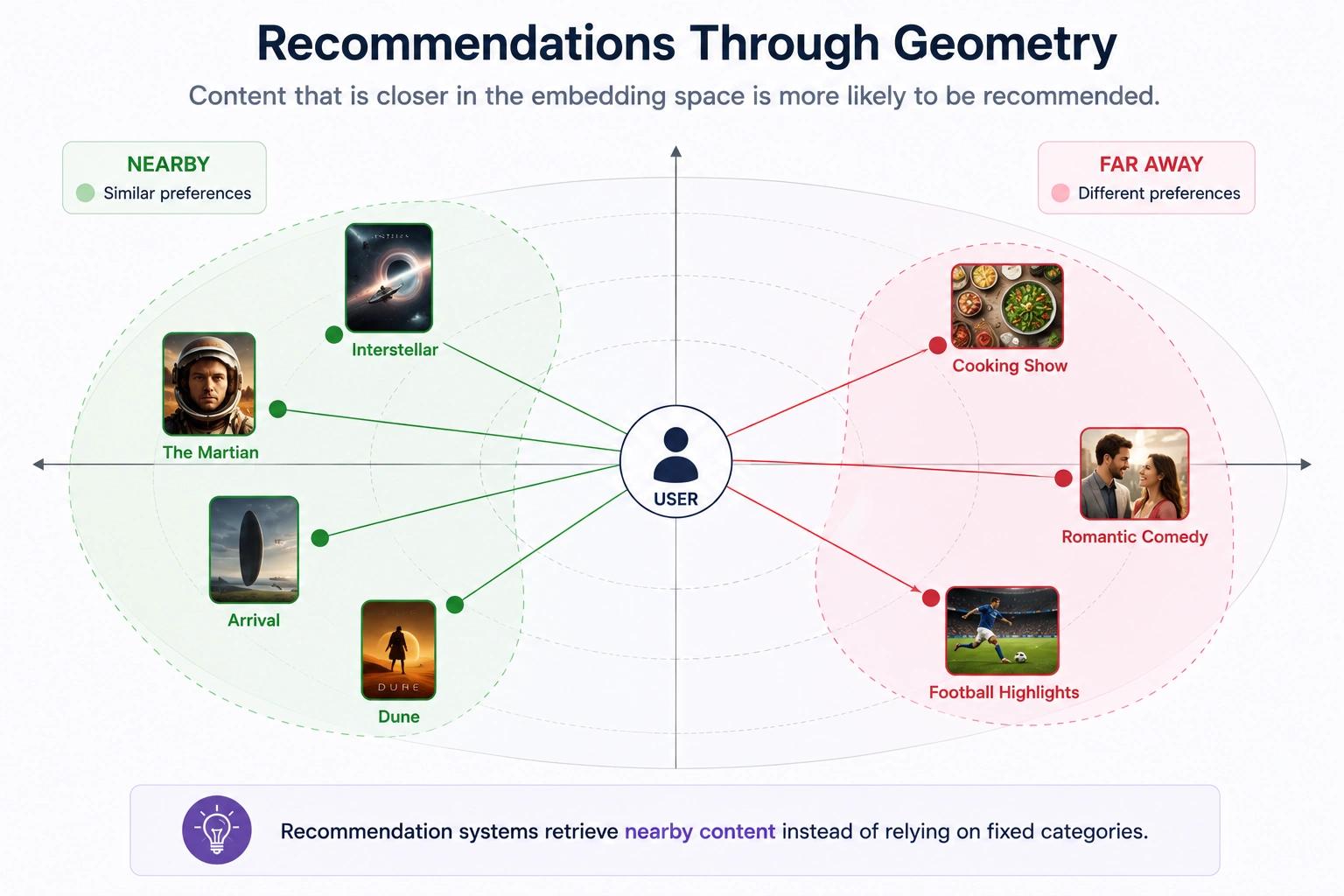
Movies, books, songs, products, and even users can all be represented as vectors.
If a user frequently watches science-fiction films, their embedding gradually moves closer to other science-fiction content.
Instead of recommending items from manually defined categories, the system simply retrieves nearby vectors.
This allows recommendation engines to discover relationships that humans might never explicitly define.
The same mathematical idea powers movie recommendations, music playlists, shopping suggestions, and personalized news feeds.
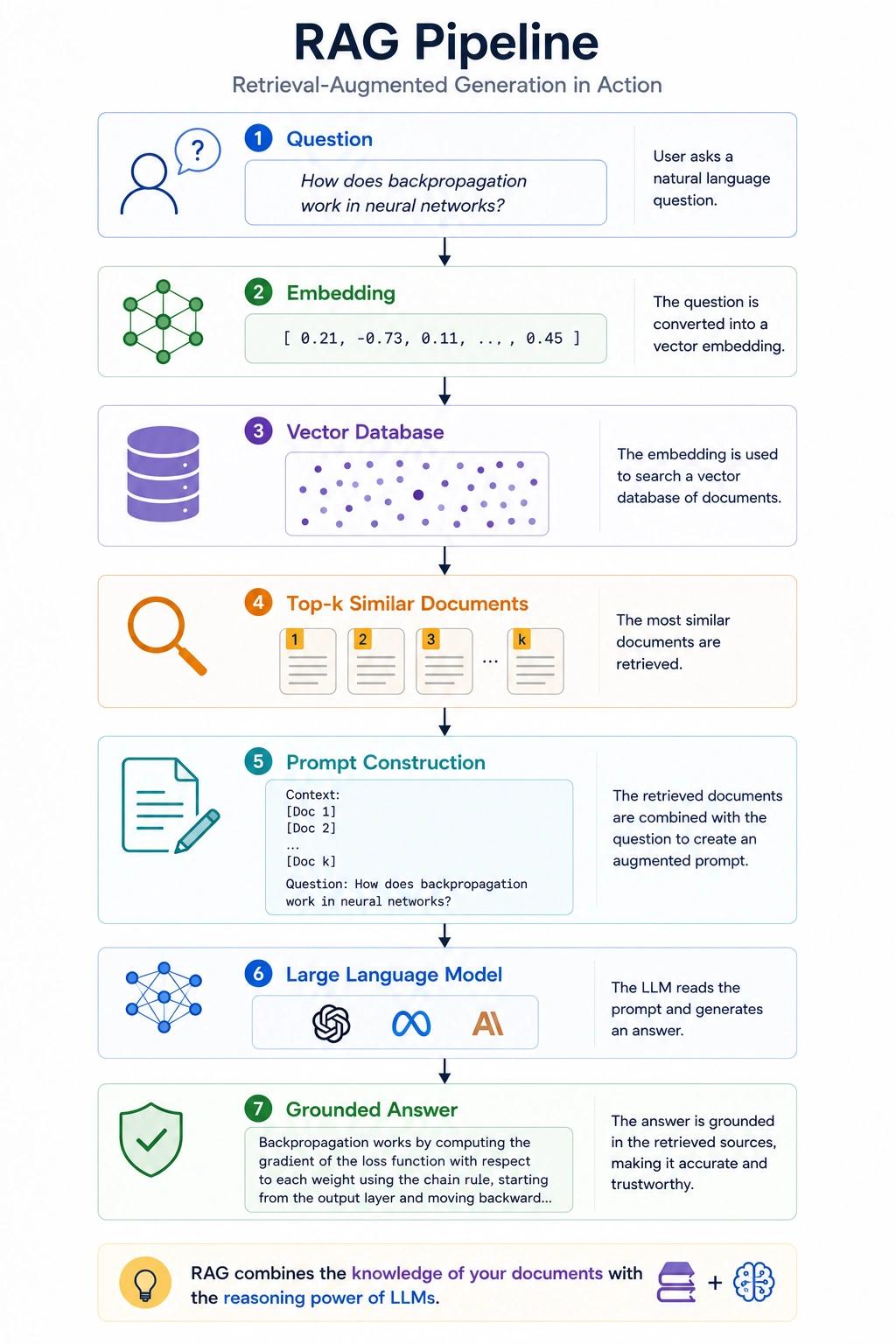
Retrieval-Augmented Generation (RAG)
One of the most influential uses of embeddings today is Retrieval-Augmented Generation, commonly known as RAG.
Large language models possess broad knowledge, but they cannot memorize every private document, company policy, research paper, or internal manual.
Embeddings solve this limitation.
Instead of asking the language model to remember everything, we first convert every document into embeddings and store them inside a vector database.
When a user asks a question, that question is also converted into an embedding.
The system retrieves the most semantically similar documents, then provides those documents to the language model as additional context.
The model does not search using keywords.
It searches using geometry.
This simple pipeline has become one of the most common architectures for building AI assistants, enterprise search systems, research tools, and customer support platforms.
Computer Vision
Embeddings are not limited to language.
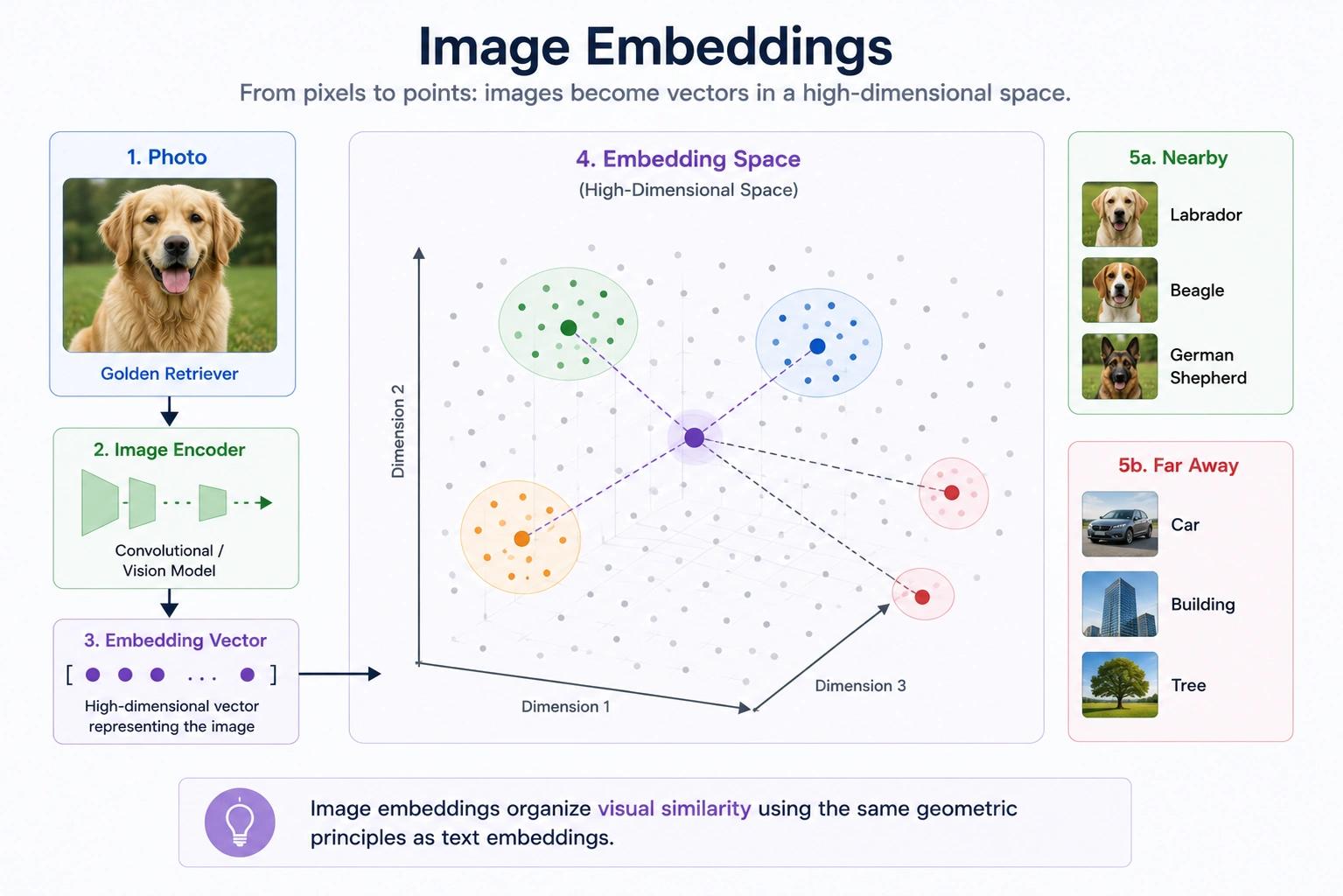
Images can also be converted into vectors.
Suppose you upload a photograph of a golden retriever.
Rather than storing millions of pixel values directly, an image encoder transforms the photograph into an embedding that captures visual characteristics such as shape, texture, and appearance.
Now, finding similar images becomes another nearest-neighbor search problem.
Photos of other golden retrievers appear nearby.
Cats, airplanes, and buildings appear much farther away.
This principle powers reverse image search, facial recognition, product matching, and visual recommendation systems.
Source Code Search
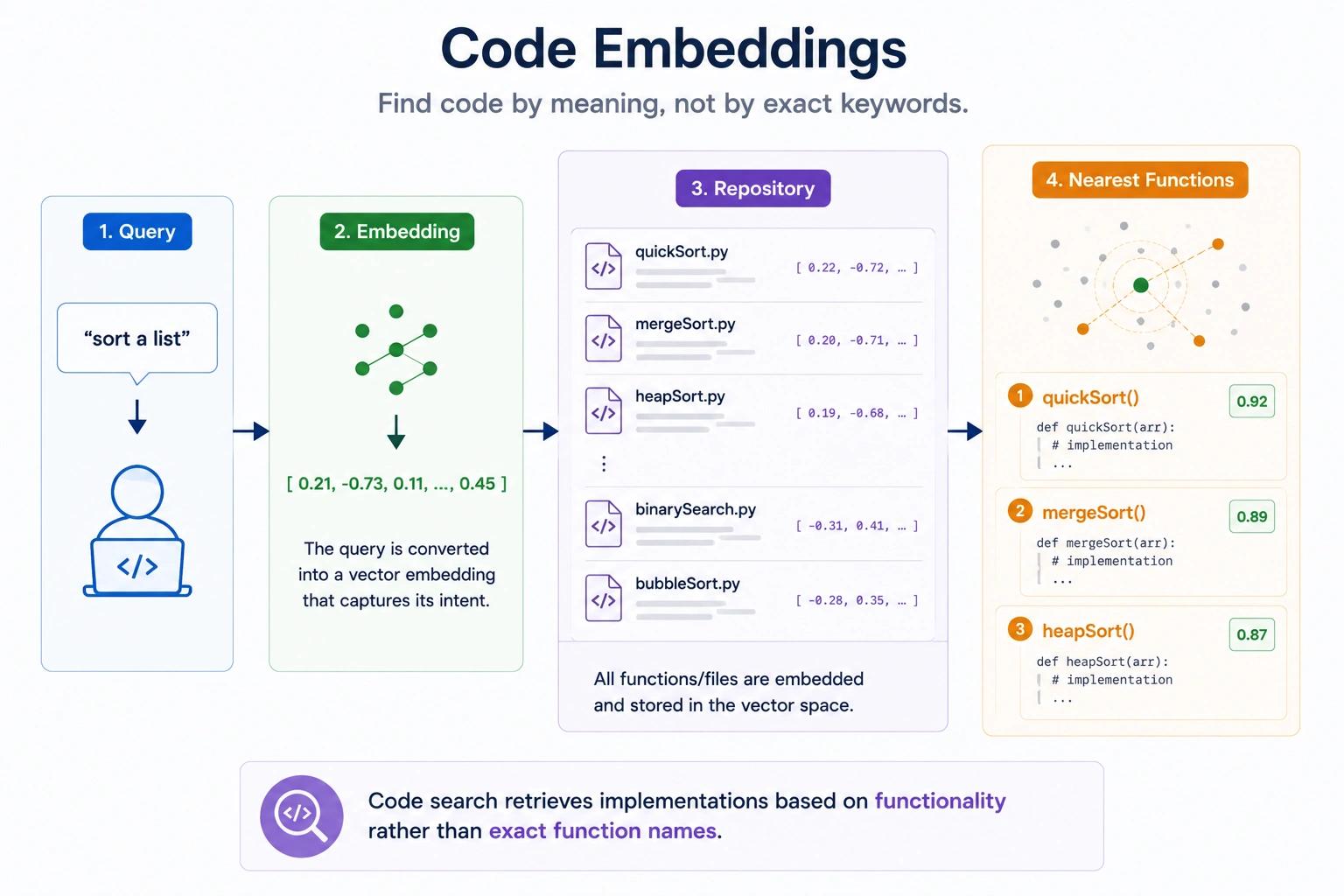
Modern coding assistants rely heavily on embeddings.
Functions, classes, documentation, APIs, and entire repositories are converted into vectors.
This allows developers to search using natural language rather than exact function names.
A query like
Sort a list efficiently
may retrieve implementations named
quickSort()mergeSort()heapSort()
even if none of those functions literally contain the words "sort efficiently."
The embedding captures the intent of the code.
This capability powers semantic code search, documentation lookup, AI pair programming, and repository understanding.
Scientific Discovery
Perhaps the most exciting applications of embeddings lie outside traditional software.
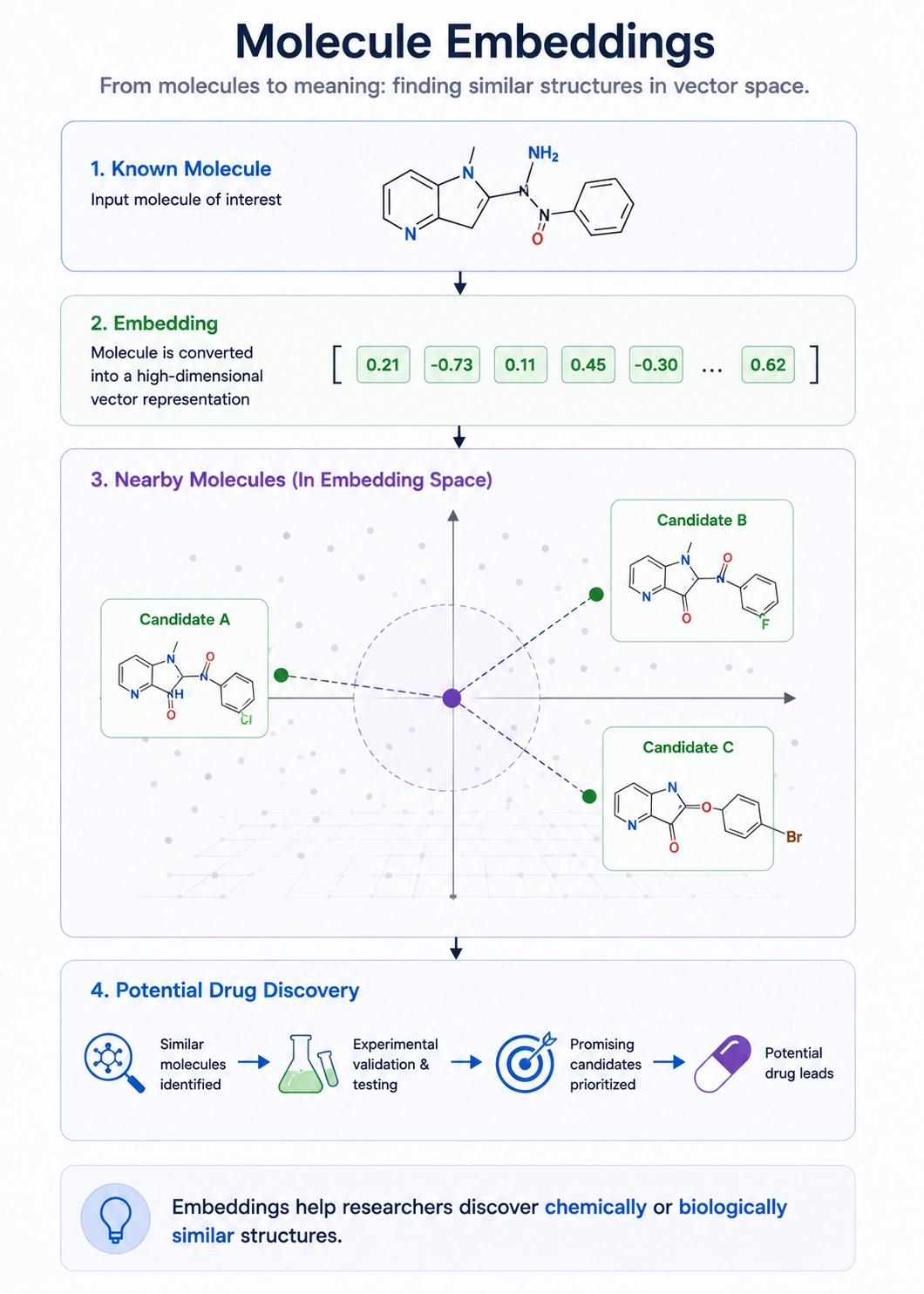
Proteins can be embedded.
Chemical compounds can be embedded.
Genes, molecules, and biological sequences can all be represented as vectors.
Researchers can then search for nearby structures, identify similar compounds, discover previously unknown relationships, and accelerate drug discovery.
The same mathematical framework that retrieves research papers can also help scientists explore biological knowledge.
Geometry once again becomes a universal language.
Fraud Detection
Financial institutions continuously analyze millions of transactions looking for unusual behavior.
Instead of evaluating each transaction independently, embeddings allow systems to represent users, merchants, locations, devices, and payment patterns inside a shared space.
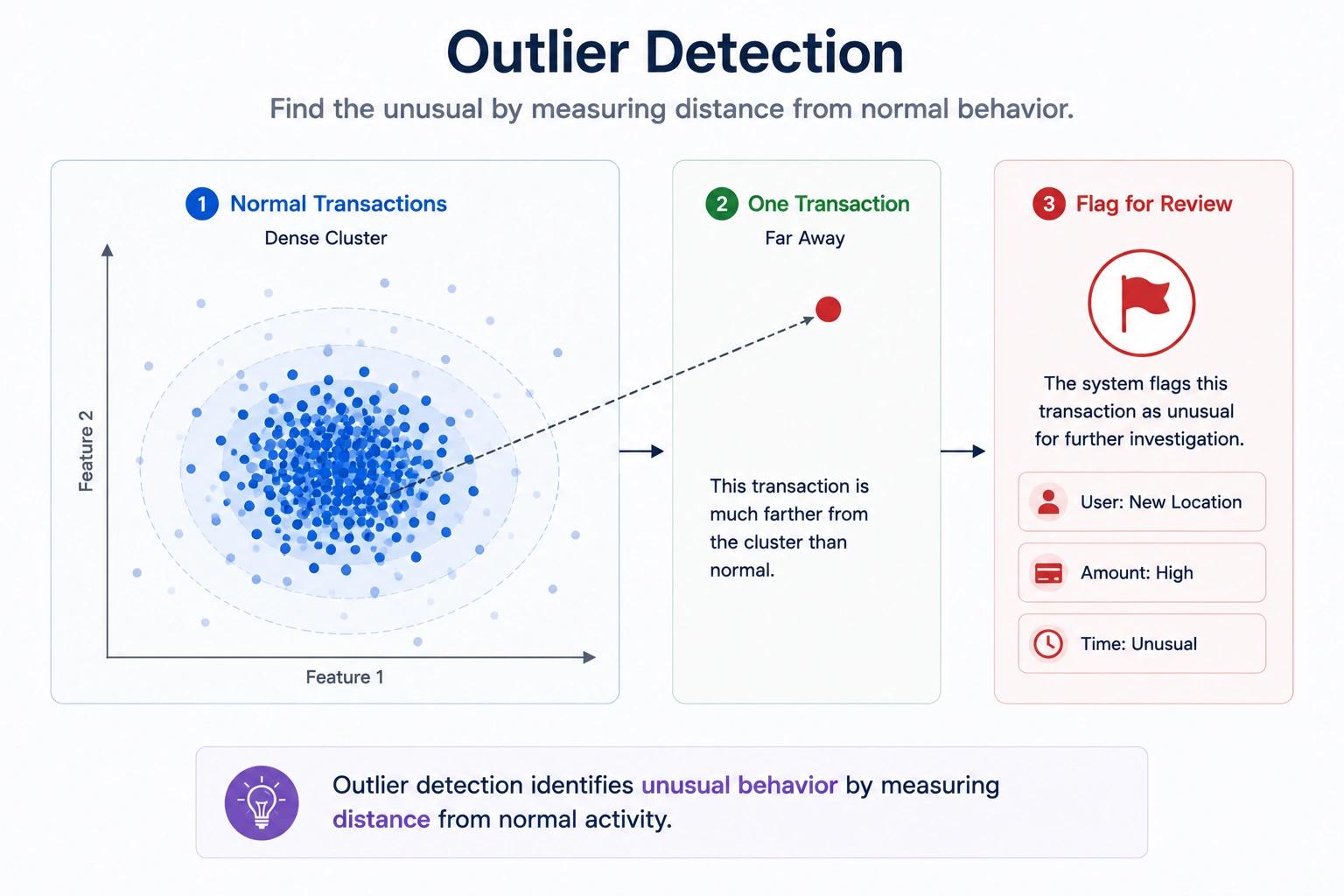
Normal activity forms stable neighborhoods.
Suspicious transactions often appear as outliers, far from the customer's usual behavior.
By measuring geometric distance rather than relying solely on manually crafted rules, fraud detection systems can identify novel attack patterns that traditional methods might overlook.
Multimodal AI
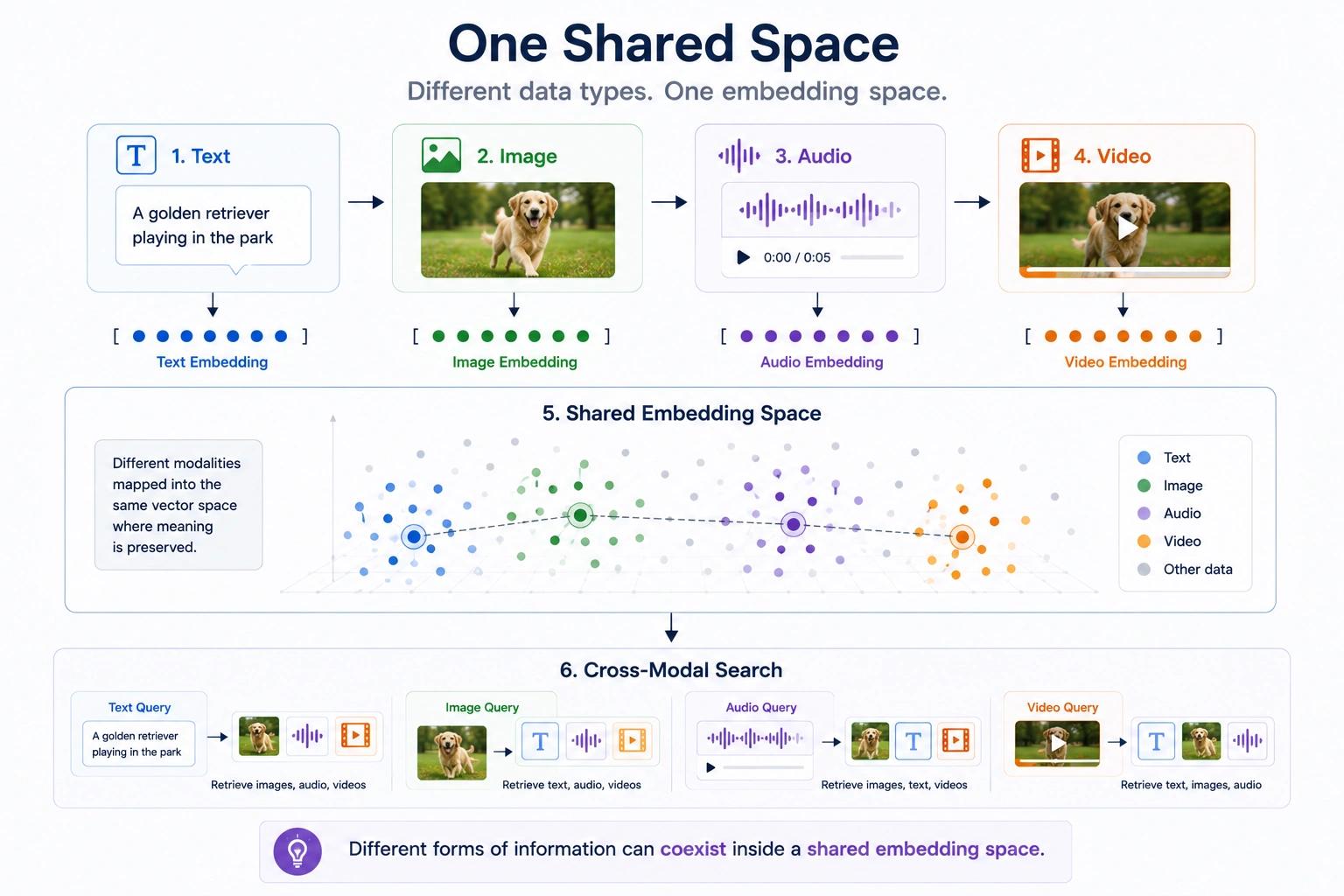
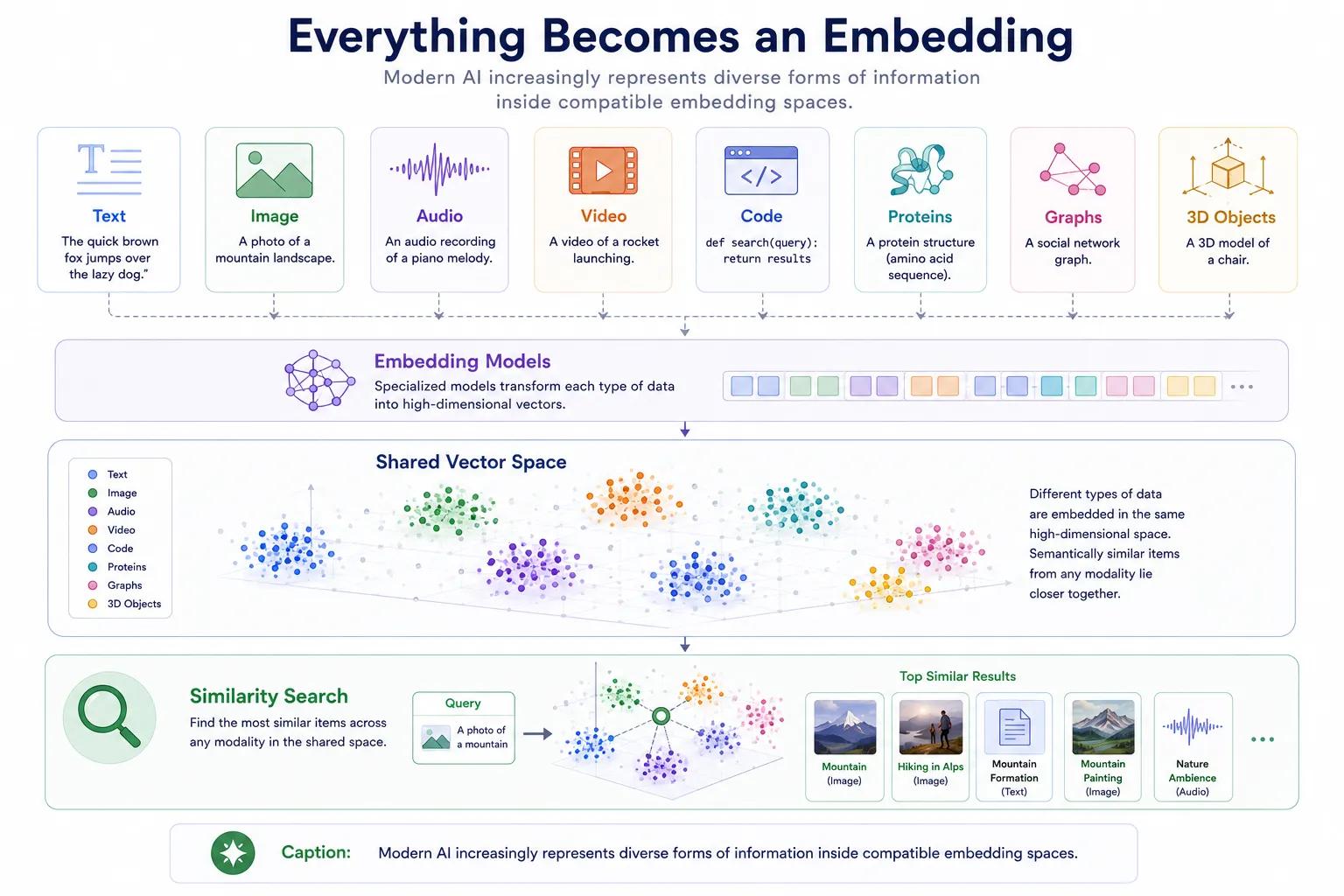
Perhaps the most remarkable evolution of embeddings is that different types of information can now share the same mathematical space.
Text can become embeddings.
Images can become embeddings.
Audio can become embeddings.
Video can become embeddings.
In many modern AI systems, these different modalities are projected into compatible vector spaces.
That means a sentence can retrieve an image.
An image can retrieve a video.
A spoken question can retrieve a document.
The underlying representation is no longer tied to one specific type of data.
Meaning becomes modality-independent.
A Single Idea Behind Many Systems
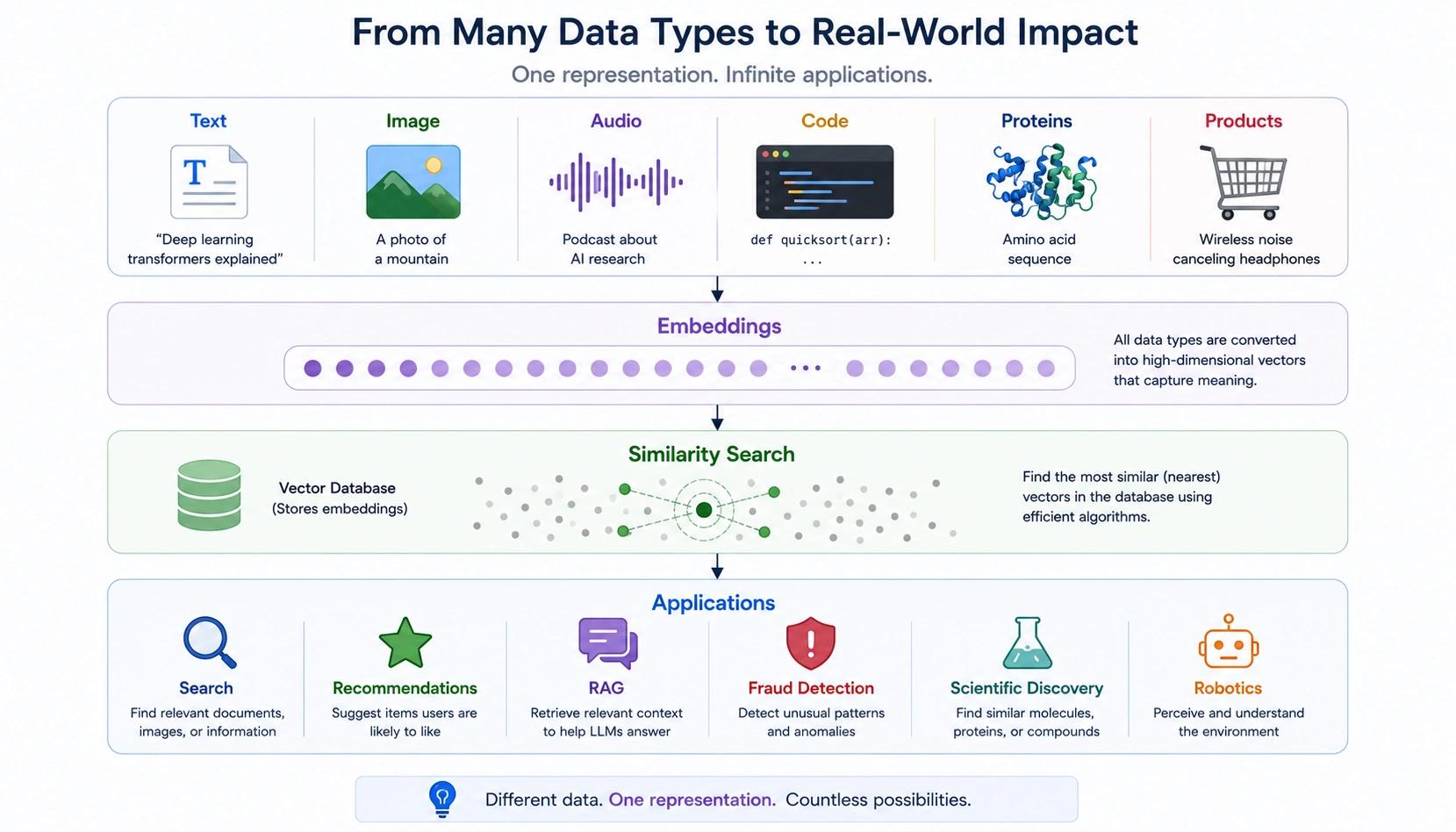
Although these applications appear completely different, they all follow the same fundamental pipeline.
Convert information into embeddings.
Measure similarity.
Retrieve nearby neighbors.
Use those neighbors to perform a useful task.
Whether the data consists of research papers, photographs, proteins, songs, or source code, the workflow remains surprisingly consistent.
This is why embeddings have become one of the foundational abstractions of modern artificial intelligence.
Mental Model
Different data. One representation. Countless applications.
By now, we've seen embeddings power search engines, recommendation systems, image retrieval, code search, scientific research, and enterprise AI.
But one question remains.
What role do embeddings play inside a large language model itself?
After all, ChatGPT doesn't receive raw words as input.
Before a transformer can reason about language, every token must first become an embedding.
9. Embeddings Inside Large Language Models7 min read
Throughout this article, we've treated embeddings as a general-purpose way of representing meaning.
We've seen them power search engines, recommendation systems, image retrieval, code search, scientific discovery, and retrieval-augmented generation.
But one question still remains.
What role do embeddings play inside a large language model itself?
After all, systems like ChatGPT never receive raw text.
Before a transformer can recognize patterns, reason about language, or generate an answer, every piece of text must first be translated into a mathematical form the model can process.
That translation begins with embeddings.
Far from being an optional component, embeddings are the foundation upon which every modern transformer is built.
From Text to Numbers
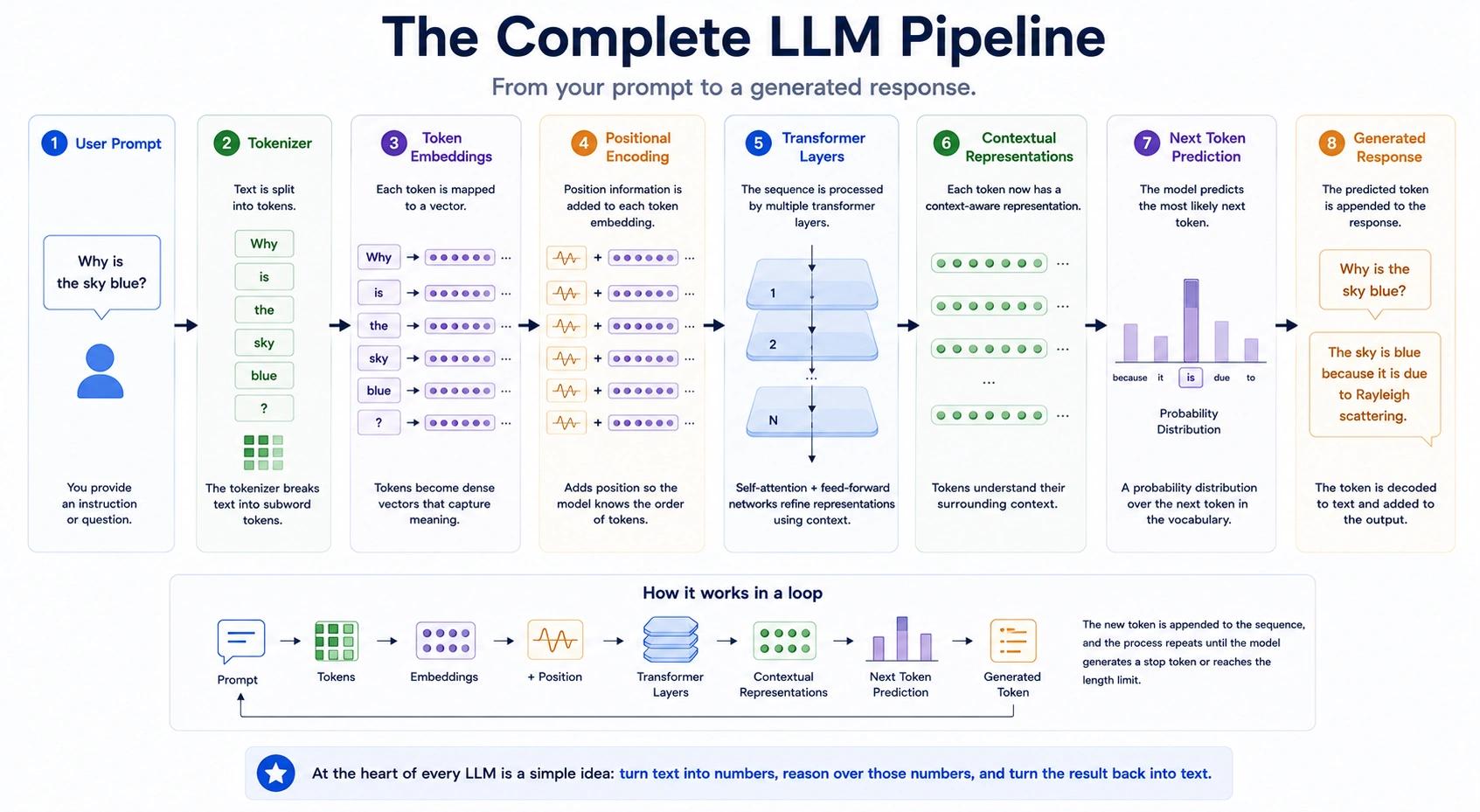
Suppose you ask a language model a simple question:
Why is the sky blue?
To us, this appears as a short sentence composed of familiar words.
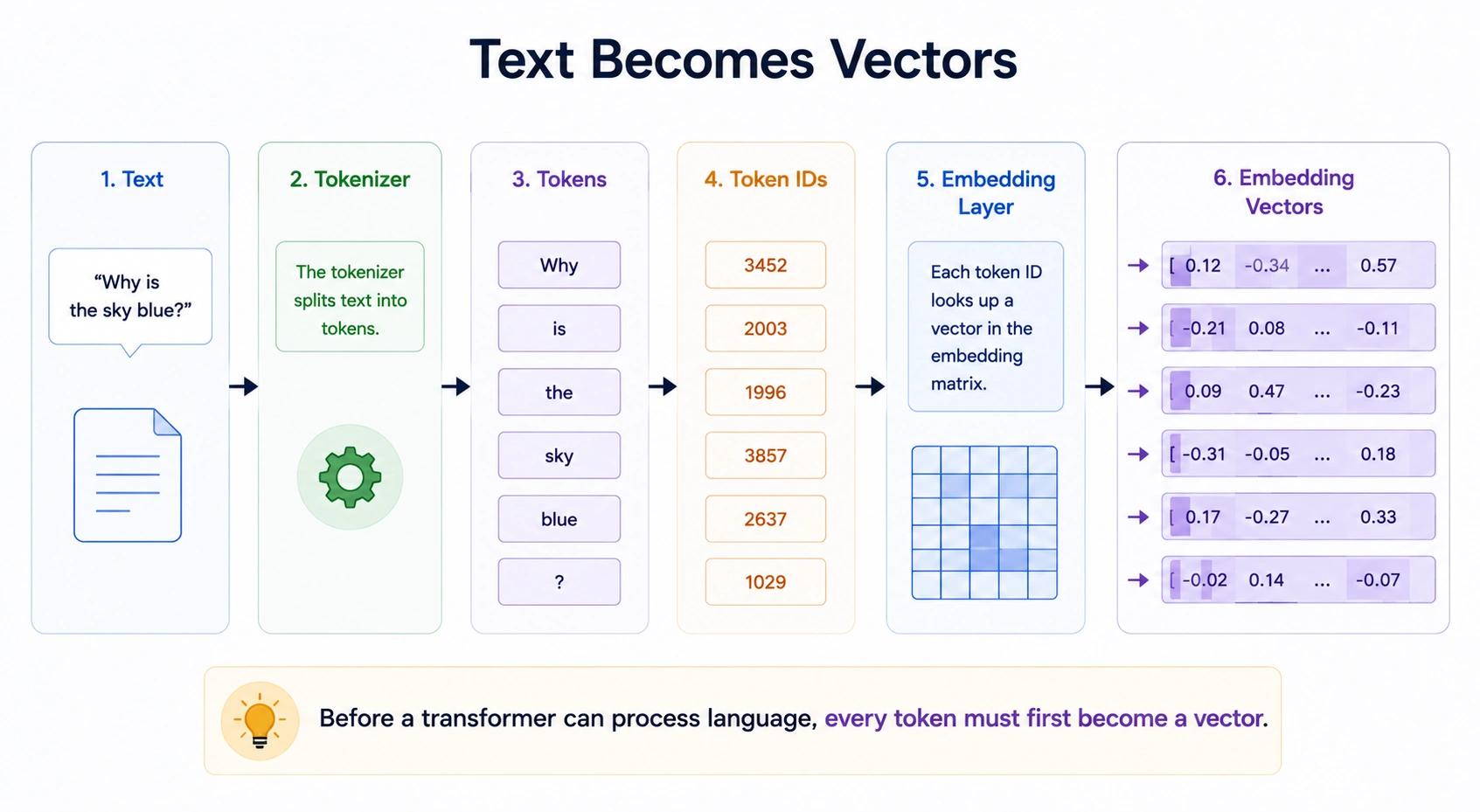
To a language model, however, the sentence is initially nothing more than a sequence of characters.
The transformer cannot reason directly over letters or words.
It first converts the text into tokens.
Depending on the tokenizer, the sentence might become something similar to:
Whyistheskyblue?
Each token is then mapped to a unique numerical identifier.
Those identifiers are useful for indexing the vocabulary, but they still carry no semantic information.
Just as we saw with one-hot encoding earlier in this article, IDs alone cannot express meaning.
The model therefore performs one more transformation.
Every token ID is replaced with its corresponding embedding vector.
At that moment, language becomes geometry.
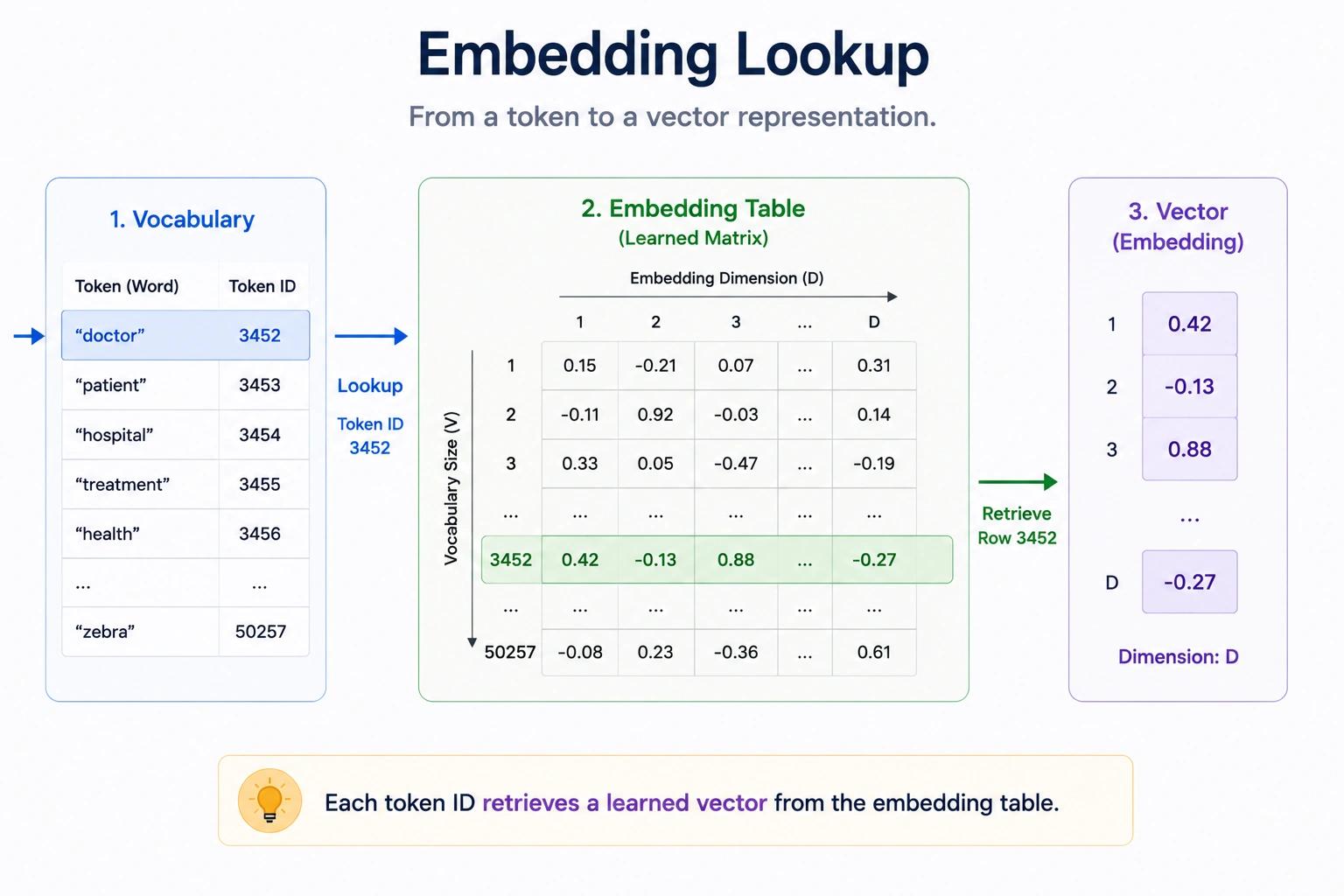
The Embedding Layer
The embedding layer is the first learned component of most transformer architectures.
You can think of it as a large lookup table.
Every token in the model's vocabulary has an associated vector stored inside this table.
When the tokenizer produces a token ID, the embedding layer retrieves the corresponding vector.
Unlike a dictionary, however, these vectors are not manually written.
They were learned during training.
Words that frequently appear in similar contexts gradually acquire similar embeddings, creating the semantic neighborhoods we've explored throughout this article.
By the time training is complete, the embedding table has become a compact map of the model's vocabulary.
Position Matters Too
Embeddings capture what each token represents.
But language also depends on where each token appears.
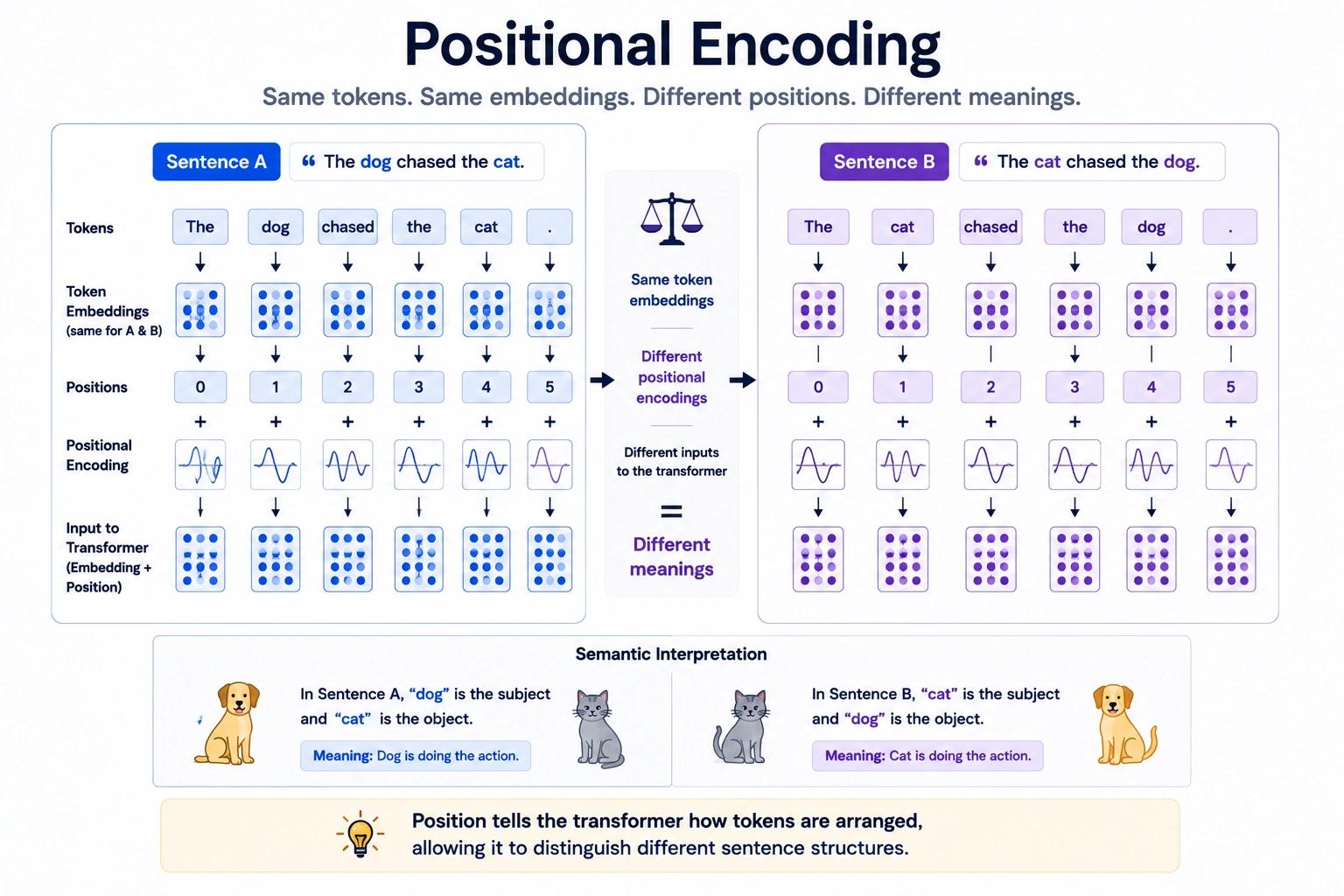
Consider these two sentences:
The dog chased the cat.
The cat chased the dog.
Both sentences contain exactly the same words.
If we looked only at token embeddings, they would appear almost identical.
Yet the meanings are completely different because the order has changed.
To solve this problem, transformers add positional information to every embedding before processing begins.
This allows the model to distinguish not only which tokens are present but also where they occur in the sequence.
Without positional information, word order would disappear entirely.
Embeddings Are Only the Beginning
At this stage, many people imagine that the transformer simply passes the same embeddings through dozens of layers until it produces an answer.
That is not what happens.
The initial embeddings are only the starting point.
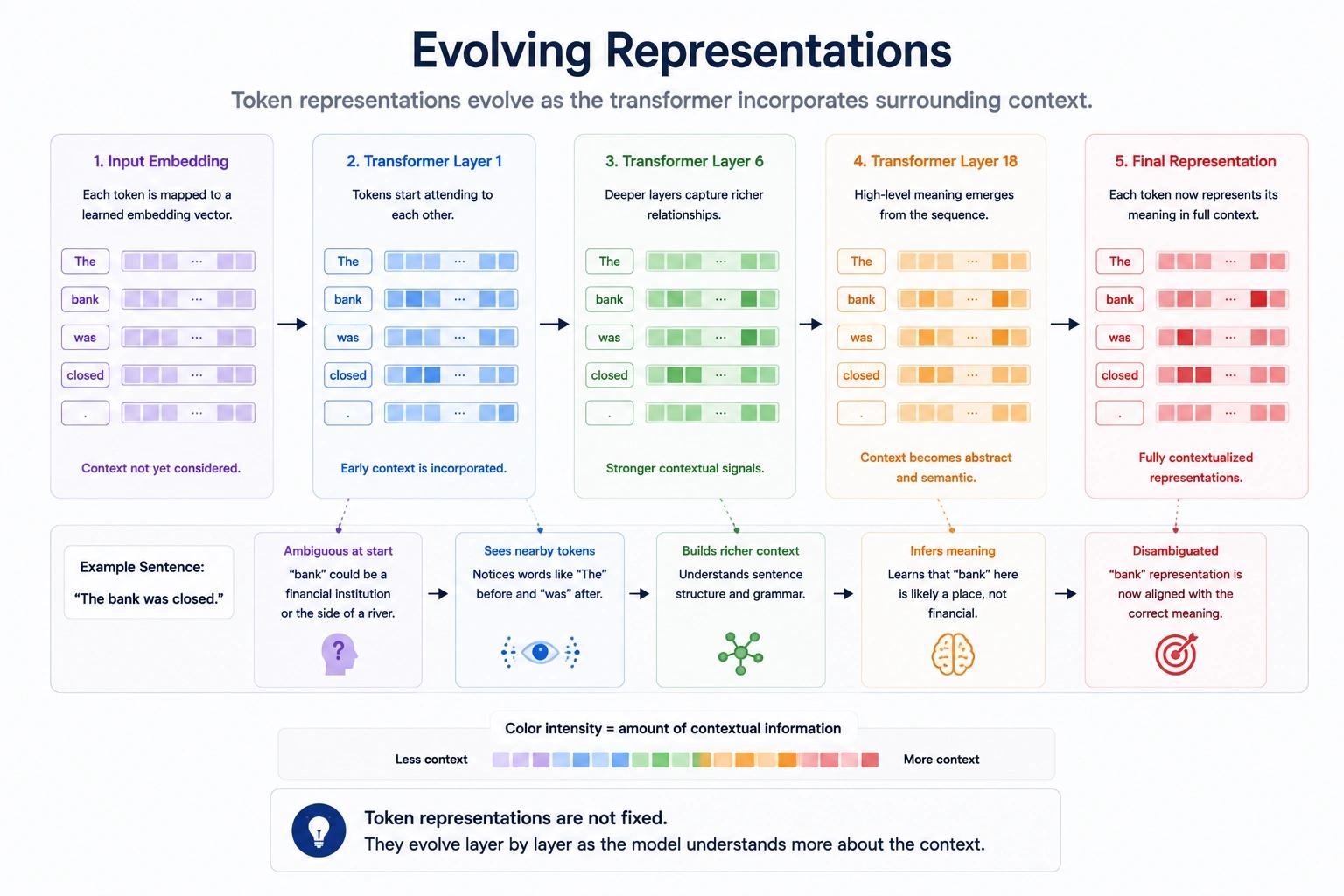
As information flows through successive attention layers, the representation of every token changes.
The embedding for the word bank at the input layer may initially be ambiguous.
After several transformer layers, the surrounding context determines whether it refers to a financial institution or the side of a river.
The vectors become increasingly contextualized.
By the final layers, they no longer represent isolated words.
They represent words in context.
From Understanding to Prediction
Once the transformer has refined these contextual representations, it performs one final task.
It predicts the most likely next token.
That prediction is converted back into a token ID, decoded into text, and presented as part of the model's response.
Every answer generated by a large language model begins with this same journey:
Text
→ Tokens
→ Embeddings
→ Contextual reasoning
→ Prediction
→ Text
Embeddings are not the reasoning process itself.
They are the language in which the reasoning process begins.
Why Embeddings Are Indispensable
Without embeddings, transformers would have no meaningful numerical representation of language to operate on.
Without transformers, embeddings would remain static maps of similarity.
Together, they form one of the defining ideas of modern artificial intelligence.
Embeddings provide the geometric foundation.
Transformers perform computation over that geometry.
The result is a system capable of translating language into mathematics, reasoning over that mathematical structure, and transforming it back into human language.
Mental Model
Embeddings are not the intelligence of a language model. They are the language in which intelligence begins.
We've now seen how embeddings power language models internally.
But many modern AI systems need more than the knowledge captured during training.
They must search external documents, company knowledge bases, research papers, and private data.
That challenge gave rise to one of the most influential architectures in modern AI:
Retrieval-Augmented Generation (RAG).
In the next section, we'll move beyond the language model itself and explore how embeddings connect transformers to external knowledge through vector databases and semantic retrieval.
10. Embeddings in Retrieval-Augmented Generation (RAG)8 min read
By now, we've seen how embeddings represent meaning and how transformers reason over those representations.
At this point, it might seem like a large language model already has everything it needs.
After all, if models like ChatGPT can answer questions about mathematics, history, programming, and science, why do we need an additional retrieval system?
The answer lies in a fundamental limitation of every large language model.
They do not have access to all knowledge.
More importantly, they cannot instantly learn new information after training.
A language model is trained on an enormous collection of data, but once that training is complete, its parameters become fixed. It cannot automatically read your company's documentation, browse today's research papers, or understand private files stored inside your organization.
This is where Retrieval-Augmented Generation, or RAG, becomes one of the most powerful ideas in modern AI.
Instead of forcing the model to memorize everything, we allow it to retrieve the most relevant information exactly when it needs it.
Embeddings make that possible.
The Knowledge Problem
Imagine asking an AI assistant:
What is our company's refund policy for enterprise customers?
Even the most capable language model cannot answer this question unless it has somehow seen that exact document during training—which, for private company data, it almost certainly has not.
The problem is not reasoning.
The problem is access.
The knowledge exists.
The model simply cannot reach it.
Rather than retraining an entire language model whenever new information appears, RAG separates two responsibilities:
- The language model focuses on reasoning and generating responses.
- The retrieval system focuses on finding relevant knowledge.
Together, they behave as though the model has access to an ever-growing memory.

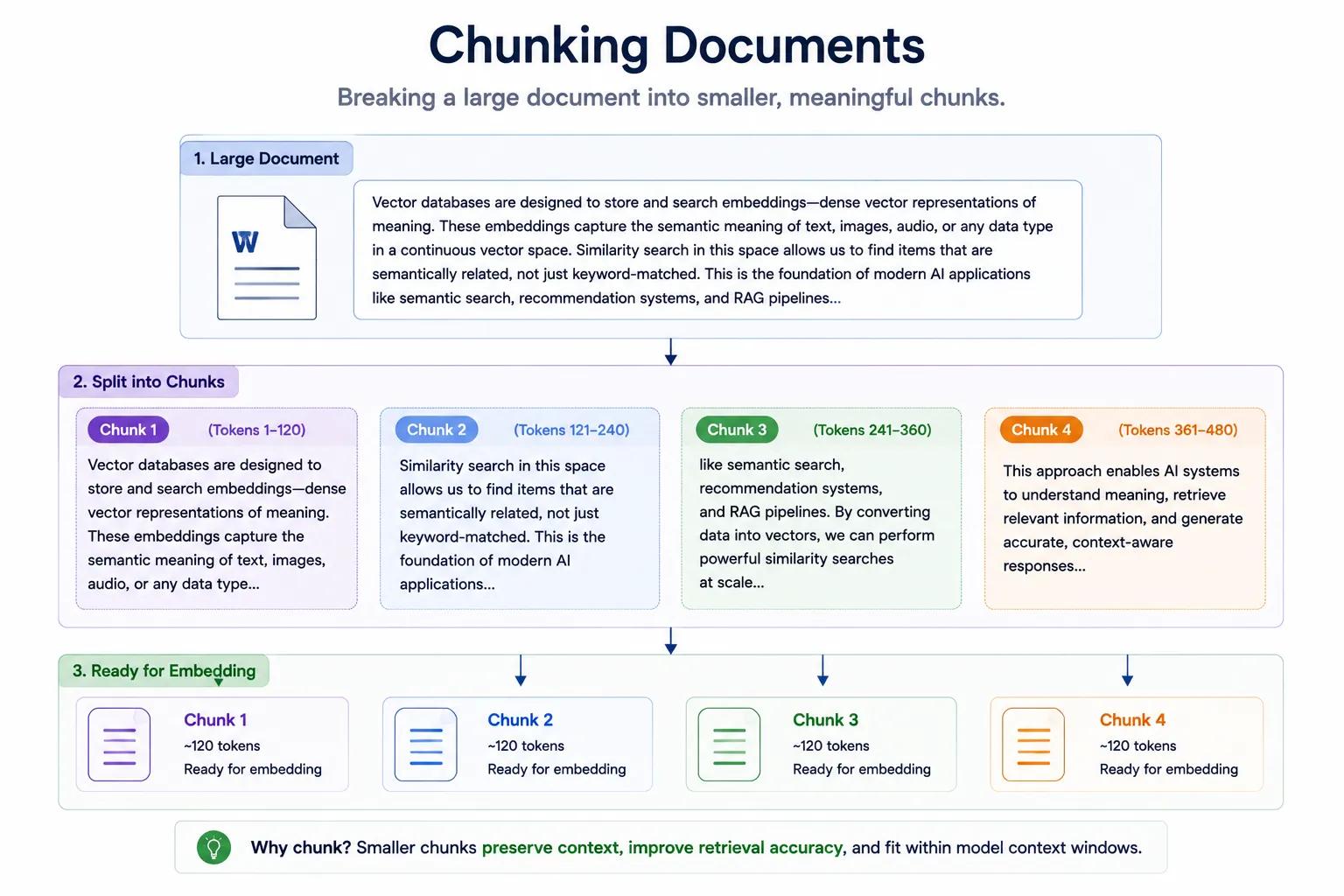
Step 1 — Breaking Documents Into Chunks
Documents rarely fit into a language model's context window all at once.
A technical manual might contain hundreds of pages.
A research paper may include dozens of sections.
An entire company knowledge base could contain millions of documents.
Searching every word every time would be inefficient.
Instead, documents are divided into smaller pieces called chunks.
A chunk might represent a paragraph, a section, or a fixed number of tokens.
Each chunk becomes an independent unit that can later be searched.
The size of these chunks has a surprisingly large impact on retrieval quality.
Chunks that are too small lose important context.
Chunks that are too large often contain unrelated information, making retrieval less precise.
Finding the right balance is an important part of building an effective RAG system.
Step 2 — Creating Embeddings
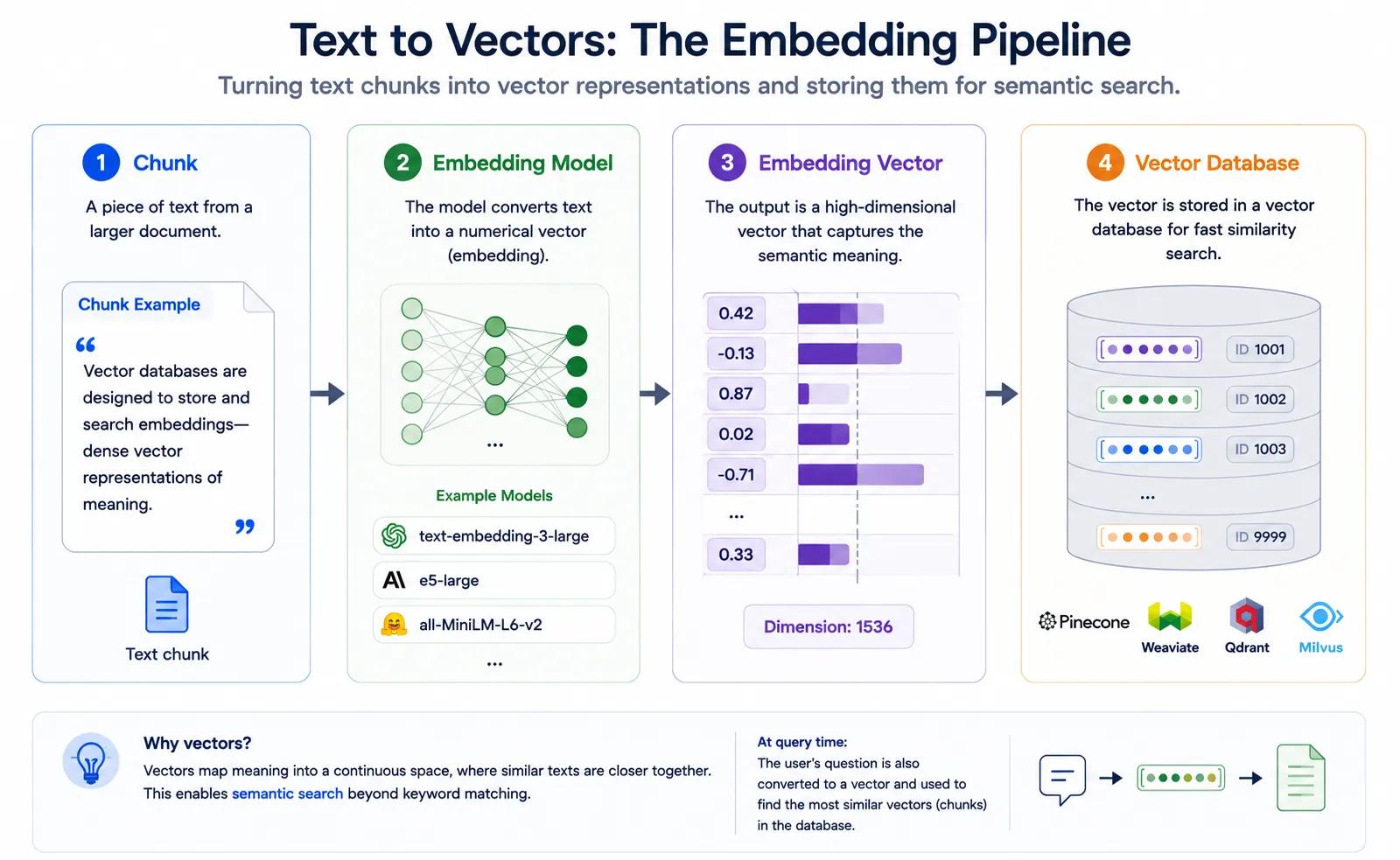
Once the documents have been divided into chunks, each chunk is passed through an embedding model.
Instead of storing raw text inside the search index, the system stores high-dimensional vectors.
These vectors preserve semantic meaning.
For example, two chunks discussing gradient descent may produce similar embeddings even if one uses the phrase optimization algorithm while the other never mentions those exact words.
The retrieval system no longer depends on matching keywords.
It searches for nearby meaning.
Step 3 — Storing the Knowledge
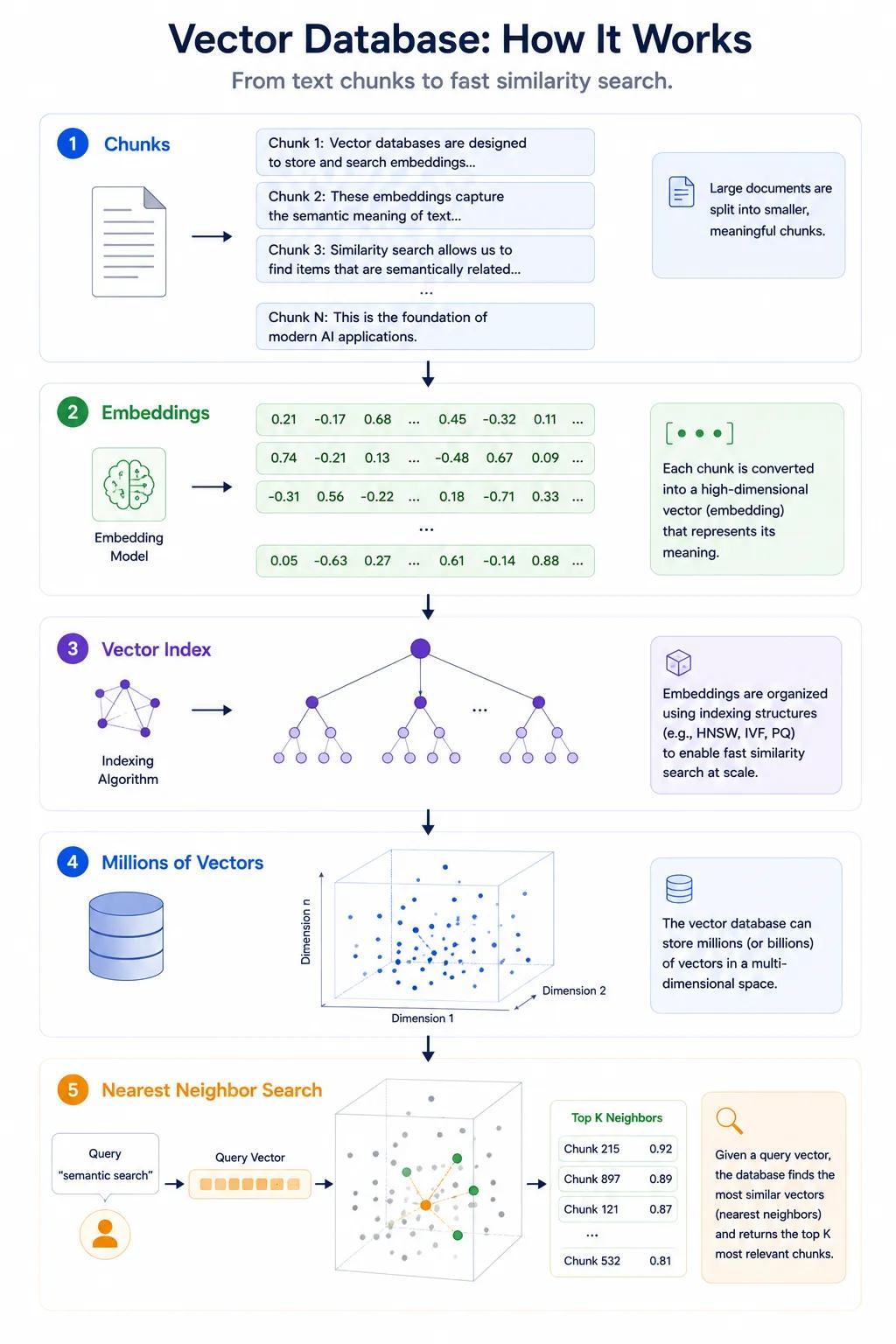
After embeddings have been generated, they are stored inside a vector database.
Unlike traditional databases that search using exact values or SQL conditions, vector databases are optimized for nearest-neighbor search.
When a new query arrives, they rapidly locate the embeddings that lie closest to the query vector.
Systems such as FAISS, HNSW, IVF, Qdrant, Pinecone, Weaviate, Milvus, and pgvector all solve this same problem using different indexing strategies.
Although their implementations differ, the underlying idea remains identical.
Search by geometry.
Not by exact words.
Step 4 — Embedding the Question
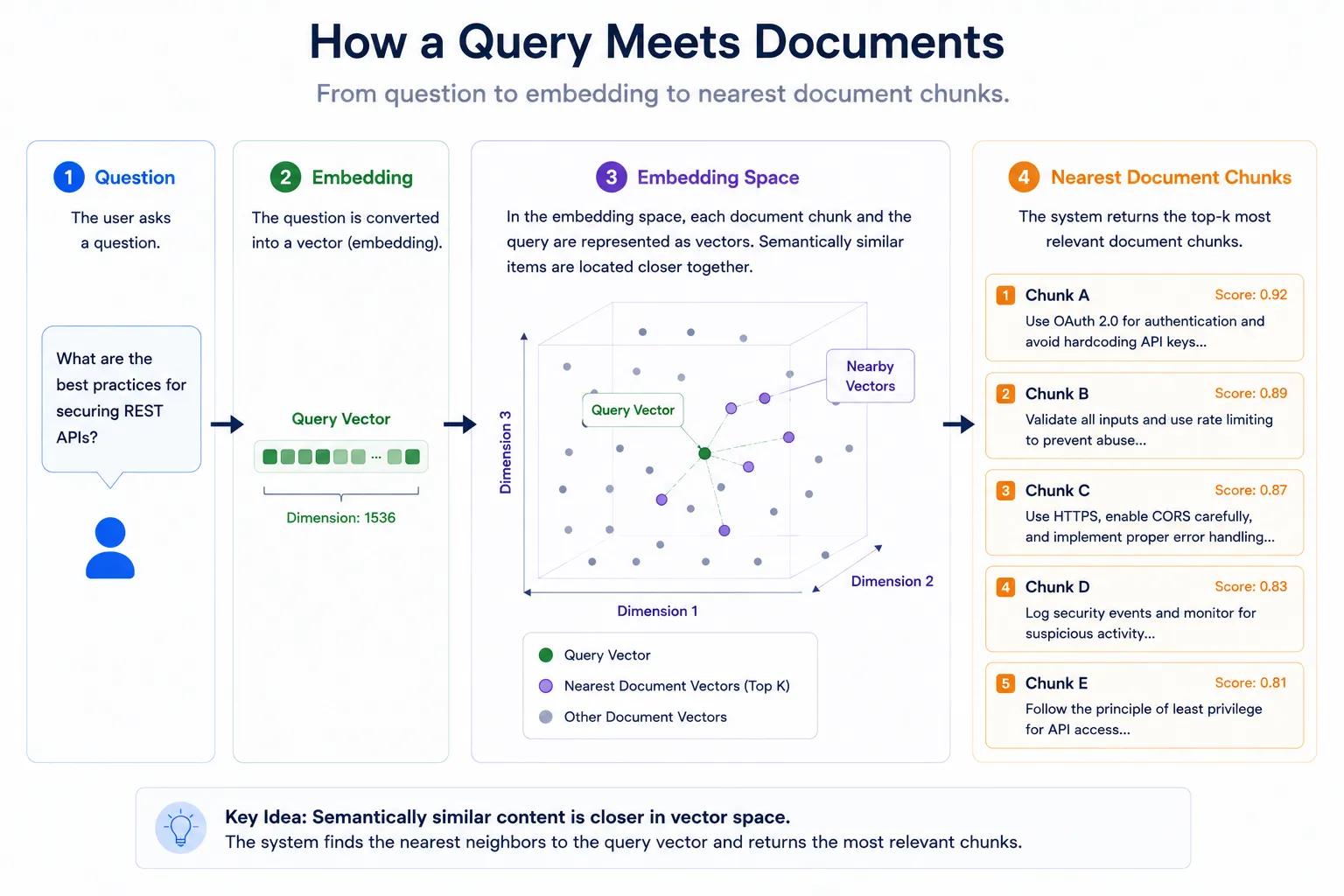
When the user asks a question, the system performs exactly the same transformation it used for the documents.
The question is converted into an embedding.
Because both the question and the documents now live inside the same embedding space, similarity becomes measurable.
Rather than comparing text directly, the retrieval engine compares vectors.
This allows semantically related documents to be found even when the wording differs significantly.
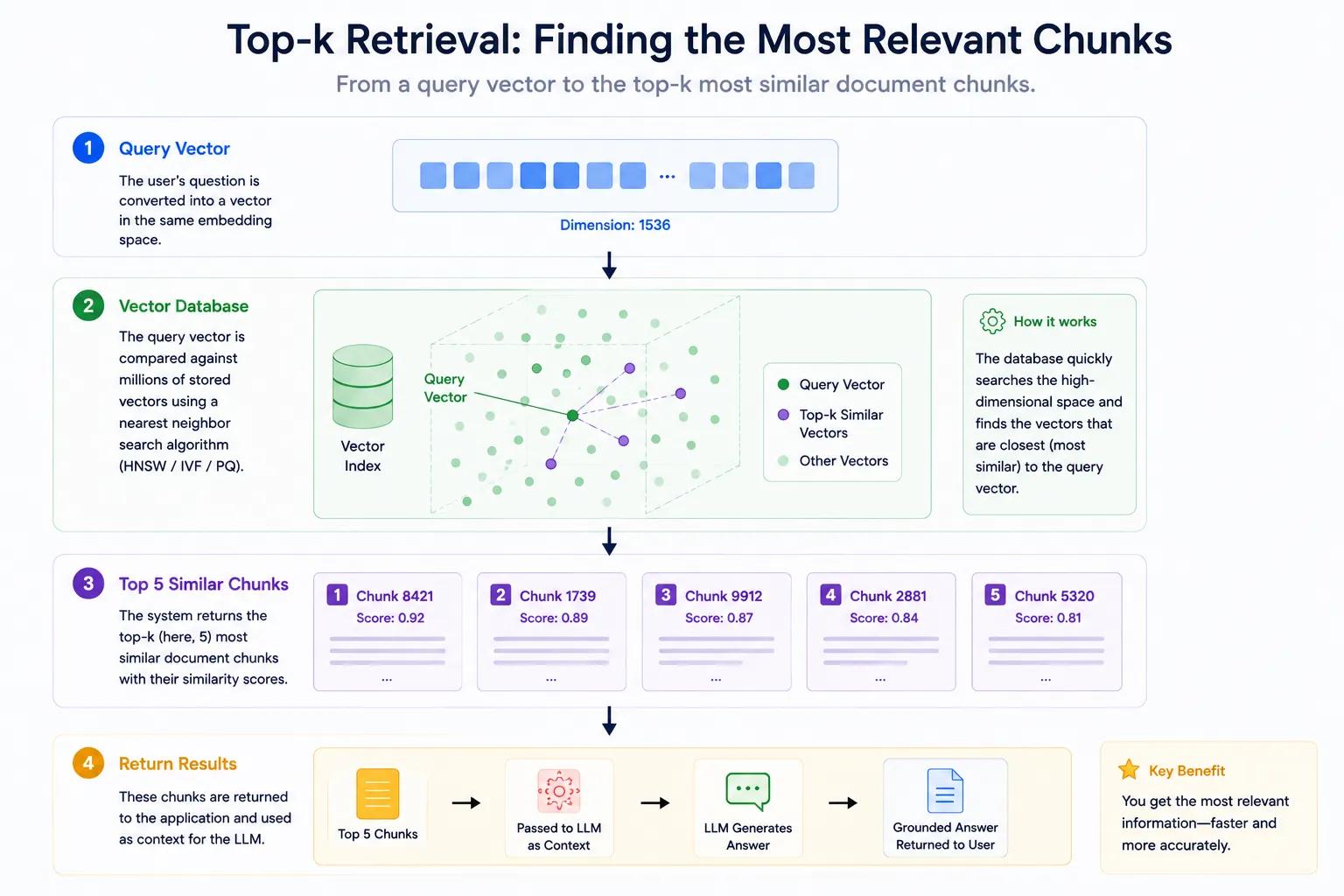
Step 5 — Retrieval
The vector database calculates similarity between the query embedding and every stored document embedding.
In practice, approximate nearest neighbor algorithms make this process extremely fast, even across hundreds of millions of vectors.
Instead of returning an entire database, the system retrieves only the most relevant chunks—often called the Top-k results.
These retrieved passages become the model's external memory for that specific question.
Step 6 — Prompt Construction
Retrieval alone does not improve the language model.
The retrieved information must still be incorporated into the prompt.
The system therefore combines:
- the user's original question,
- the retrieved document chunks,
- any system instructions,
- conversation history (if applicable),
into a single prompt.
This step is sometimes called context construction or prompt augmentation.
It gives the language model access to information that never existed inside its parameters.

Step 7 — Grounded Generation
Only after retrieval is complete does the language model begin generating an answer.
Unlike a standard LLM, which relies entirely on learned parameters, a RAG system grounds its response in retrieved evidence.
If the retrieval step succeeds, the generated answer is more likely to be:
- factually accurate,
- up to date,
- domain specific,
- traceable to source documents.
The language model is no longer answering from memory alone.
It is answering from retrieved knowledge.

Putting It All Together
Although RAG systems contain many moving parts, the overall workflow is surprisingly elegant.
Knowledge is transformed into embeddings.
Questions become embeddings.
Similarity search finds relevant information.
That information is provided to the language model.
The language model reasons over retrieved knowledge instead of relying solely on its internal memory.
Every component we explored throughout this article now comes together in a single architecture.
Embeddings.
Similarity search.
Vector databases.
Transformers.
Prompt construction.
Together, they form the foundation of modern enterprise AI.

Mental Model
RAG doesn't make a language model smarter. It gives the model access to the right information at the right time.
So far, we've focused on how embeddings work.
But not all embedding models are the same.
Some are optimized for semantic search.
Others excel at multilingual retrieval.
Some are lightweight enough to run on a laptop, while others are designed for large-scale production systems.
Choosing the right embedding model can dramatically influence retrieval quality, latency, and cost.
In the next section, we'll explore the most widely used embedding models today, how they differ, and when you should choose one over another.
11. Choosing an Embedding Model8 min read
By this point, we've seen that embeddings lie at the heart of semantic search, recommendation systems, retrieval-augmented generation, and modern language models.
But one important question remains.
Where do these embeddings actually come from?
The answer is surprisingly straightforward.
Just as there are many different large language models, there are also many different embedding models.
Each model is trained with a different objective.
Some are optimized for semantic search.
Others specialize in multilingual understanding.
Some prioritize retrieval accuracy.
Others focus on speed, cost, or the ability to run locally.
Choosing an embedding model is therefore not about finding a universally "best" model.
It is about selecting the model that best matches your application.
What Is an Embedding Model?
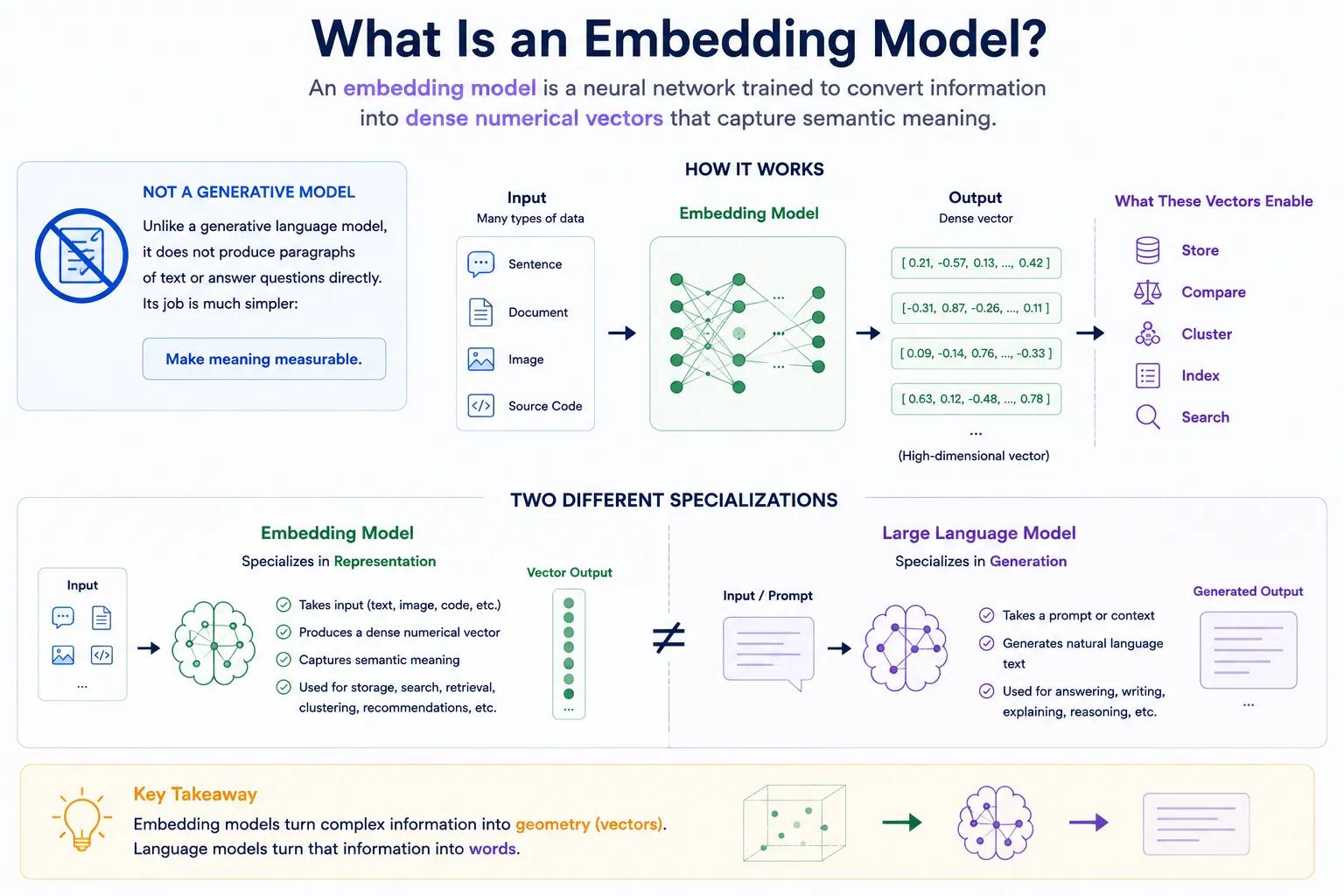
An embedding model is a neural network trained to convert information into dense numerical vectors.
Unlike a generative language model, it does not produce paragraphs of text or answer questions directly.
Its job is much simpler.
Given an input—such as a sentence, document, image, or piece of source code—it produces a vector that captures the semantic meaning of that input.
Once those vectors have been created, they can be stored, compared, clustered, indexed, or searched.
In many production AI systems, the embedding model and the language model are completely separate components.
One specializes in representation.
The other specializes in generation.
General-Purpose Embedding Models
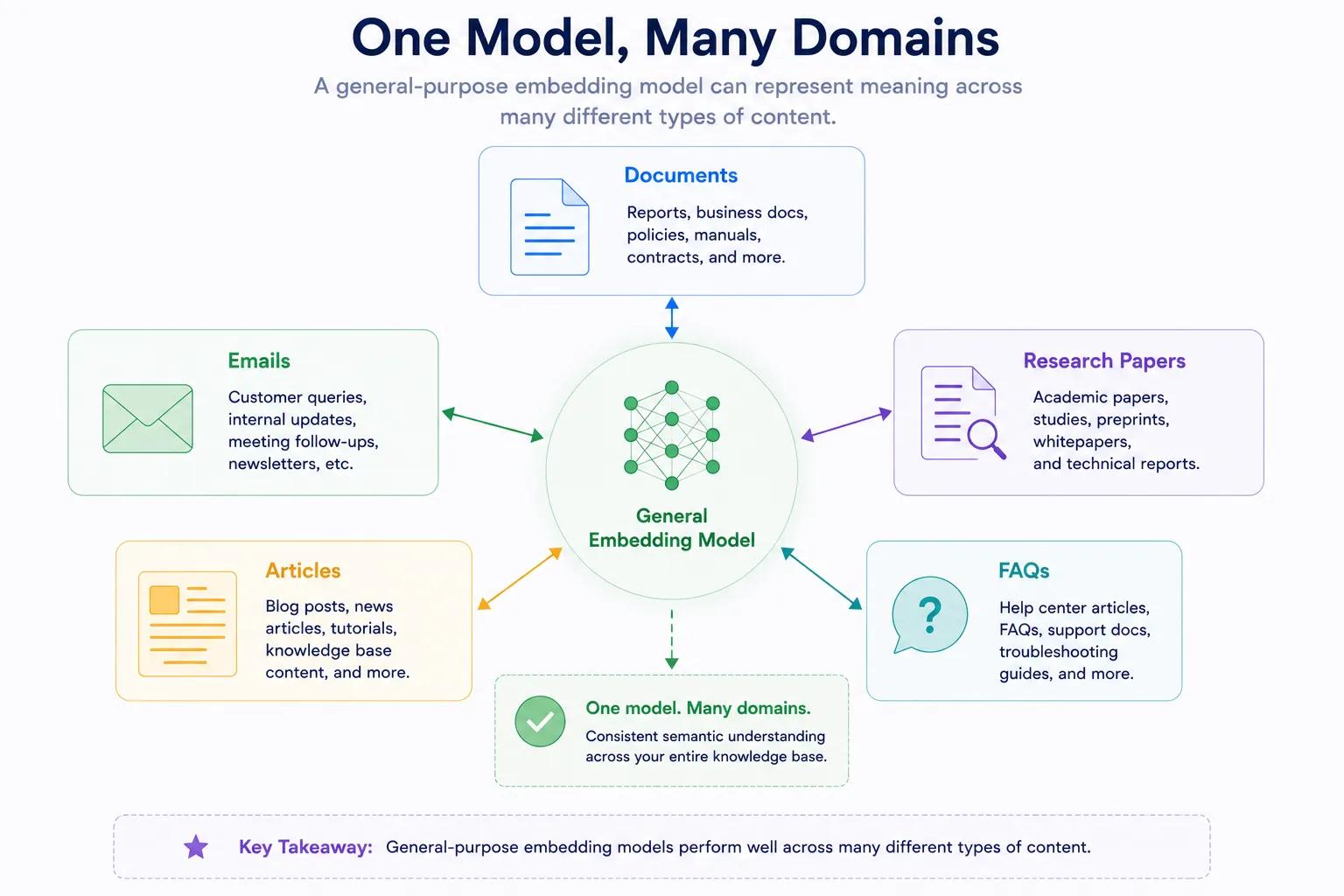
For many applications, a general-purpose embedding model is the right starting point.
These models are trained on diverse collections of text covering many different topics.
As a result, they perform well across a wide range of tasks without requiring domain-specific training.
If you are building semantic search, document retrieval, question answering, or a basic RAG system, a general-purpose model is often sufficient.
Their biggest advantage is versatility.
Rather than optimizing for one particular domain, they aim to represent meaning consistently across many different kinds of text.
Retrieval-Optimized Models
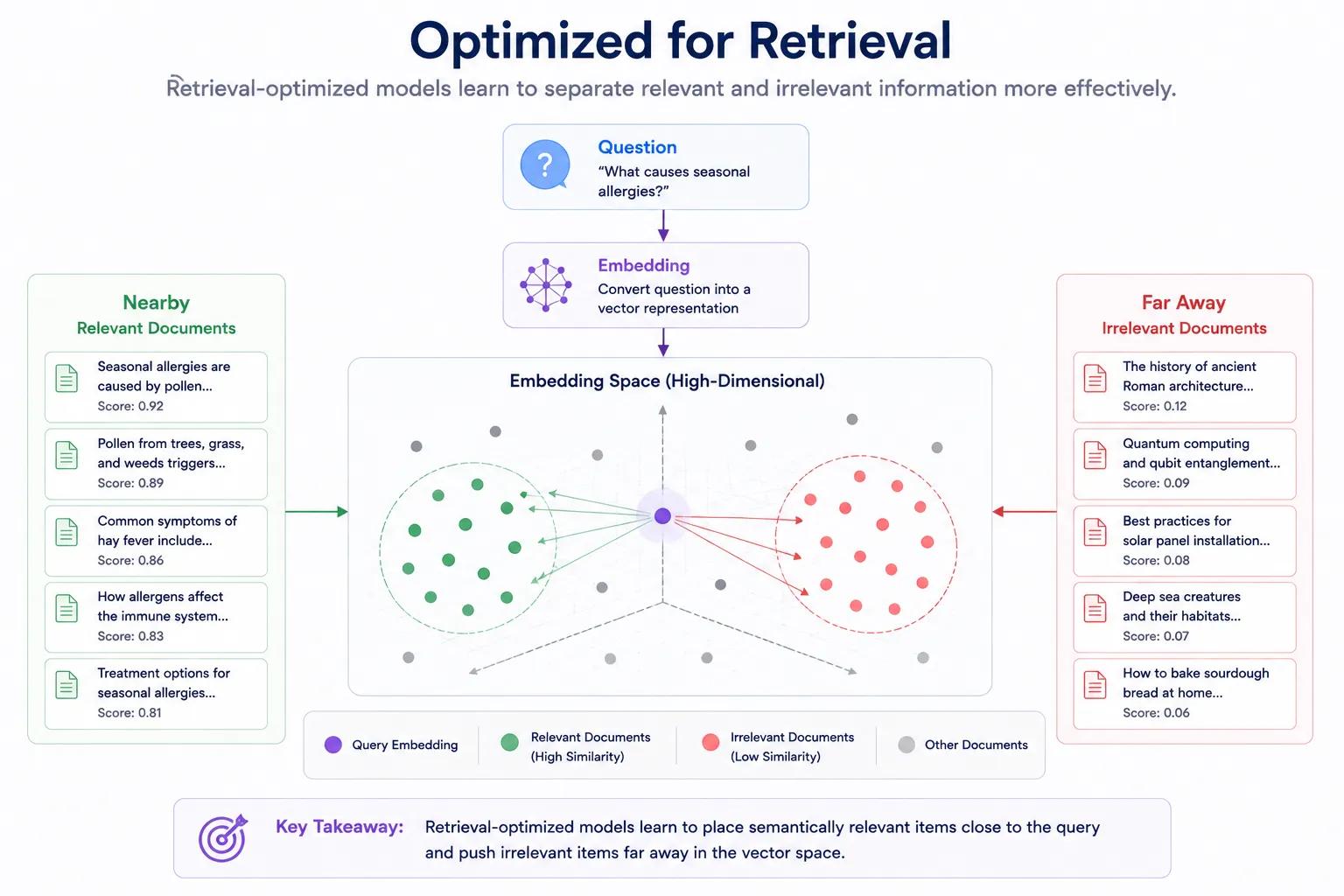
Not every embedding model is trained for search.
Some models are specifically optimized to improve retrieval quality.
During training, these models learn to place questions close to relevant documents while pushing unrelated documents farther away.
This produces embeddings that perform exceptionally well for semantic search and retrieval-augmented generation.
If your primary goal is finding the most relevant passages from a large collection of documents, retrieval-optimized models are often the strongest choice.
Rather than maximizing general semantic understanding, they maximize retrieval performance.
Multilingual Models
Modern applications rarely operate in a single language.
A customer support system might receive English, Spanish, Hindi, Japanese, or Arabic queries within the same day.
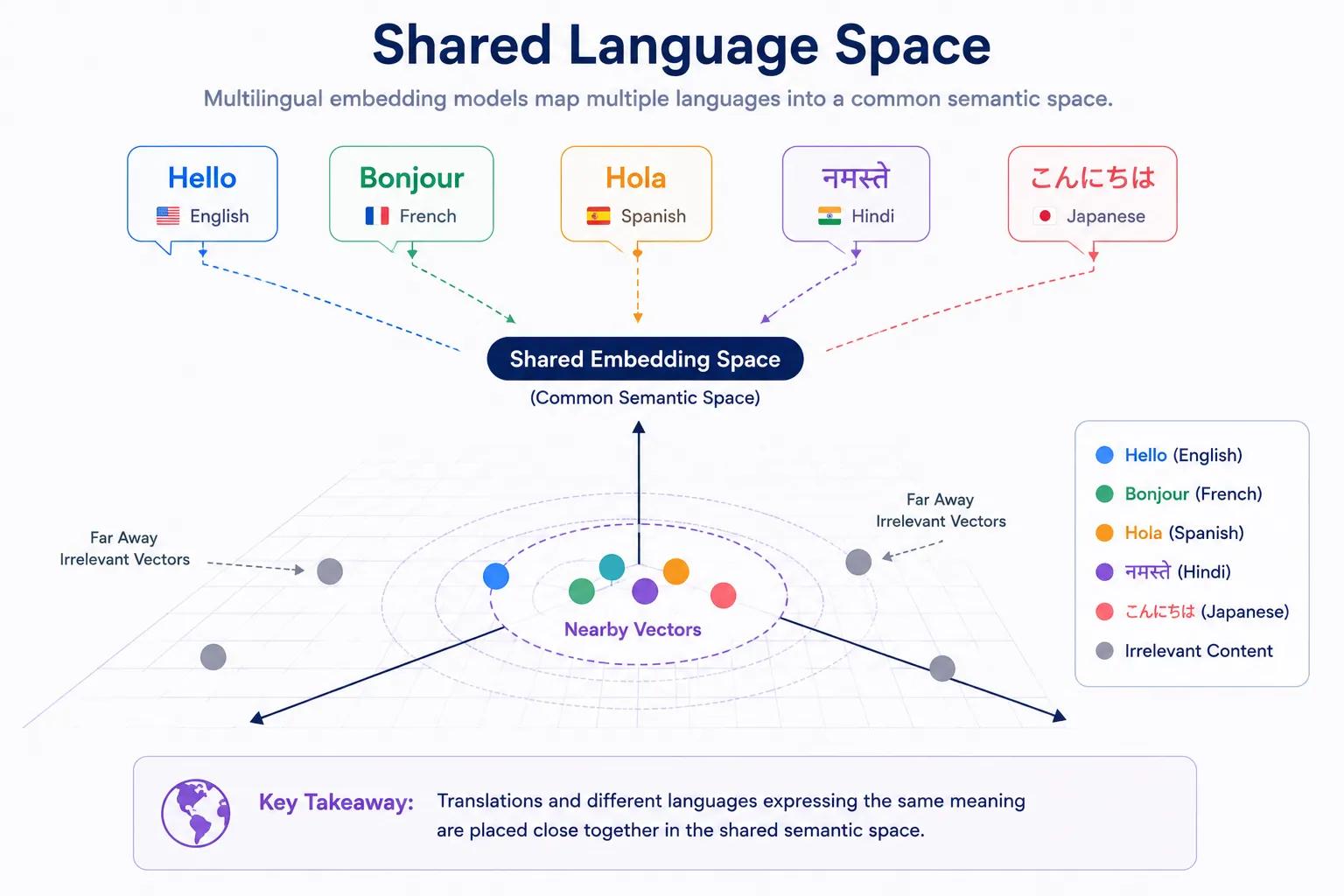
Multilingual embedding models solve this challenge by learning a shared semantic space across many languages.
Instead of treating each language independently, they attempt to position translations of the same idea near one another.
That means an English question can retrieve a French document if both describe the same concept.
The words differ.
The meaning remains close.
Open-Source Models
Many organizations prefer to run embedding models entirely on their own infrastructure.
Open-source models make this possible.
Instead of calling a hosted API, companies can deploy embedding models locally, ensuring greater privacy, lower latency, and complete control over their data.
This is particularly valuable in healthcare, finance, government, and enterprise environments where sensitive information cannot easily leave internal systems.
The trade-off is operational complexity.
Running models locally requires hardware, infrastructure, and ongoing maintenance.

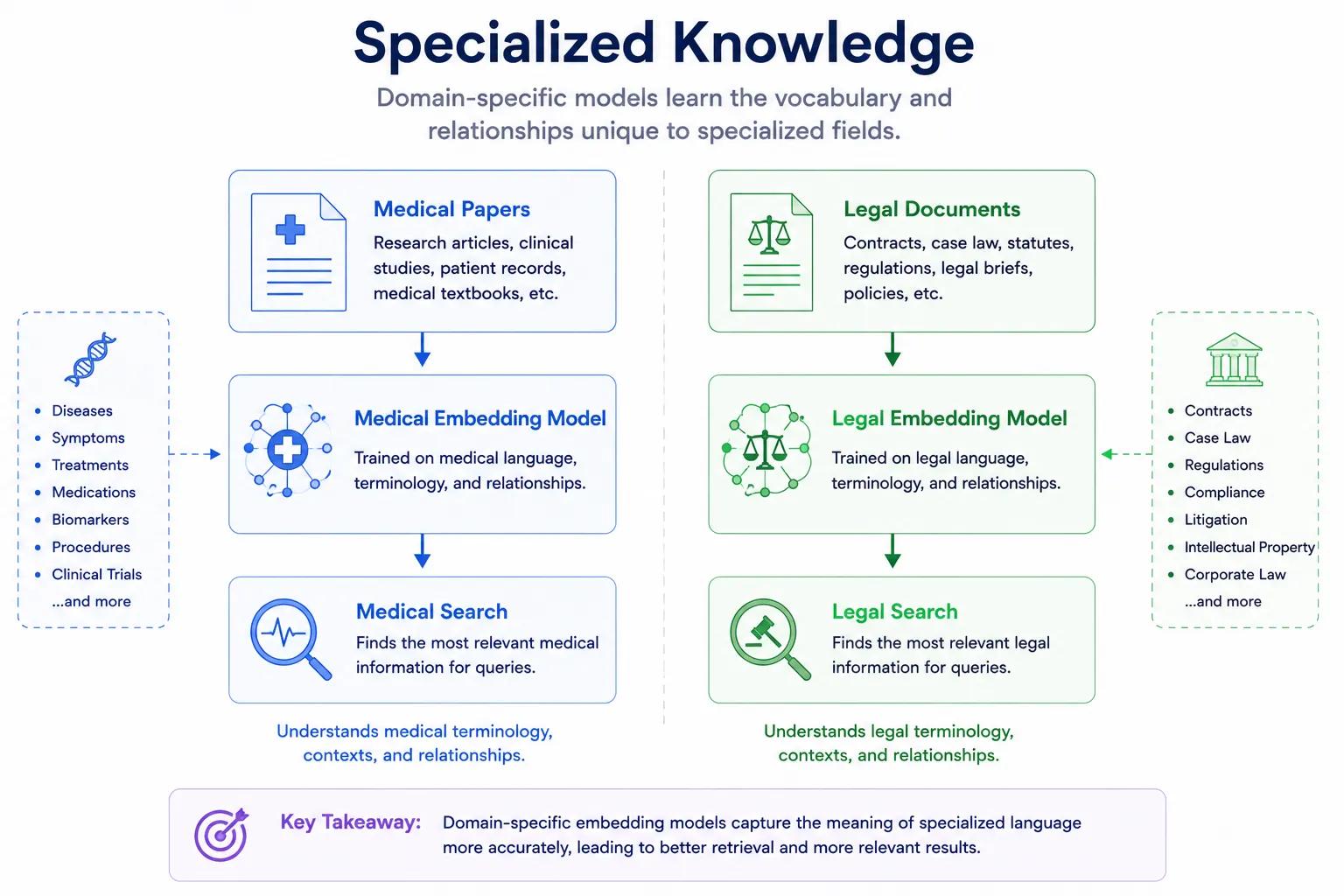
Domain-Specific Models
General-purpose models perform well on everyday language.
But specialized industries often use terminology that differs dramatically from ordinary text.
Medical research.
Legal contracts.
Financial reports.
Protein sequences.
Source code.
These domains sometimes benefit from embedding models trained on highly specialized datasets.
Because they understand the language of a particular field, they often retrieve more relevant results than general-purpose alternatives.
Popular Embedding Models
Although new models appear regularly, several families have become widely adopted across industry and research.
Each has its own strengths and ideal use cases.
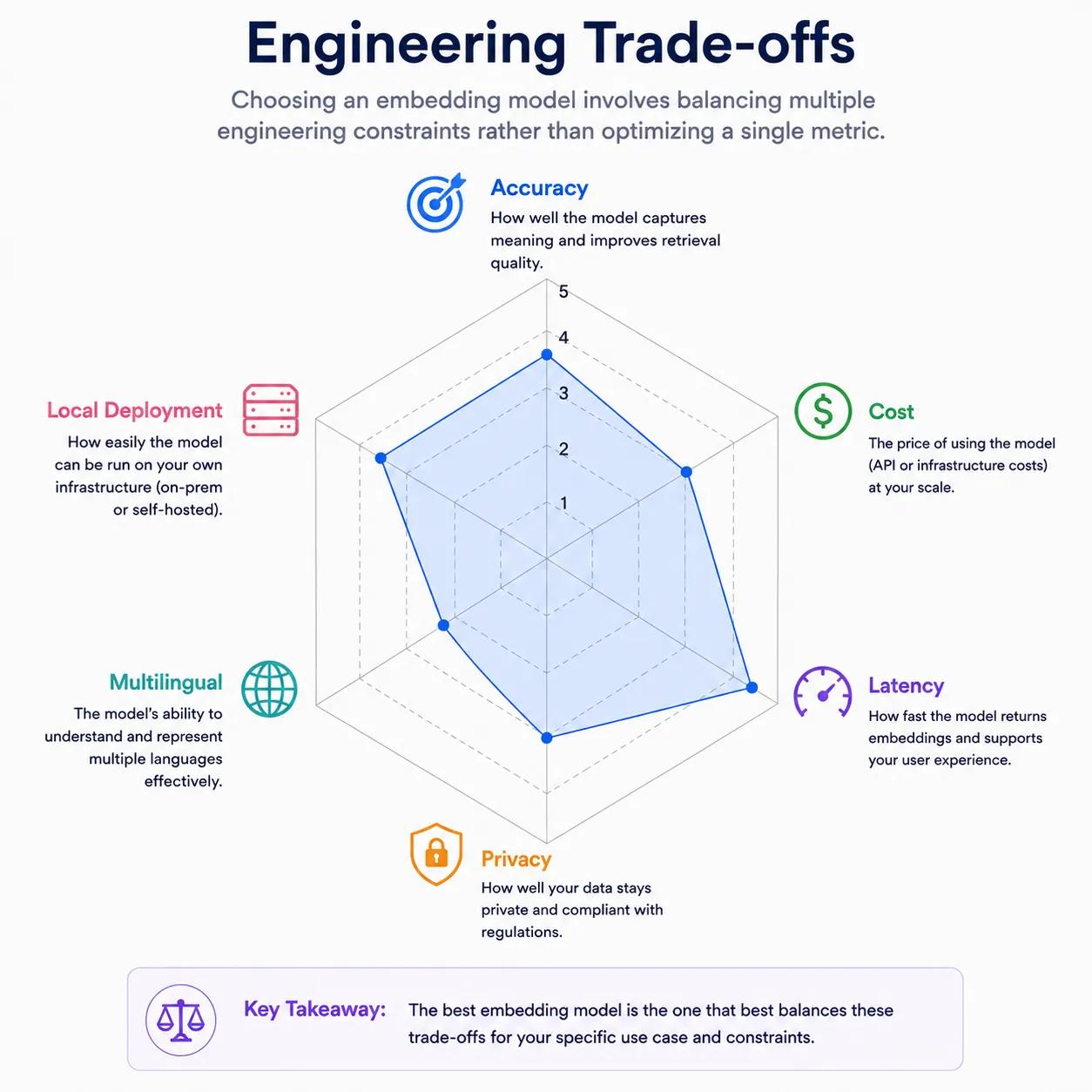
Rather than thinking of these models as competitors with a single winner, it is often more useful to think of them as tools optimized for different engineering constraints.

How Should You Choose?
When selecting an embedding model, there are several practical questions worth asking.
- How much retrieval accuracy do you need?
- Will the model run locally or through an API?
- Does your application need multilingual support?
- How important are latency and inference cost?
- Is your data highly specialized?
- How large is your document collection?
- How frequently will embeddings need to be regenerated?
There is rarely a universally correct answer.
The right choice depends on the balance between accuracy, cost, speed, privacy, and operational simplicity.
One Principle Matters Most
Despite their differences, every embedding model ultimately serves the same purpose.
They transform complex information into geometry.
Once that transformation has taken place, everything we've explored throughout this article becomes possible.
Similarity search.
Retrieval.
Recommendation systems.
Vector databases.
Large language models.
The quality of those downstream systems depends heavily on the quality of the embeddings they begin with.
Choosing an embedding model is therefore one of the most important design decisions in any AI application.
Mental Model
The best embedding model isn't the one with the highest benchmark. It's the one that best fits your data, your infrastructure, and your application.
So far, embeddings have seemed almost magical.
They organize meaning into geometry.
They power semantic search.
They enable recommendation systems, RAG pipelines, and large language models.
But like every representation, embeddings have limitations.
They can inherit bias.
They can struggle with unfamiliar domains.
They sometimes confuse subtle meanings or fail when context changes dramatically.
Understanding these limitations is just as important as understanding their strengths.
In the next section, we'll explore where embeddings break down, why those failures occur, and how modern AI systems attempt to overcome them.
12. The Limitations of Embeddings8 min read
By now, embeddings might seem almost magical.
They transform words into vectors, organize meaning into geometry, power semantic search, enable recommendation systems, and allow language models to retrieve information from enormous knowledge bases.
It's easy to conclude that if two concepts are represented mathematically, then the representation must perfectly capture their meaning.
But that isn't true.
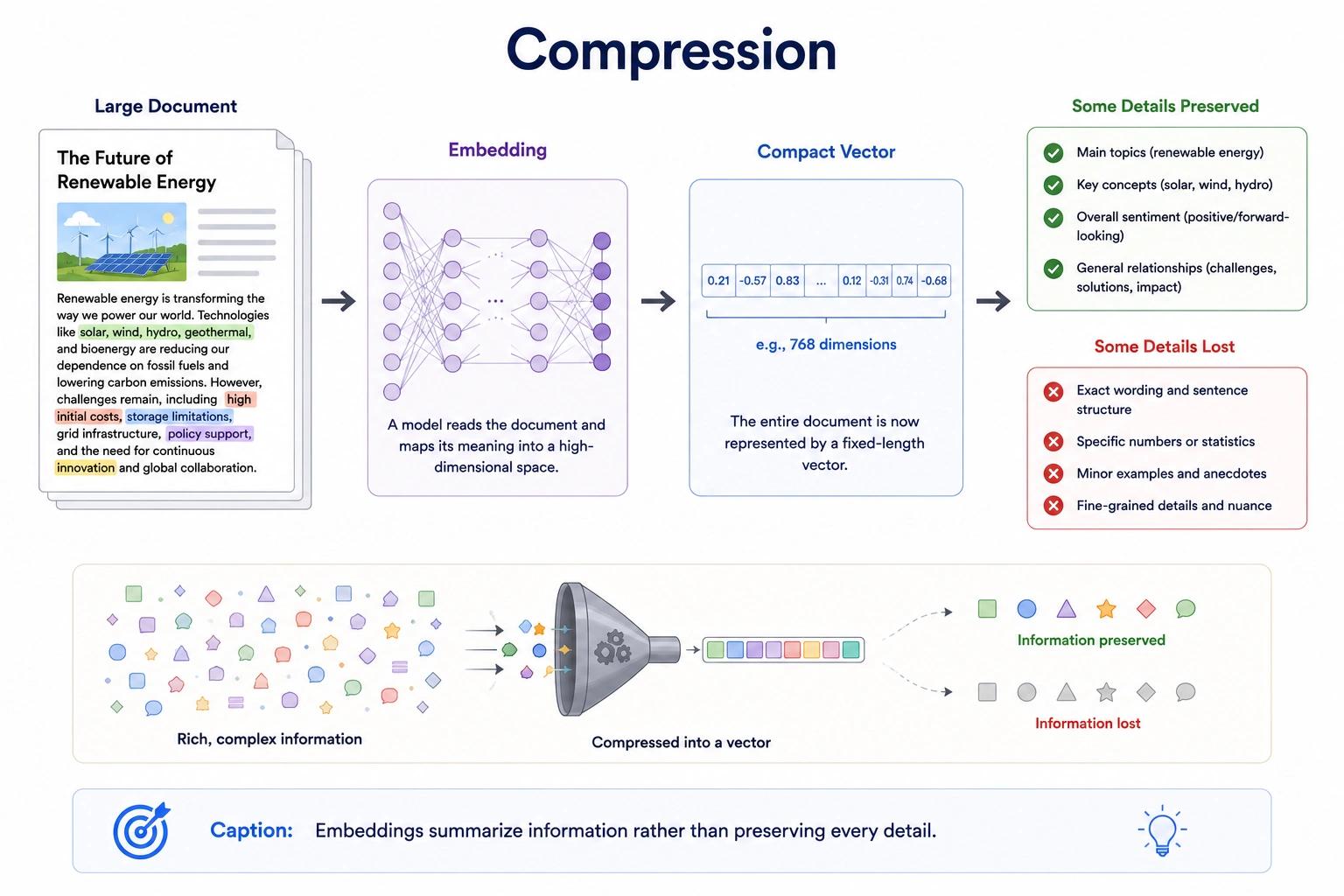
An embedding is a compressed representation of information.
Like every compression technique, it preserves what it considers important while inevitably discarding some details.
That trade-off is what makes embeddings practical. Instead of storing every nuance of language, they summarize meaning into a fixed-length vector that can be searched efficiently. The result is remarkably powerful, but it is never a complete representation of reality.
Understanding these limitations helps explain why even the best AI systems sometimes retrieve the wrong document, misunderstand a question, or struggle in unfamiliar domains.
Embeddings Are Approximations, Not Definitions
When people first learn about embeddings, they often imagine that every concept occupies one perfect location inside the embedding space.
Reality is much messier.
Human language is filled with ambiguity, metaphor, sarcasm, cultural references, and constantly evolving meanings. A fixed vector cannot capture every possible interpretation of a concept simultaneously.
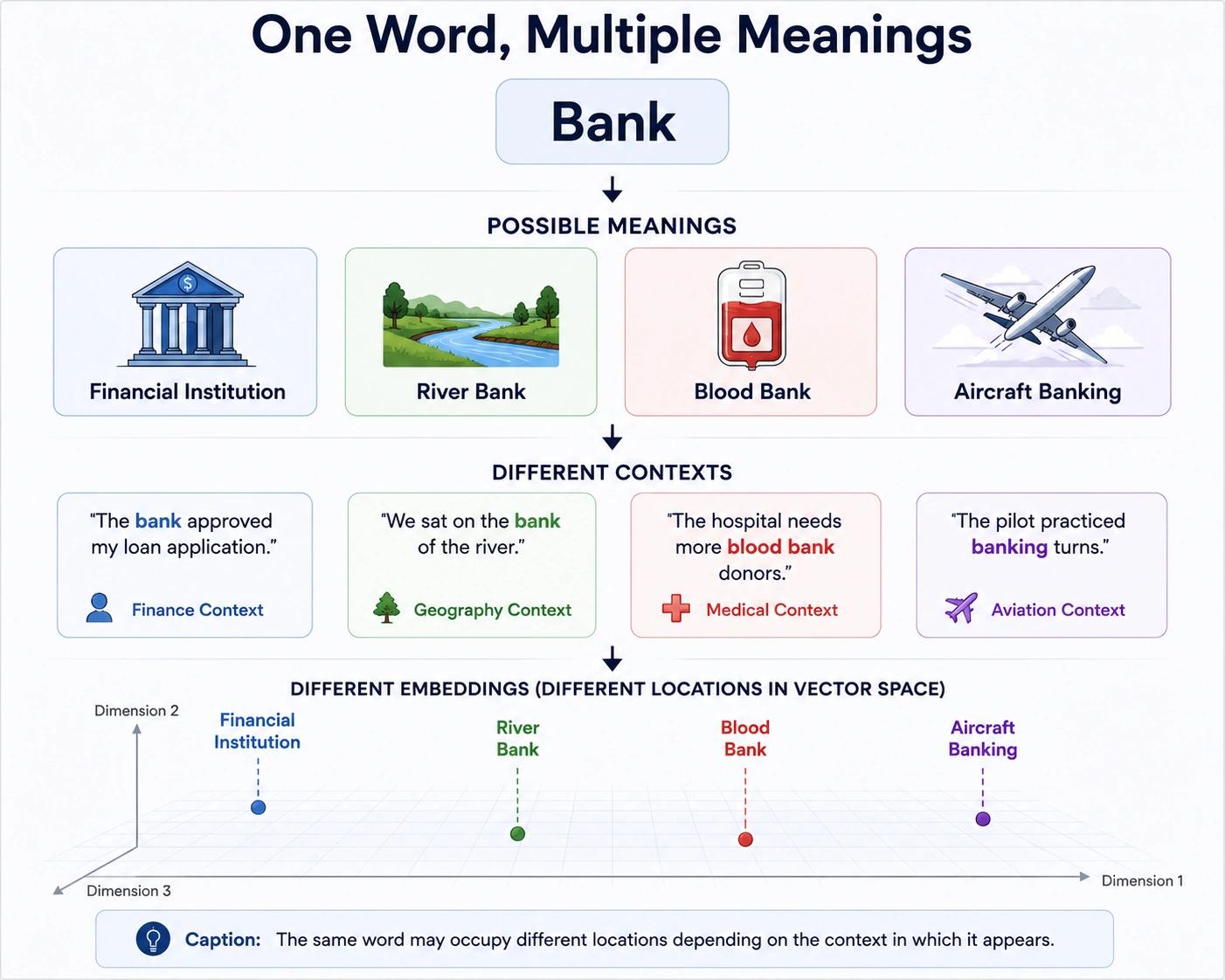
Consider the word "bank."
Without additional context, it could refer to a financial institution, the side of a river, a storage of resources such as a blood bank, or even the act of tilting an airplane during flight.
Modern contextual embedding models reduce this ambiguity considerably, but they still depend on the surrounding information to determine which meaning is most likely.
An embedding therefore represents the model's best approximation of meaning—not an absolute definition.
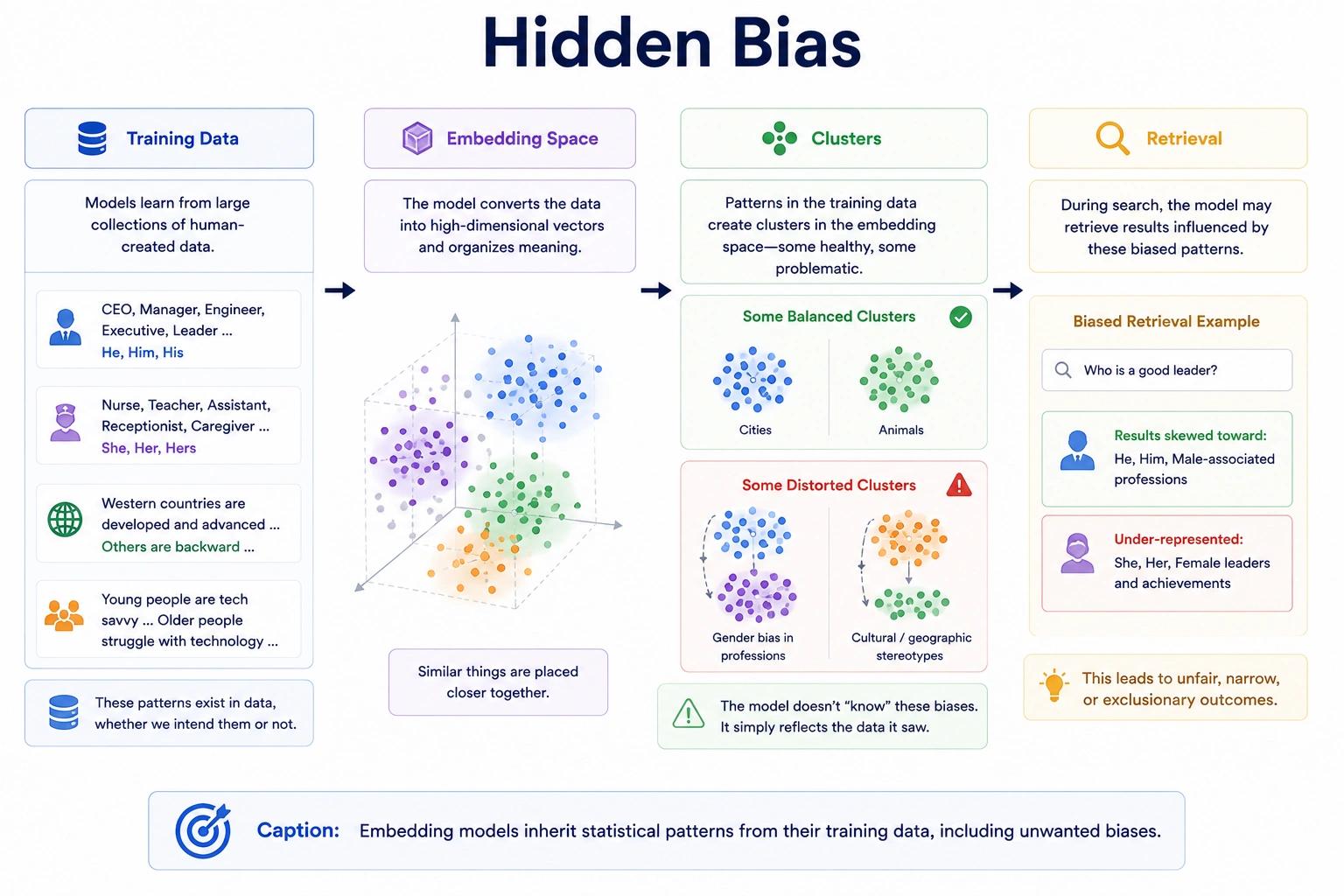
Bias Hidden Inside Geometry
Embedding models learn from enormous collections of human-created data.
Those datasets contain knowledge, but they also contain historical assumptions, cultural stereotypes, and societal biases.
Because embeddings are learned from statistical patterns rather than explicit rules, they may unintentionally encode these biases inside the geometry of the embedding space.
For example, if a training dataset consistently associates certain professions with one demographic more often than another, nearby regions of the embedding space may begin reflecting those same associations.
The model is not intentionally making a judgment.
It is reproducing statistical patterns that existed in its training data.
This is one reason why responsible AI systems often include bias evaluation, dataset curation, and safety testing before deployment.
Domain Mismatch
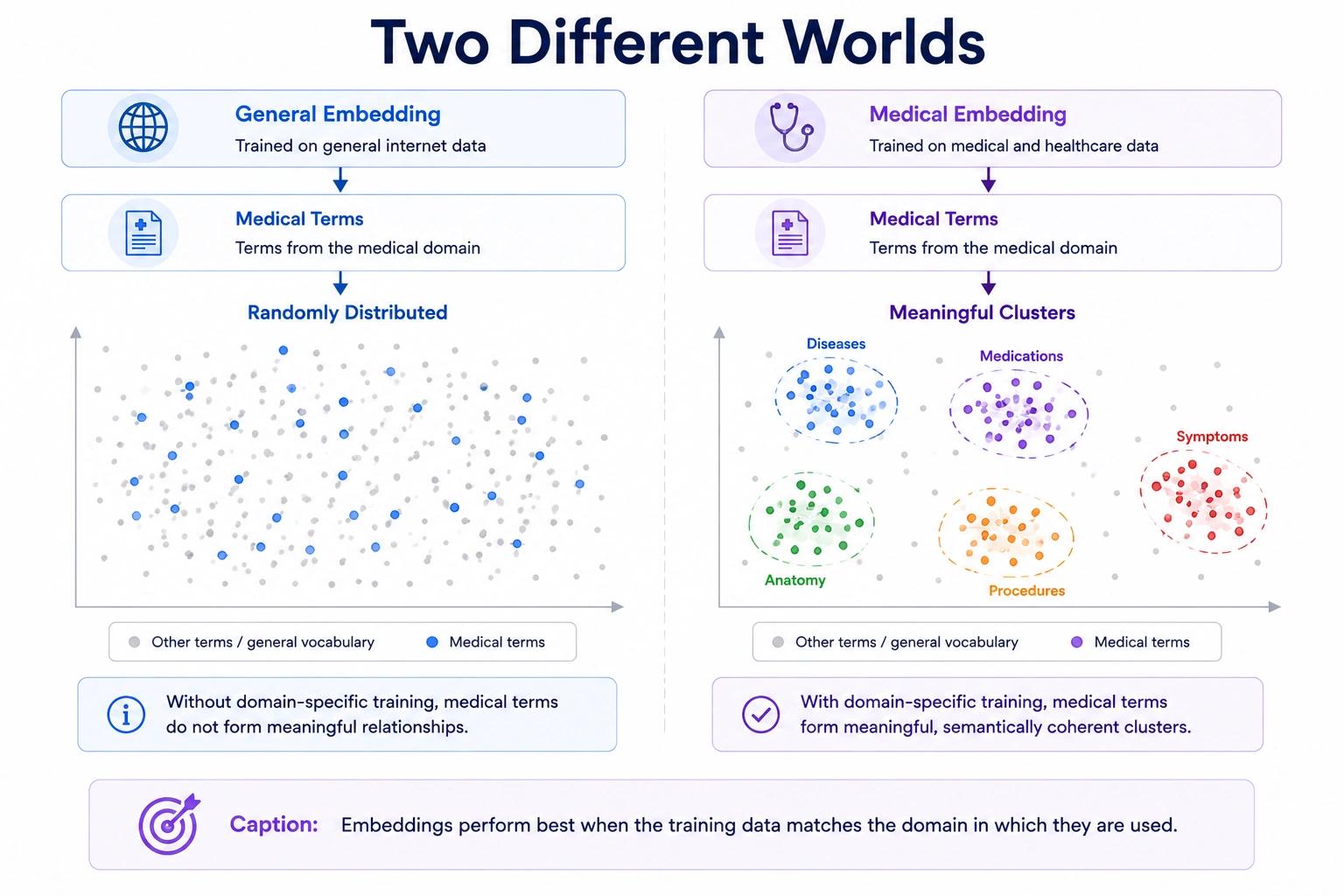
An embedding model trained on general internet text performs remarkably well across everyday language.
However, specialized fields often use terminology that differs significantly from common usage.
Medical research.
Patent law.
Genomics.
Financial regulation.
Materials science.
These domains contain concepts, abbreviations, and relationships that may appear rarely—or not at all—in general training data.
As a result, a general-purpose embedding model may position highly specialized concepts incorrectly because it has never developed a strong understanding of their relationships.
This is one reason domain-specific embedding models often outperform general-purpose alternatives in specialized applications.
The problem is not that the embeddings are incorrect.
The problem is that they were trained to represent a different world.
Knowledge Changes Faster Than Models
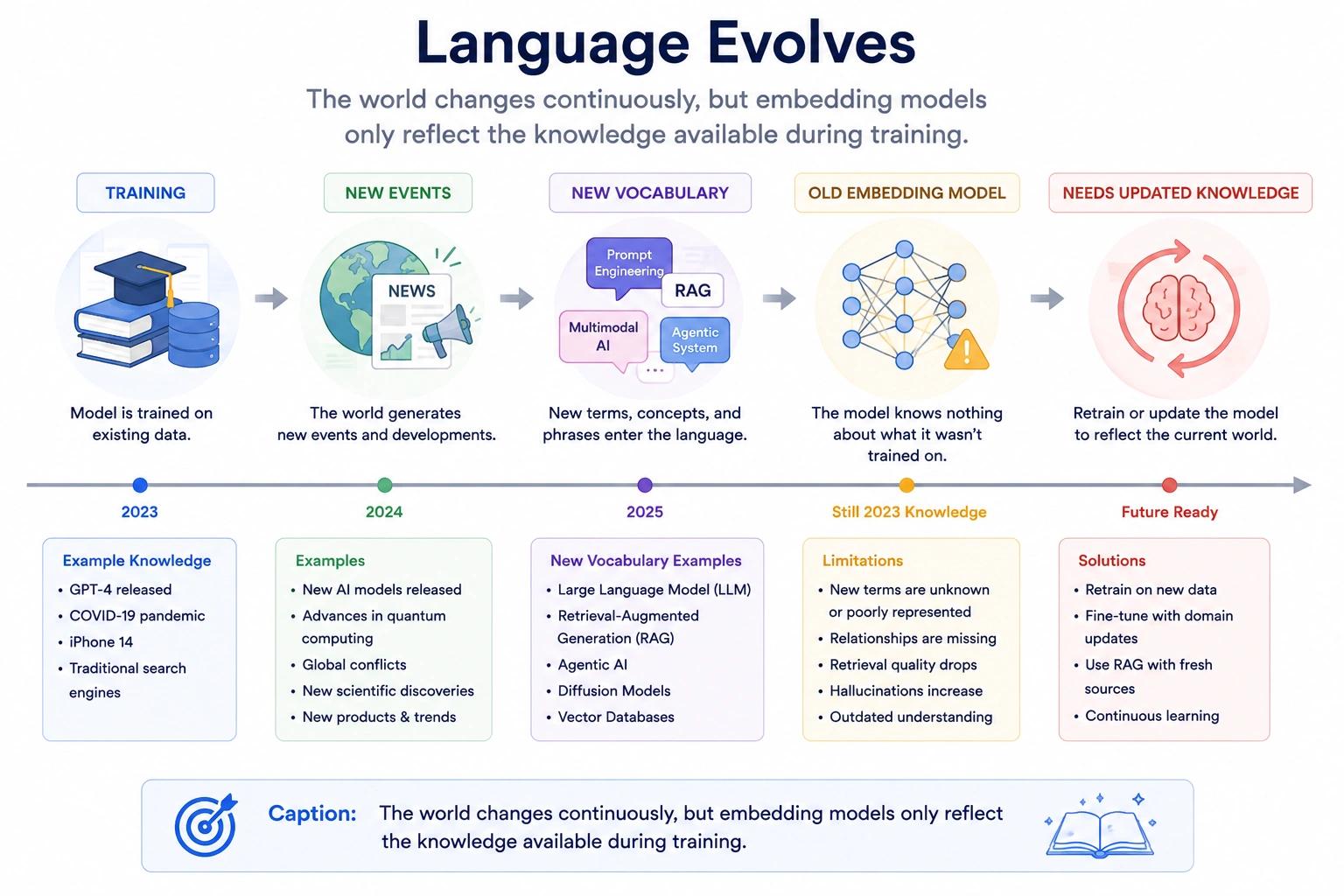
Language evolves continuously.
New technologies emerge.
Companies change names.
Scientific discoveries reshape established theories.
Entire industries can develop new vocabulary within months.
Embedding models, however, only know what they learned during training.
Once training is complete, the embedding space becomes relatively fixed until the model is retrained or replaced.
A query about a newly released programming framework or a recent scientific breakthrough may therefore produce embeddings that lack the relationships necessary for accurate retrieval.
This challenge is one of the reasons retrieval-augmented generation has become so important.
Rather than relying entirely on static knowledge, modern systems retrieve current information from external documents before generating an answer.
Out-of-Distribution Inputs
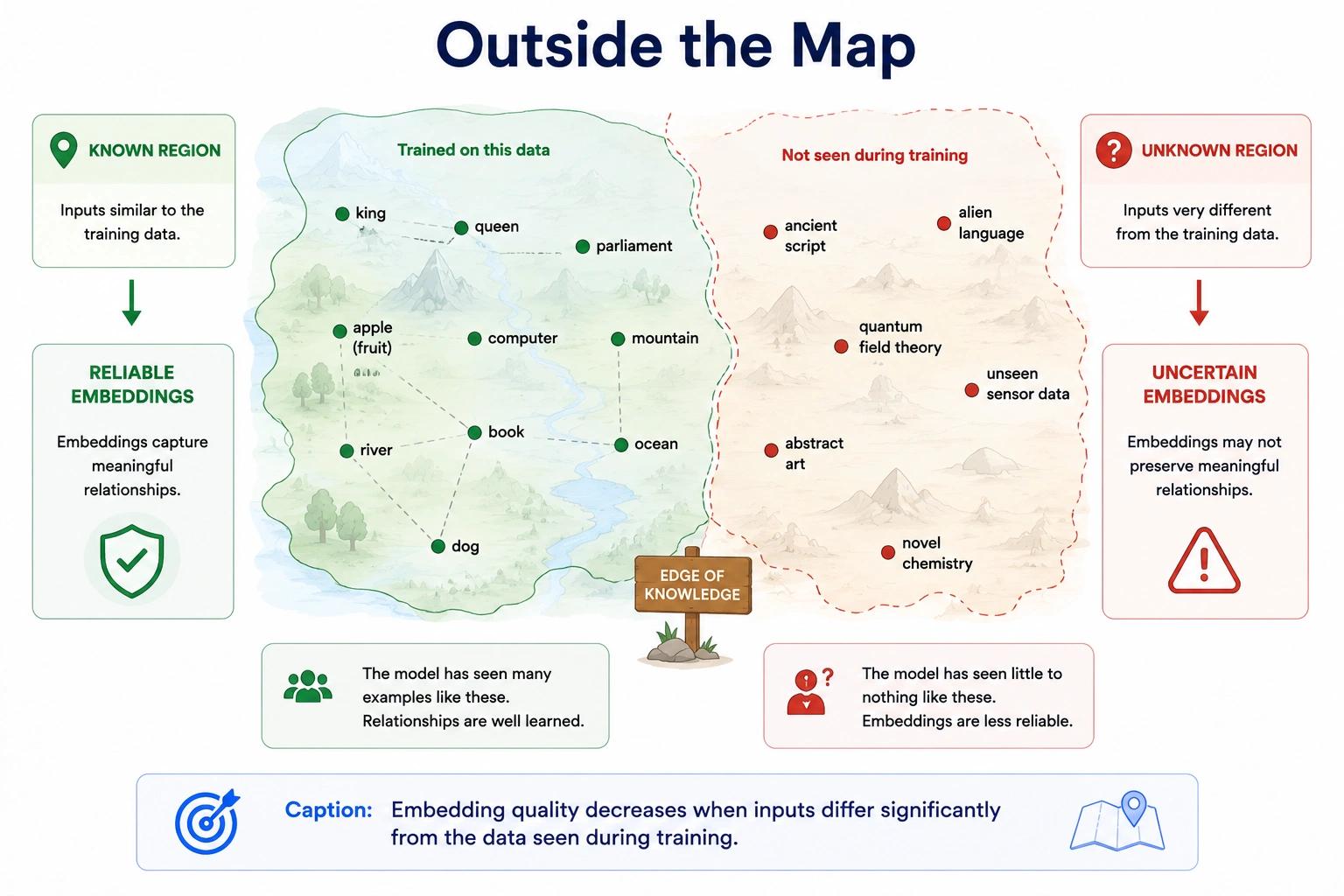
Embedding models perform best on data that resembles what they encountered during training.
When presented with something fundamentally different, their representations become less reliable.
Researchers refer to this situation as out-of-distribution, often abbreviated as OOD.
Imagine asking a medical embedding model to analyze ancient Sanskrit poetry.
Or using a programming-focused embedding model to interpret satellite imagery.
The model will still produce vectors, but those vectors may no longer preserve meaningful relationships because the input falls outside the distribution of examples it learned from.
Producing an embedding is not the same as understanding the input.
Compression Always Loses Information
Every embedding converts rich information into a vector with a fixed number of dimensions.
Whether that vector contains 384, 768, or 3,072 dimensions, it is still dramatically smaller than the original document, image, or codebase it represents.
That compression is what makes similarity search practical.
It also means some information is inevitably discarded.
Subtle stylistic differences.
Rare contextual clues.
Complex logical relationships.
Long-range dependencies.
Not every detail survives the transformation.
Embeddings are therefore exceptionally good at capturing semantic similarity, but they are not perfect substitutes for the original information.
Retrieval Quality Depends on Embedding Quality
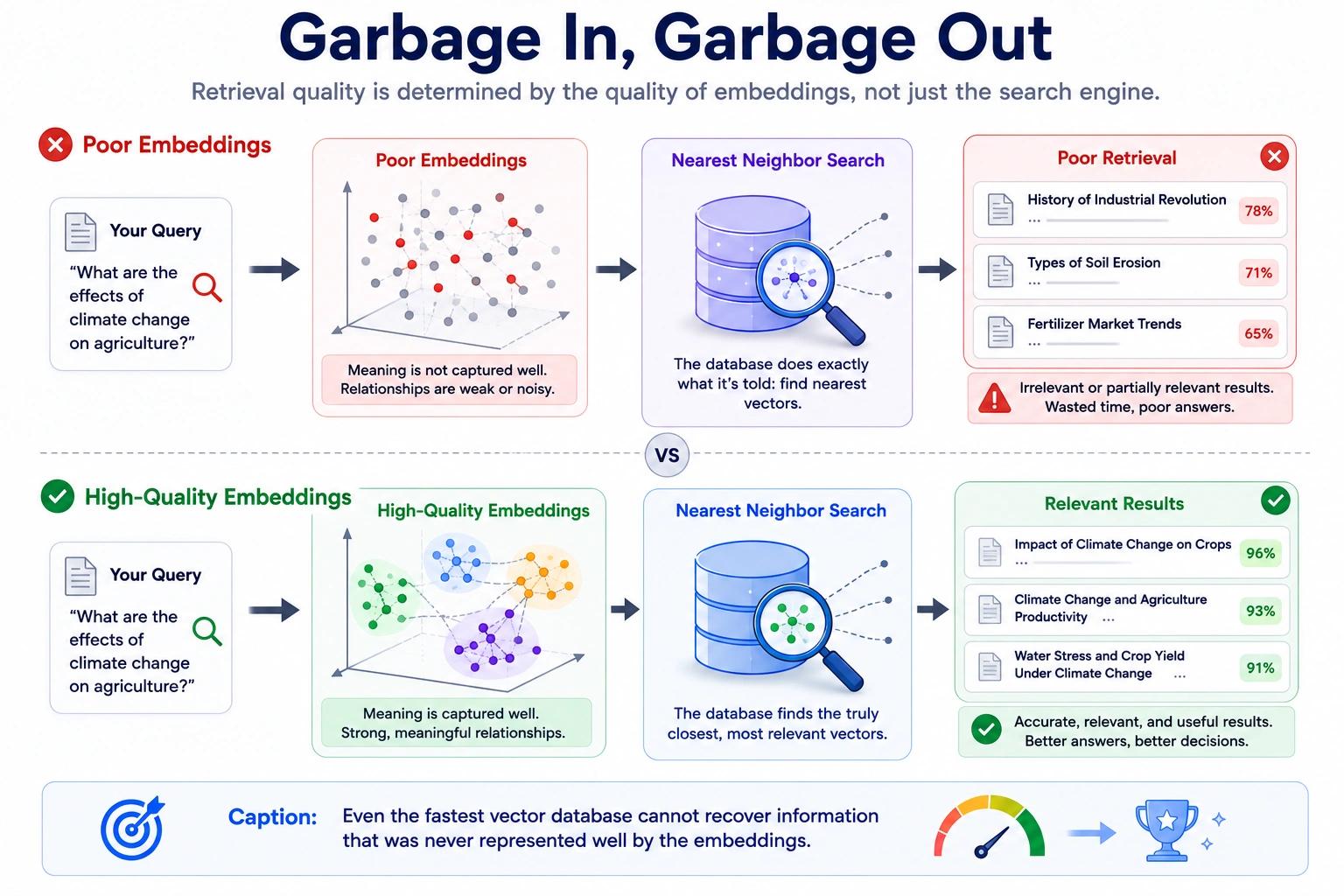
One of the most common misconceptions about retrieval systems is that vector databases determine search quality.
They do not.
A vector database simply finds the nearest vectors.
If the embeddings themselves fail to capture meaningful relationships, the database will faithfully retrieve the wrong results.
This means retrieval quality is determined long before the search begins.
The quality of the embedding model, the training objective, the chunking strategy, and the preprocessing pipeline often have a far greater impact than the retrieval algorithm itself.
In many production systems, improving embeddings yields larger gains than changing the vector database.
Limitations Lead to Better Systems
None of these limitations suggest that embeddings are fundamentally flawed.
On the contrary, they explain why modern AI systems combine multiple techniques rather than relying on embeddings alone.
Contextual transformers reduce ambiguity.
RAG provides access to current knowledge.
Domain-specific models improve specialized retrieval.
Hybrid search combines semantic similarity with keyword matching.
Re-ranking models evaluate retrieved results before they reach the language model.
Each innovation addresses a limitation rather than replacing embeddings altogether.
Embeddings remain the foundation—but they work best as part of a larger intelligent system.
Mental Model
Embeddings are powerful representations of meaning, not perfect representations of reality. Understanding where they fail is the first step toward building systems that succeed.
Throughout this article, we've explored how embeddings transformed artificial intelligence by turning meaning into mathematics.
But this idea is no longer limited to language
Researchers are now embedding images, audio, video, molecules, robots, and even physical environments into shared mathematical spaces.
The future of embeddings is no longer just about understanding information.
It is about building machines that can understand the world itself.
In the final section, we'll look ahead at how embedding spaces are expanding beyond text and becoming one of the foundational ideas behind the next generation of intelligent systems.
13. The Future of Embeddings7 min read
Throughout this article, we've watched a simple idea grow into one of the defining concepts of modern artificial intelligence.
We began with a seemingly impossible question.
How can a computer understand language if it only processes numbers?
The answer turned out not to be dictionaries, grammar rules, or handcrafted knowledge.
Instead, the breakthrough came from a completely different direction.
Rather than trying to teach computers what every word means, researchers taught them where ideas belong.
Meaning became location.
Similarity became distance.
Relationships became directions.
Language became geometry.
That shift transformed not only natural language processing but nearly every branch of modern machine learning.
Today, embeddings quietly power search engines, recommendation systems, fraud detection, robotics, scientific discovery, and large language models. They have become one of the fundamental abstractions through which machines organize information.
Yet language is only the beginning.
Beyond Words
The first successful embedding models focused on text.
Today, almost every kind of information can be represented in a similar way.
Images become vectors.
Audio recordings become vectors.
Videos become vectors.
Computer programs become vectors.
Proteins become vectors.
Three-dimensional objects become vectors.
Entire scientific datasets can now be embedded into high-dimensional spaces where relationships become searchable.
Different forms of information that once required completely separate algorithms are increasingly being described using the same mathematical language.
Instead of asking "How do we search text?" researchers now ask a much broader question:
How do we search meaning, regardless of its form?
Multimodal Intelligence
One of the most exciting developments in AI is the emergence of multimodal models.
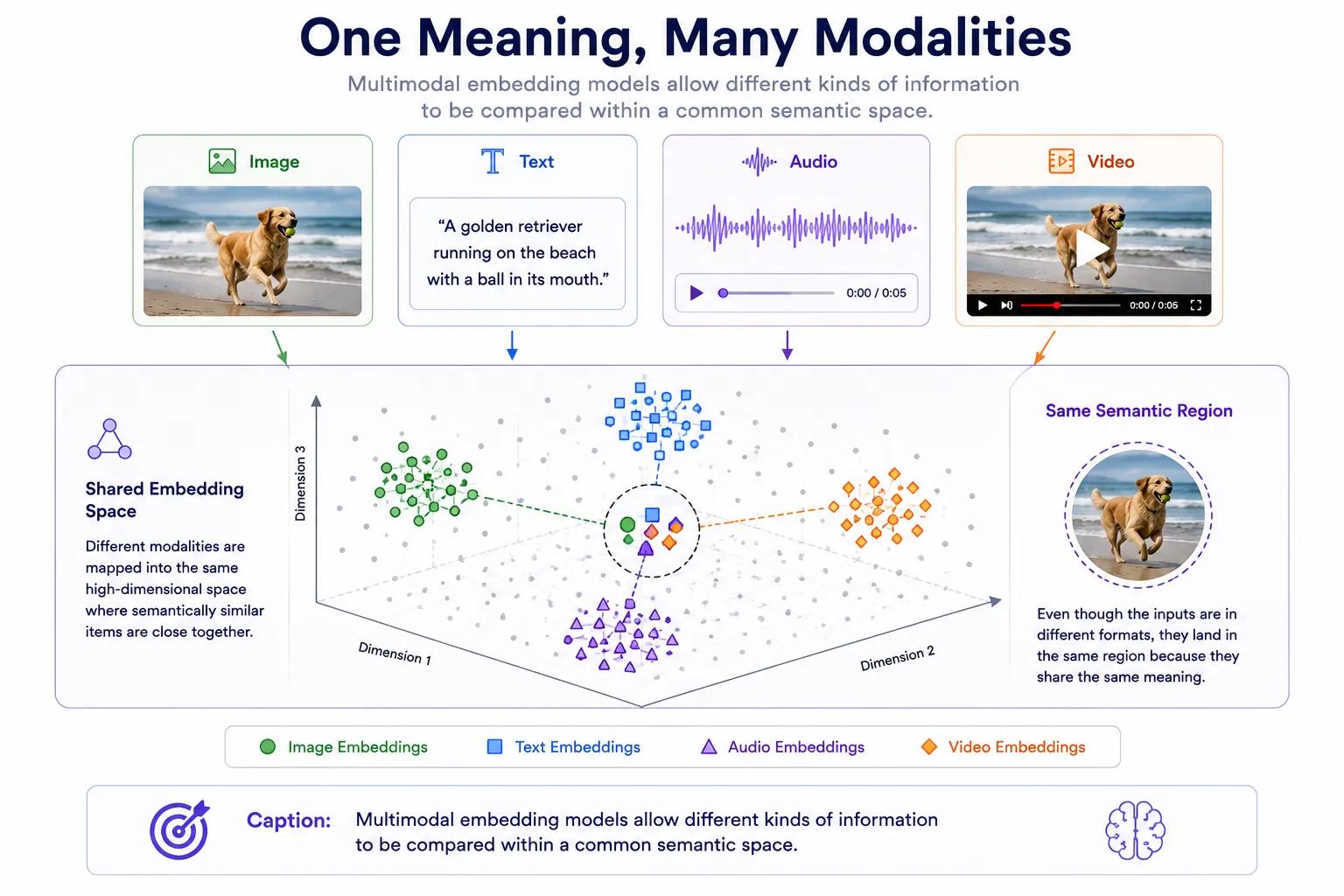
Unlike earlier systems that processed text, images, or audio independently, multimodal models learn to represent many different types of information within compatible embedding spaces.
A photograph can retrieve a paragraph describing its contents.
A written sentence can locate a matching video.
A spoken command can retrieve a relevant diagram.
An image of a product can recommend visually similar alternatives.
Although these inputs appear fundamentally different to humans, embedding models translate them into the same mathematical language.
Once everything becomes a vector, entirely new forms of interaction become possible.
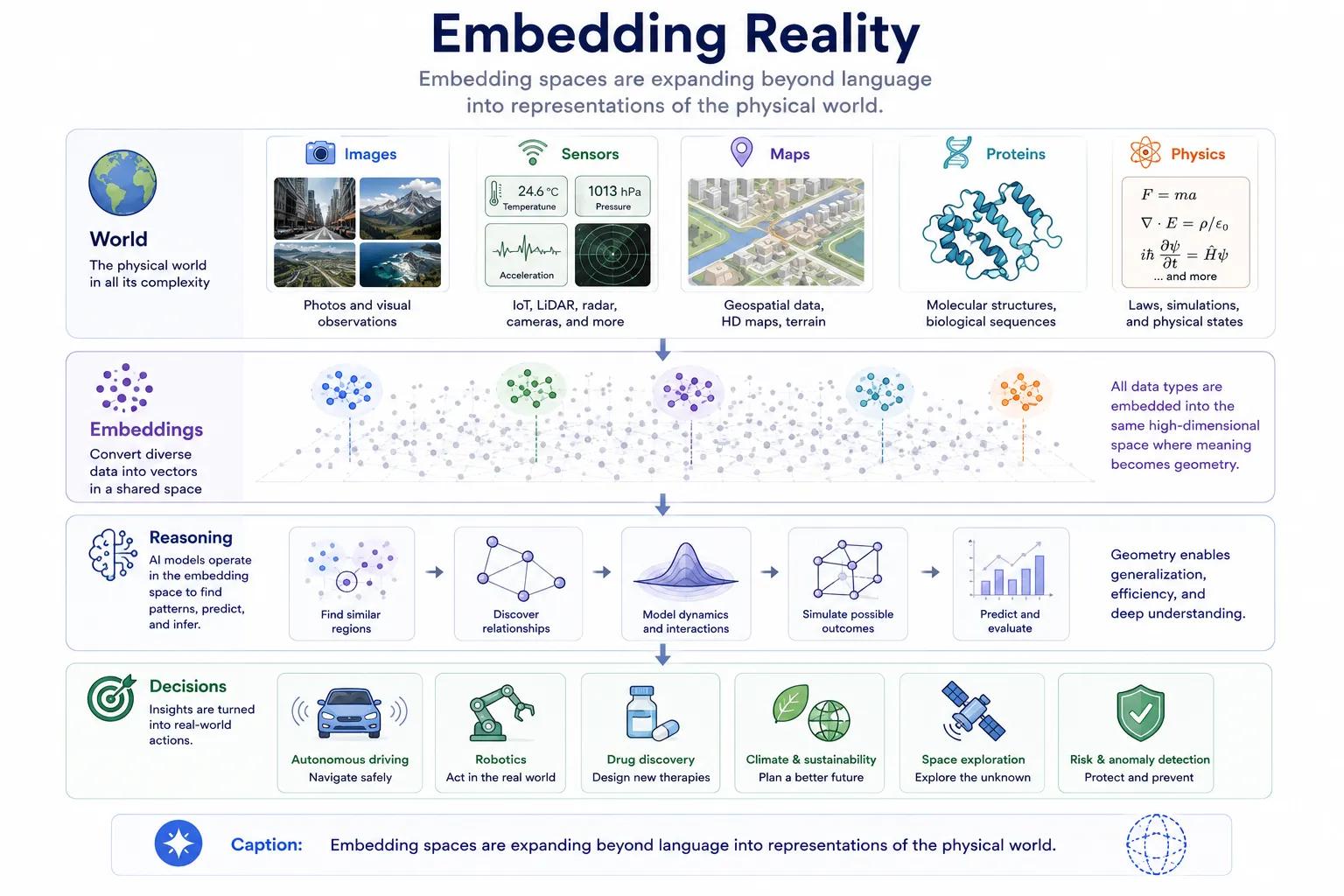
Embedding the Physical World
Researchers are no longer limiting embeddings to digital information.
Robots increasingly use embedding models to represent physical environments.
Autonomous vehicles embed roads, obstacles, and traffic conditions.
Scientific simulations embed molecular interactions.
Biologists embed proteins and genes.
Chemists embed chemical structures.
Astronomers embed galaxies.
Increasingly, AI systems are not merely learning language.
They are learning structured representations of reality itself.
Instead of memorizing individual observations, they organize the world into relationships that can be searched, compared, and reasoned about.
World Models
Many researchers believe the next generation of AI will rely less on predicting words and more on constructing internal models of the world.
These systems, often called world models, attempt to learn how environments behave rather than simply how language is written.
Instead of representing isolated sentences, future embedding spaces may represent entire situations, physical states, causal relationships, and long-term interactions.
An autonomous robot, for example, does not merely need to recognize a chair.
It must understand that chairs support weight, occupy space, can block movement, and interact predictably with other objects.
Those relationships themselves may eventually become embeddings.
The geometry grows richer.
The representations become more abstract.
And the systems become capable of increasingly sophisticated reasoning.
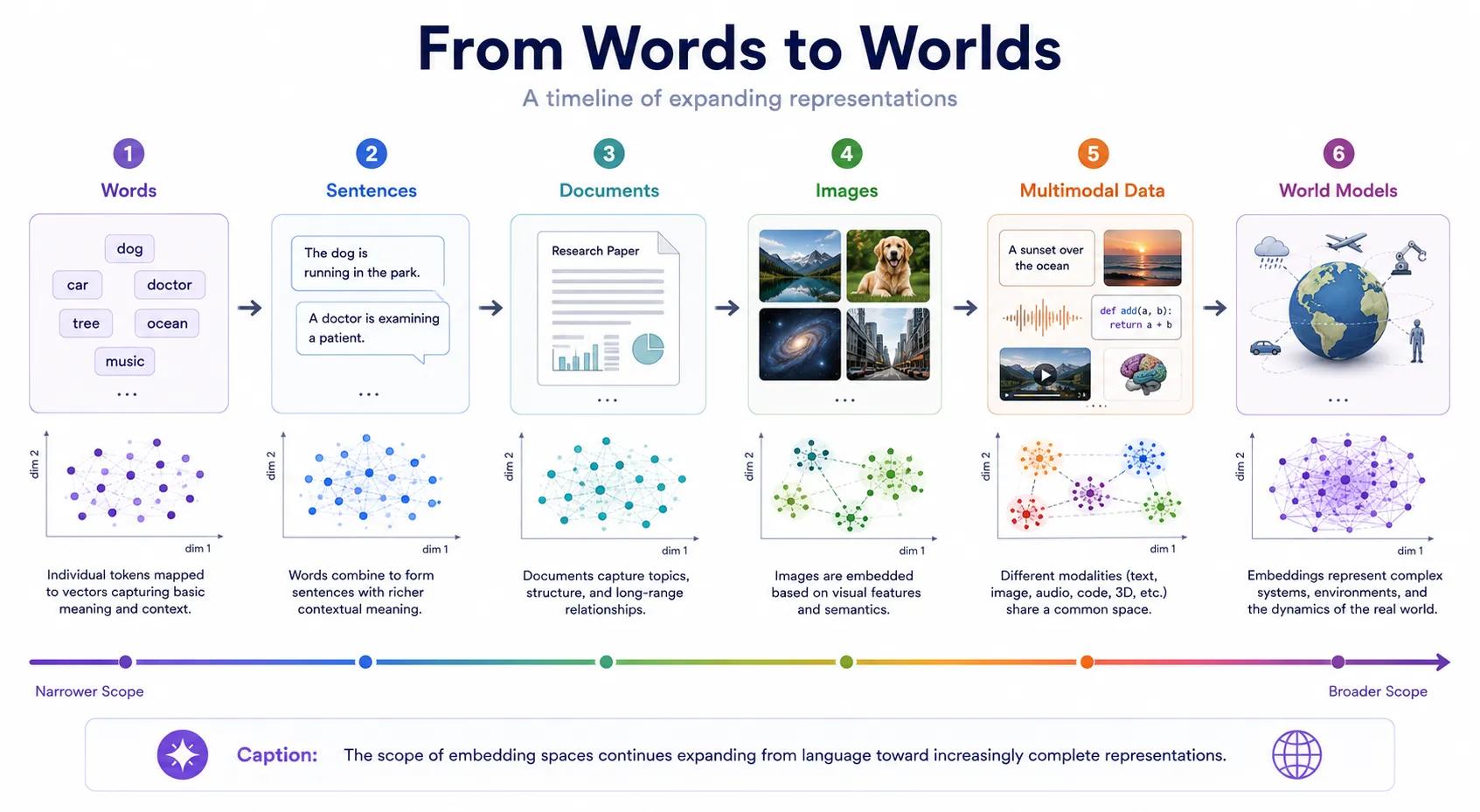
Scientific Discovery
One of the most promising applications of embeddings may lie outside traditional software entirely.
Scientists increasingly use embedding models to explore spaces too large for humans to search manually.
Drug discovery.
Protein engineering.
Materials science.
Climate research.
Astronomy.
Mathematics.
By organizing these enormous search spaces geometrically, embeddings help researchers identify patterns that might otherwise remain invisible.
Instead of evaluating every possible candidate individually, algorithms can explore neighborhoods of promising solutions.
In many scientific fields, embeddings are becoming a tool not only for finding information but for generating entirely new hypotheses.
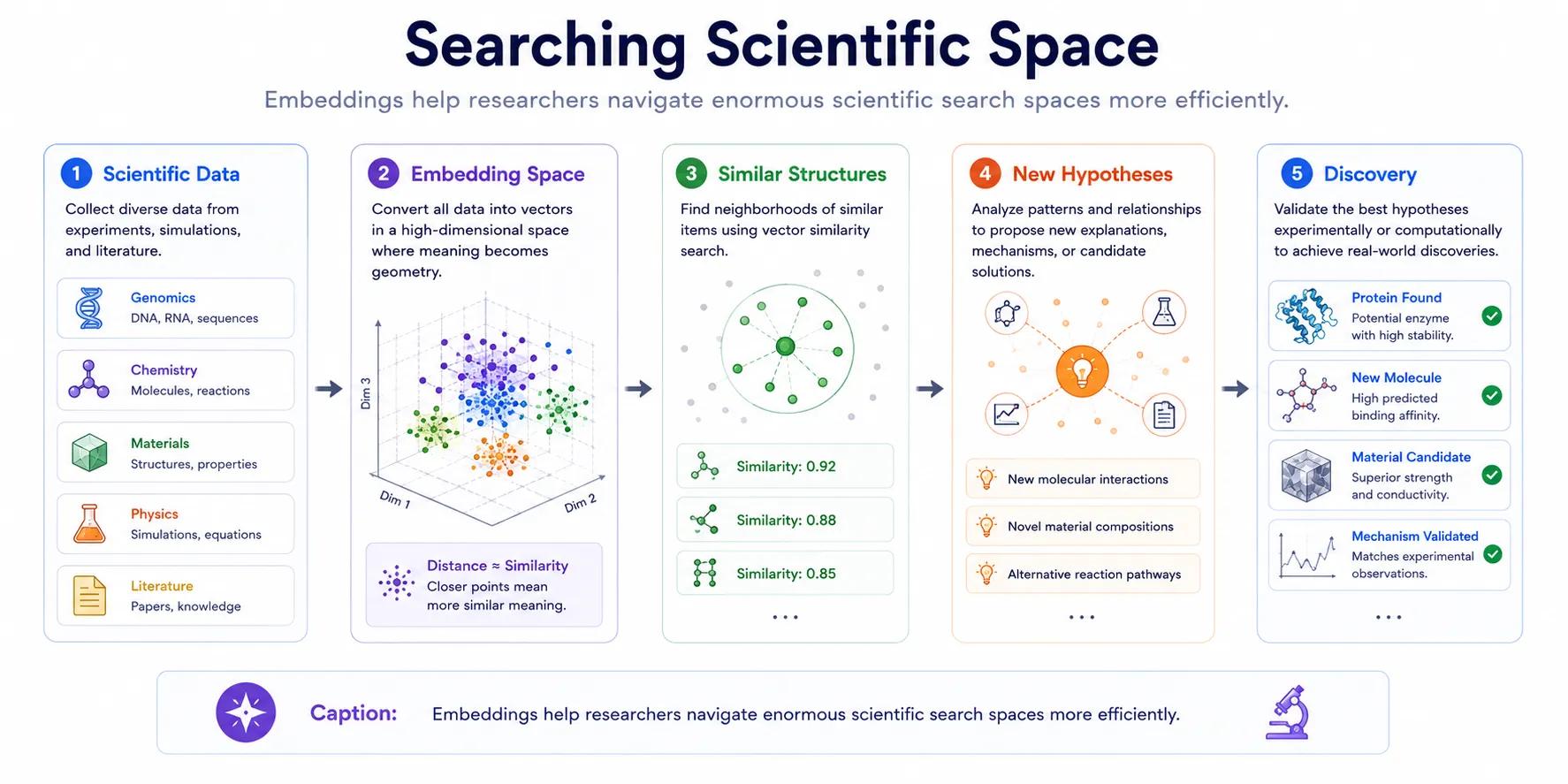
The Bigger Picture
It is tempting to think of embeddings as a clever trick for semantic search.
But after exploring how they are learned, how they organize meaning, how they power retrieval, and where they are used, a different picture begins to emerge.
Embeddings are not merely vectors.
They are a way of representing relationships.
Whenever intelligence must compare, retrieve, recommend, classify, or reason about complex information, some form of representation is required.
Modern AI increasingly builds that representation as geometry.
This idea appears across transformers.
Recommendation systems.
Vector databases.
Multimodal learning.
Robotics.
Scientific computing.
Different applications.
The same mathematical foundation.
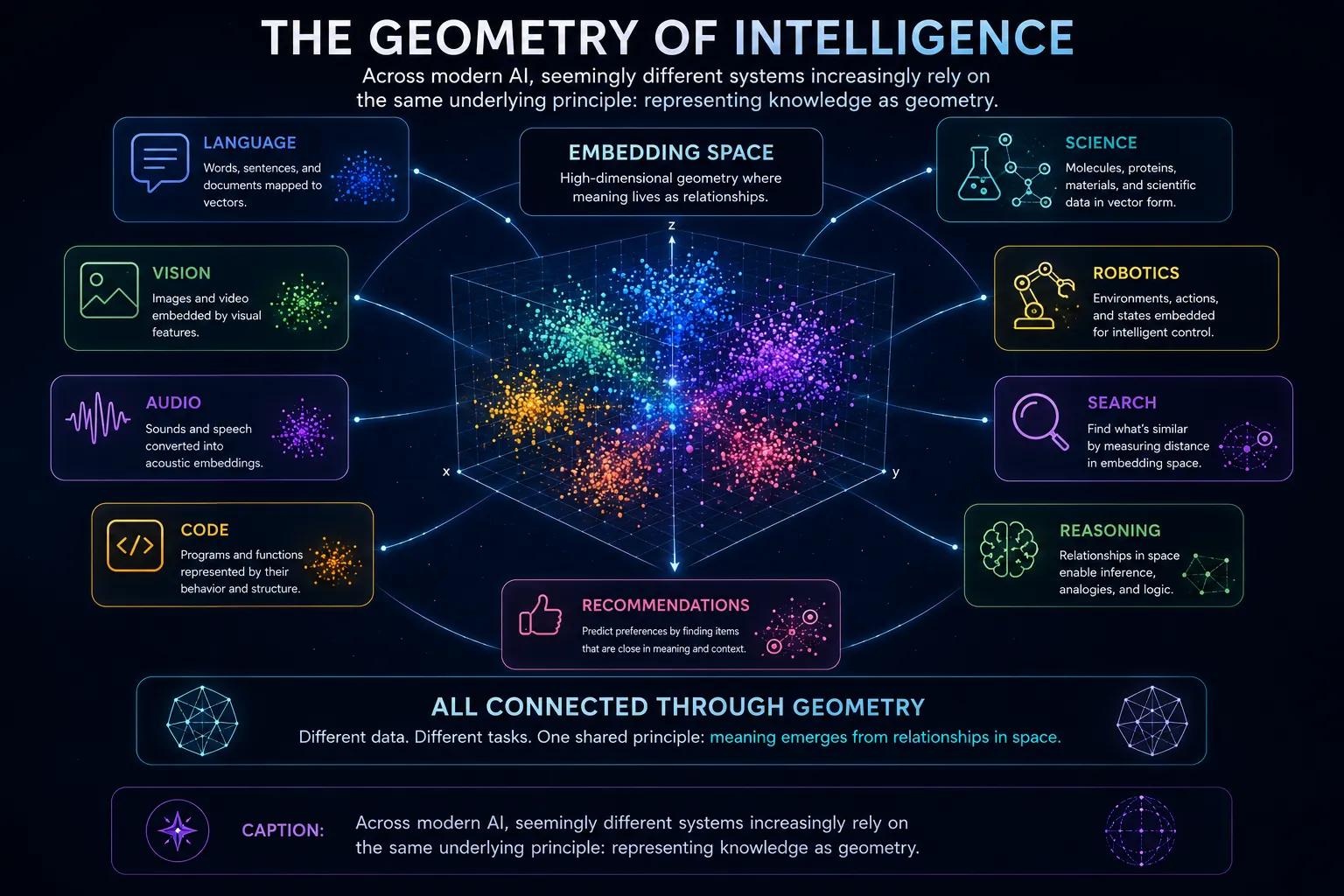
Conclusion
When we first asked how computers understand words like doctor, car, or physician, the answer seemed likely to involve dictionaries, rules, or symbolic logic.
Instead, the solution was surprisingly elegant.
Machines do not memorize meaning.
They learn where meaning lives.
Every sentence becomes a point.
Every document becomes a location.
Every relationship becomes a direction.
Every search becomes a journey through geometry.
That single idea has reshaped modern artificial intelligence.
And it may ultimately reshape how we think about intelligence itself.
Perhaps intelligence is not fundamentally about language.
Perhaps it is not even about symbols.
Perhaps intelligence begins with the ability to organize experience into a space where similar ideas naturally become neighbors.
Embeddings gave machines that ability.
The next generation of AI may simply continue exploring that space.
Final Callout
Embeddings did not teach machines language. They taught machines geometry—and geometry turned out to be one of the languages of intelligence.
I would end the article with something original that readers remember:
"The history of artificial intelligence can be told as a story of better representations. Embeddings were the moment we stopped asking machines to memorize the world—and started teaching them its shape."
- [1] Yoshua Bengio. Foundational Representation Learning . Journal of Machine Learning Research . 2003
- [2] Nils Reimers. Sentence Embeddings . Journal of Computer and Communications . 2019
- [3] Jacob Devlin. Contextual Embeddings . Arxiv . 2019
- [4] Ashish Vaswani. Transformers . NeurIPS . 2017
- [5] Patrick Lewis. Retrieval . NeurIPS . 2020
- [6] Jeff Johnson. Vector Search . IEEE . 2017
- [7] Alec Radford. Contrastive Learning . Proceedings of Machine Learning Research . 2021
- [8] Chao Jia. Multimodal . Proceedings of Machine Learning Research . 2021